
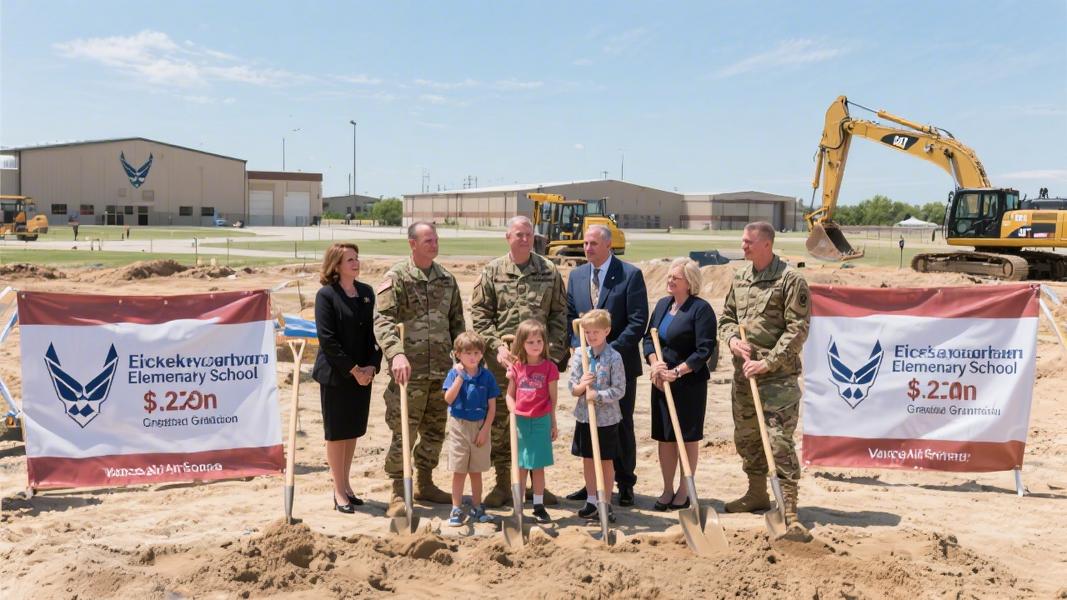
A decades-old school serving the children of military families at a northwest Oklahoma air base is finally getting the replacement it’s needed for years — and the federal government is footing most of the bill.
The Department of War has awarded Enid Public Schools a $22 million grant as the federal share of a $28.2 million project to construct a brand-new Eisenhower Elementary School at Vance Air Force Base in Oklahoma. The funding flows through the Department’s Public Schools on Military Installations Program, which targets schools with the most serious facility deficiencies — and Eisenhower, by any measure, had been waiting its turn for a long time.
A School Long Overdue for Relief
How bad had things gotten? Bad enough that Eisenhower Elementary landed at #65 on the 2019 Deputy Secretary of Defense Public Schools on Military Installations Priority List, flagged specifically for capacity and condition deficiencies. That ranking, grim as it sounds, is actually what unlocked the path to this funding — the program prioritizes schools with the most serious problems, and Eisenhower’s aging bones made a compelling case.
The school has been educating the children of Vance AFB families since 1960. That’s over six decades of service to a community that moves frequently, sacrifices routinely, and — as one state official put it — deserves better. As the noted by Oklahoma’s military planning commission, “Military personnel expect a higher quality of life for their families including the schools that teach their children.” It’s a simple enough sentiment, but one that carries real weight when the building your kid attends was built during the Eisenhower administration.
What’s Actually Being Built
The new school will serve 350 students annually, spanning kindergarten through fifth grade. It’s a full replacement — not a renovation, not a patch job. The project was reviewed by a Federal Evaluation Team drawing from the Assistant Secretaries of the Air Force, Army, and Navy, as well as the Office of Local Defense Community Cooperation, before the grant was awarded. That’s a significant level of interagency scrutiny, which signals just how seriously the Pentagon takes these installations-based school projects.
Still, federal dollars alone don’t cover everything. The grant represents roughly 80 percent of the total project cost, with the remaining 20 percent — approximately $6.2 million — falling to the local side. That’s where Oklahoma’s own infrastructure has been quietly grinding away for years.
Oklahoma Worked Hard for Its Share
The Oklahoma Strategic Military Planning Commission approved $290,000 toward the Eisenhower project in 2023 and came back requesting another $250,000 in 2024 — incremental contributions aimed at assembling the local match required to qualify for federal dollars. In total, the commission has committed $1 million toward the project, with roughly $750,000 already disbursed.
It’s the kind of slow, unglamorous budget work that rarely makes headlines — state commissions chipping in six figures at a time, year after year, to raise a share that unlocks a much larger federal investment. But it worked. Enid’s school district now holds a $22 million federal commitment to replace a facility that has served — and strained — through multiple generations of military families.
What It Means for Vance and Enid
Vance Air Force Base is a significant economic and strategic presence in northwest Oklahoma, and the quality of on-base schools has long been tied to military retention and recruitment. Families don’t just follow orders — they weigh quality-of-life factors, and a deteriorating elementary school is exactly the kind of thing that influences whether a service member chooses to stay or go. In that sense, this isn’t just a construction project. It’s an investment in the base’s long-term viability.
For Enid Public Schools, the grant represents one of the larger federal investments in its district infrastructure in recent memory — and a reminder that school districts serving military communities operate under a unique set of pressures and, occasionally, unique opportunities.
Sixty-plus years after the original building opened its doors, the children of Vance’s airmen and airwomen are getting a school that actually reflects what their families have given to the country. That feels about right.
