
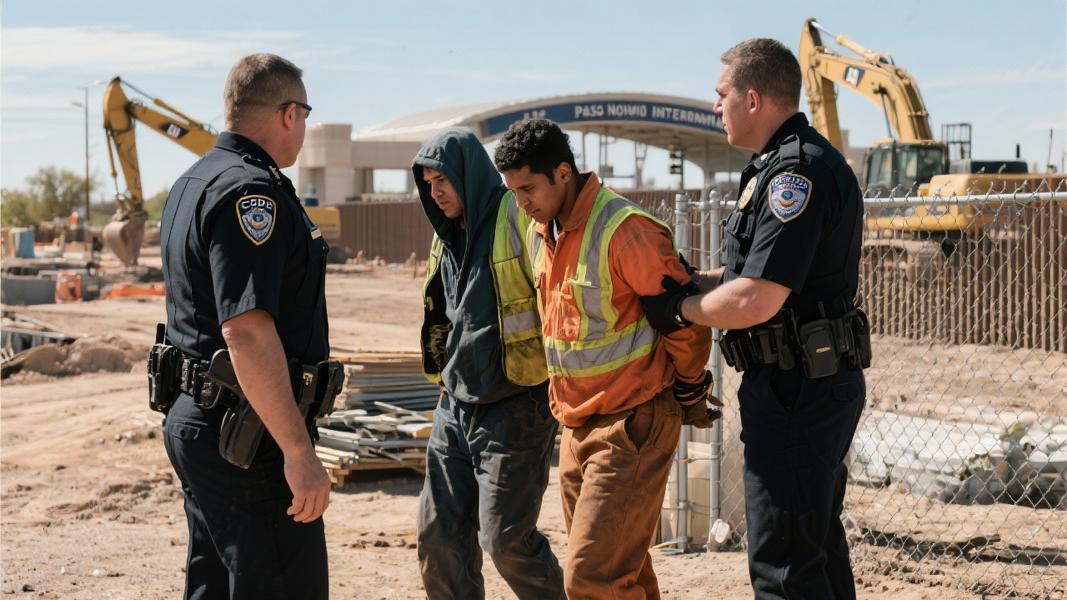
Two individuals attempting to slip across the border disguised as construction workers were arrested near the Paso del Norte International Port of Entry on January 9, authorities announced Tuesday.
The pair, whose identities were not released, tried to blend in with legitimate construction personnel at the busy crossing point just west of the port of entry, according to information released by border officials. One suspect had a previous criminal record for domestic assault.
The incident highlights ongoing challenges at the El Paso sector, where infrastructure projects have created new opportunities for illegal crossing attempts. “People who cross illegally in or around these construction projects will face federal charges and removal, consistent with the 100-percent prosecution policy in this sector,” acting U.S. Attorney Ryan Ellison for the District of New Mexico stated.
Criminal Charges Filed
The individual with the prior domestic assault record will be prosecuted for reentry of a removed alien, while the second person faces charges for illegal entry without inspection. Both are serious federal charges that typically result in deportation following any prison sentence.
Construction zones along the border have become a particular focus for Border Patrol agents. Why? These areas often feature temporary barriers, equipment staging grounds, and increased human traffic that can potentially mask unauthorized entry attempts.
“These construction zones will continue to be heavily monitored by our Border Patrol agents and unlawful entry will not be tolerated,” El Paso Sector Chief Patrol Agent Jesse D. Munoz warned. “Individuals attempting to enter the United States unlawfully in construction zones or anywhere in the El Paso Sector are subject to immediate detection, prosecution and removal.”
The construction worker disguise tactic isn’t entirely new, but represents a calculated attempt to exploit ongoing infrastructure development along the Texas-New Mexico border. The El Paso sector has seen increased security measures in recent months as multiple projects aim to enhance border infrastructure.
Federal authorities have implemented a zero-tolerance approach specifically targeting these construction zones. Ellison emphasized that strict enforcement “enhances safety for construction workers, agents, and the public while this critical infrastructure is being built.”
The case serves as the latest reminder of the cat-and-mouse dynamic that continues to play out along America’s southern border, where enforcement strategies and crossing tactics constantly evolve in response to each other.
