
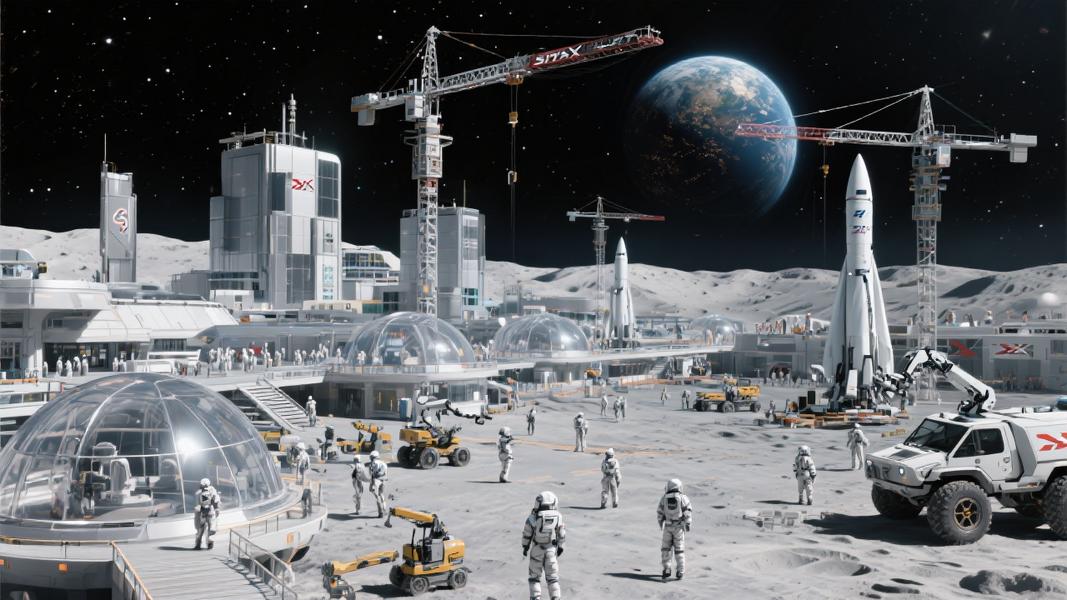
Elon Musk is changing course on his interplanetary ambitions, at least temporarily. The SpaceX CEO announced the company is pivoting its immediate focus from Mars colonization to establishing a “self-growing city” on the Moon within the next decade.
“For those unaware, SpaceX has already shifted focus to building a self-growing city on the Moon, as we can potentially achieve that in less than 10 years, whereas Mars would take 20+ years,” Musk stated in a recent announcement that caught many space enthusiasts by surprise.
Lunar Logic
Why the change in trajectory? It comes down to simple celestial mechanics and the harsh realities of deep space travel. Our lunar neighbor sits just a three-day journey away, while the Red Planet remains a challenging six-month voyage that can only be attempted during specific planetary alignments.
Musk explained the practical reasoning behind the shift: “It is only possible to travel to Mars when the planets align every 26 months (six month trip time), whereas we can launch to the Moon every 10 days (2 day trip time). This means we can iterate much faster to complete a Moon city than a Mars city,” he explained.
The proximity advantage cannot be overstated. When building something as complex as a permanent human settlement beyond Earth, the ability to send regular shipments of supplies, equipment, and personnel without waiting years between launch windows provides significant logistical benefits.
Mars Not Forgotten
Has Musk abandoned his famous Mars obsession? Not quite.
The billionaire entrepreneur clarified that Mars remains firmly on SpaceX’s roadmap, with plans to “begin building a Mars city in about 5 to 7 years.” However, he emphasized that “the overriding priority is securing the future of civilization and the Moon is faster,” according to his comments reported by Fox Business.
This strategic pivot represents a more pragmatic approach to SpaceX’s long-standing mission of making humanity a multi-planetary species. Rather than putting all resources toward the more challenging Mars goal, establishing a lunar presence first creates an intermediate stepping stone that could provide valuable experience and technology development.
The announcement comes as SpaceX continues development of its massive Starship vehicle, designed specifically with planetary colonization in mind. The spacecraft has experienced both spectacular failures and successes during its testing program, with orbital tests demonstrating progress toward the vehicle’s eventual operational status.
For space policy experts, the shift makes sense. The Moon offers not just proximity but potentially valuable resources like water ice at its poles, which could be converted to rocket fuel, drinking water, and breathable air for future inhabitants.
What remains unclear is exactly what a “self-growing city” entails and how SpaceX plans to achieve this ambitious goal within the stated timeframe. Previous NASA estimates for establishing even modest lunar outposts stretched well beyond Musk’s suggested timeline.
As the billionaire entrepreneur has demonstrated repeatedly throughout his career, conventional timelines rarely apply to his ventures — sometimes they’re wildly optimistic, and sometimes, surprisingly, they’re met against all expectations. Whether humans will be living in a lunar city within a decade remains to be seen, but SpaceX’s pivot ensures the Moon will feature prominently in humanity’s next chapter of space exploration.
