
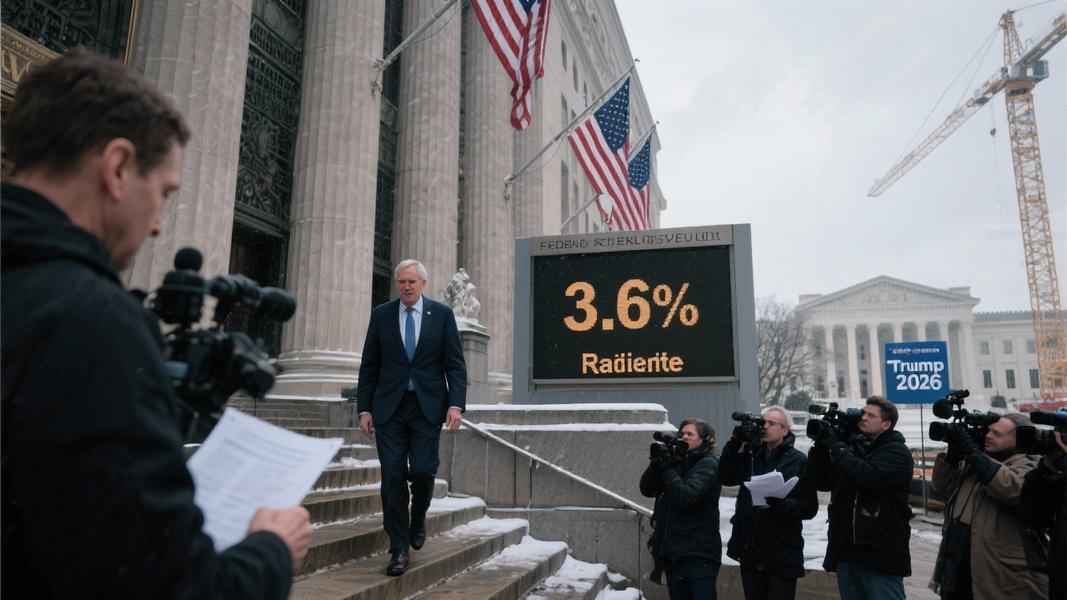
Fed Holds Interest Rates Steady After 2025’s Rate-Cutting Streak
The Federal Reserve hit the pause button on Wednesday, leaving its benchmark interest rate unchanged at 3.5% to 3.75% in its first meeting of 2026. The decision marks a temporary halt to what had been a series of three consecutive rate cuts throughout 2025, as officials weigh solid economic growth against inflation that remains stubbornly above target.
“The Federal Reserve said Wednesday that it is leaving its benchmark interest rate unchanged, marking the central bank’s first pause after three consecutive rate cuts last year,” the Fed announced following its January meeting.
Split Decision Shows Internal Debate
The vote wasn’t unanimous. Ten members of the Federal Open Market Committee, including Chair Jerome Powell, voted to maintain current rates, while two members — Stephen Miran and Christopher Waller — pushed for another quarter-point reduction, according to the Fed’s statement.
In its announcement, the central bank pointed to a “solid pace” of economic activity and low unemployment, while acknowledging that inflation “remains somewhat elevated” at a 2.7% annual rate as of December’s Consumer Price Index. This split decision highlights the tension within the rate-setting committee between those who want to see inflation drop below 2% before further cuts and others who believe additional easing is needed to support hiring.
Most economists expect the Fed to cut rates twice more in 2026, likely starting at the June meeting or later in the year, analysts predict. The central bank holds eight scheduled meetings annually, with upcoming sessions in March, April, June, July, September, October, and December.
Leadership Transition and Political Pressure
The Fed’s decision comes amid significant political crosscurrents. Jerome Powell’s term as Federal Reserve Chair ends in May 2026, and President Trump has yet to name a successor, though an announcement appears imminent.
Adding to the intrigue, the Department of Justice recently served the central bank with subpoenas related to Powell’s testimony about the Fed’s $2.5 billion building renovation project. Powell responded forcefully, issuing what observers called an “unusually blunt video statement” claiming the subpoenas were merely a pretext to punish the Fed for not cutting rates more aggressively.
The White House has been applying significant pressure for more aggressive rate cuts. At the same time, the Supreme Court is reviewing President Trump’s unprecedented attempt to fire Federal Reserve Governor Lisa Cook over allegations of mortgage fraud, which she denies — a move that would break with 112 years of institutional independence.
Economy Shows Surprising Strength
Why the pause now? The U.S. economy has been performing remarkably well, expanding at a 4.4% annual rate in the third quarter, far exceeding economist forecasts, data shows.
“The Fed is likely on an extended pause with strong activity data and signs of stabilization in the labor market suggesting little need to take out further insurance,” said Kay Haigh, global co-head of fixed income and liquidity solutions at Goldman Sachs Asset Management, in an email after the announcement.
Economists anticipate larger-than-usual tax refunds in coming months will further stimulate consumer spending, potentially leading to stronger hiring despite recent weakness in the job market. Lower interest rates, when they do come, would reduce borrowing costs for mortgages, auto loans, and credit cards, providing additional economic stimulus.
But the path forward isn’t entirely clear. The rate-setting committee remains divided between hawks who want inflation firmly below 2% before additional cuts and doves concerned about supporting the labor market. This tension was evident in today’s split vote.
For now, American consumers and businesses will have to wait at least until the Fed’s March meeting for any potential rate relief — though most analysts believe June is the earliest we’ll see the next cut.
As 2026 unfolds, the Fed finds itself in the unusual position of managing monetary policy amid leadership uncertainty, legal challenges, and intense political scrutiny — all while trying to navigate what continues to be a surprisingly resilient economy.
