
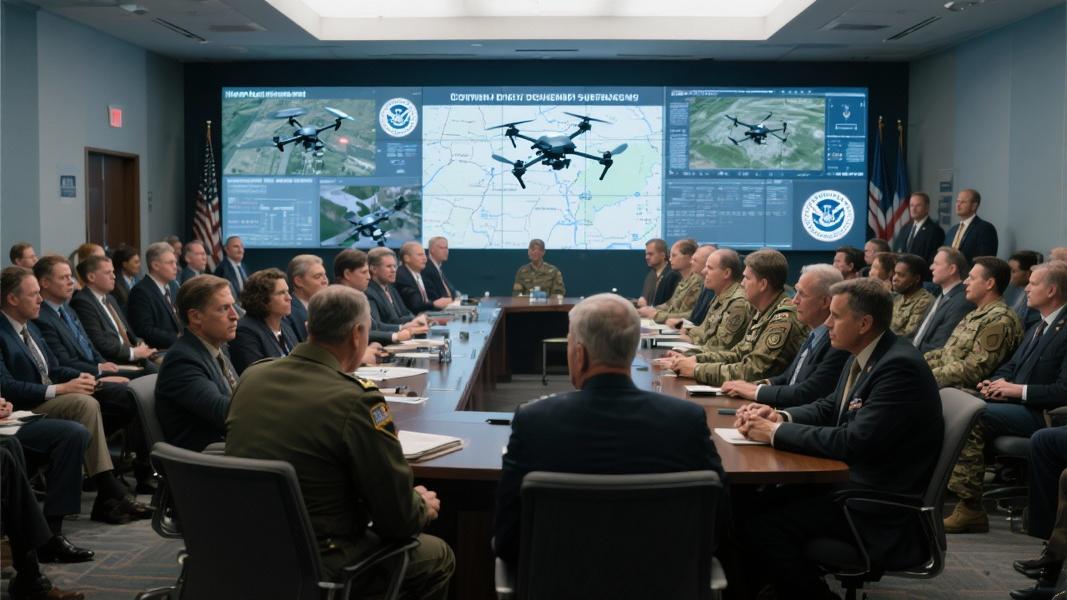
Federal agencies are joining forces in an unprecedented effort to combat the growing threat of unauthorized drones in U.S. airspace. Nearly 200 national security experts gathered in Alexandria, Virginia last month to kick off a major three-year interagency initiative focused on countering unmanned aircraft systems (C-UAS).
The November 2025 summit, spearheaded by the Science and Technology Directorate (S&T), marks the formal launch of a coordinated federal response to what officials have increasingly characterized as a critical security challenge. Representatives from nearly 50 federal agencies participated in the gathering, signaling the broad scope of the effort.
A New Task Force Takes Flight
At the heart of this initiative is JIATF-401, a Joint Interagency Task Force established in August 2025. The Department of War, alongside dozens of other federal agencies, has taken a leading role in organizing this collaboration, which aims to standardize counter-drone approaches across government.
“The threat landscape has evolved dramatically,” said one official who attended the Alexandria summit. “We’re no longer talking about hobbyist drones accidentally straying into restricted airspace — we’re facing sophisticated systems that can be weaponized or used for surveillance.”
The task force’s creation follows months of interagency planning and consultations that began earlier this year, as incidents involving unauthorized drones near critical infrastructure and government facilities have multiplied.
Funding Boost on the Horizon
What’s driving this sudden surge in counter-drone activity? The passage of the Safer Skies Act has opened the floodgates for significant increases in C-UAS spending across federal, state, and local agencies.
Industry analysts expect the legislation to transform how state, local, tribal, and territorial (SLTT) security agencies approach drone threats. For the first time, these organizations will have a clear pathway to coordinate purchases, support, scaling, and training through the new task force.
The funding boost comes at a critical moment. Drone incidents at airports, sporting events, and government facilities have increased dramatically in recent years, challenging traditional security approaches and exposing gaps in existing defensive systems.
While exact figures remain classified, sources familiar with the budget allocations suggest the initiative will receive “substantial” funding over its three-year mandate. The money will support everything from detection systems and interdiction technologies to training programs and regulatory frameworks.
The Path Forward
Can a task force with so many participating agencies actually deliver results? That’s the question many security experts are asking as JIATF-401 begins its work.
The three-year timeline suggests officials recognize the complexity of the challenge. Counter-drone technology itself remains in a relatively early stage, with systems ranging from radio frequency jammers and directed energy weapons to trained birds of prey and capture nets.
One significant hurdle will be balancing security needs with the legitimate use of drones by businesses, researchers, and hobbyists. The commercial drone industry has grown exponentially over the past decade, becoming an integral part of sectors ranging from agriculture to film production.
As the task force moves forward, it will need to navigate these competing interests while developing a coherent national strategy for protecting sensitive airspace without stifling innovation in one of America’s fastest-growing technology sectors.
