
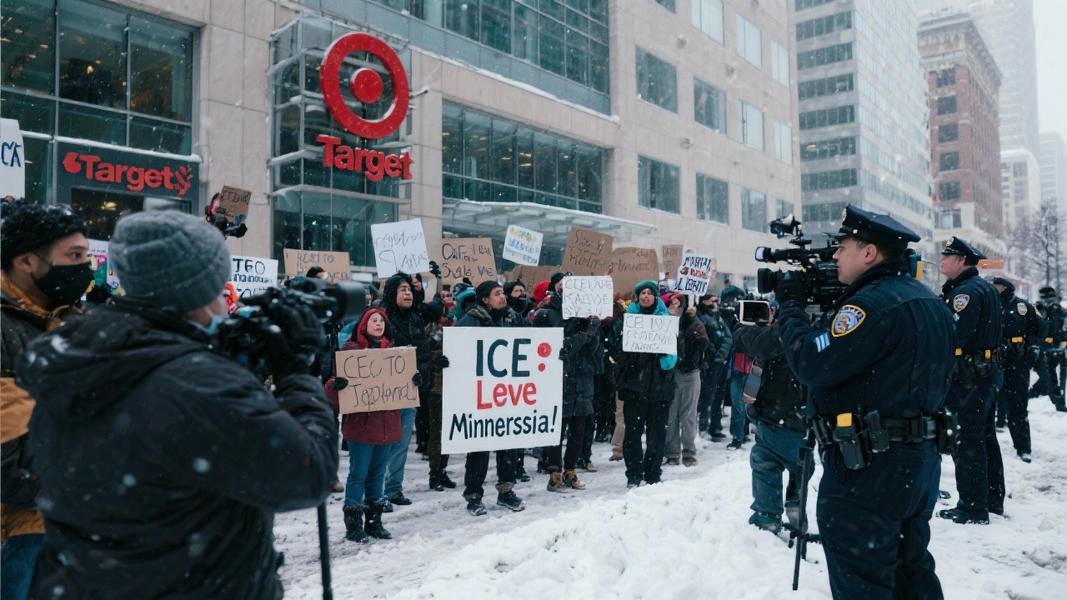
Federal officials have identified two agents who fired shots in the fatal shooting of Alex Pretti during an immigration enforcement operation in Minneapolis, according to government documents reviewed by ProPublica. The revelation comes amid a rapidly evolving situation as the Department of Homeland Security deploys what officials are calling the largest immigration operation in U.S. history to Minnesota.
Border Patrol agent Jesus Ochoa and Customs and Border Protection officer Raymundo Gutierrez were named as the federal agents who discharged their weapons during the January 24 incident that left Pretti dead, ProPublica reporter David McSwane confirmed. When asked about further details, McSwane would only say, “That’s what we can say for now.”
The Hennepin County Medical Examiner has officially ruled Pretti’s death a homicide due to multiple gunshot wounds, according to a statement released earlier this week.
Legal battles and evidence concerns
In a related development, a federal judge has lifted a temporary restraining order against federal authorities in a lawsuit brought by the Minnesota Bureau of Criminal Apprehension. The judge determined that federal agencies were unlikely to destroy evidence related to Pretti’s shooting, as had been feared by state investigators.
The case has sparked tensions between state and federal authorities over jurisdiction and investigation protocols. Meanwhile, some families caught up in the immigration enforcement operation have seen relief. Liam Conejo Ramos, 5, and his father Adrian Conejo Arias have returned to Minnesota after a judge ordered their release from a Texas detention center, with their attorney saying they’re legally pursuing asylum, local media reported.
Massive federal deployment underway
What’s the scale of this operation? DHS plans to deploy approximately 2,000 Immigration and Customs Enforcement agents and officers to the Minneapolis-St. Paul area, drawing personnel from Enforcement and Removal Operations, Homeland Security Investigations, and U.S. Customs and Border Protection. Officials have characterized it as the largest immigration operation ever undertaken.
“You will be held accountable for your crimes,” federal authorities warned in a statement addressing those targeted by the operation.
In response to growing criticism about transparency, DHS Secretary Kristi Noem announced that all federal agents in Minneapolis for “Operation Metro Surge” will be equipped with body cameras effective immediately. “As funding is available, the body camera program will be expanded nationwide. We will rapidly acquire and deploy body cameras to DHS law enforcement across the country. The most transparent administration in American history – thank you,” Noem stated.
But implementation challenges remain substantial. ICE field office director Samuel Olson clarified that equipping every ICE law enforcement personnel in Minnesota would require approximately 2,000 devices and 180 days for shipping, installation, testing, and training. “At this time, the ERO St. Paul Office is not scheduled or funded for BWC deployment. ICE law enforcement personnel out of the ERO St. Paul Offices are not properly prepared, trained, or equipped for an immediate deployment of BWC use,” Olson explained.
Political tensions escalate
Minnesota Lt. Gov. Peggy Flanagan has found herself drawn into the controversy, denying allegations that she participated in a Signal chat group coordinating anti-ICE protests and donations. “Let’s not get distracted from what really matters here – and that is getting ICE out of Minnesota, and making sure that people are safe,” Flanagan remarked, attempting to refocus attention on her administration’s concerns about federal operations.
The tensions have extended beyond immigration enforcement. U.S. Attorney General Pam Bondi announced two additional arrests connected to protests at a St. Paul church: Ian Davis Austin and Jerome Deangelo Richardson. “If you riot in a place of worship, we WILL find you,” Bondi declared in a statement.
As federal and state authorities continue their parallel and sometimes conflicting operations, Minnesota residents find themselves caught in the middle of what has become both a law enforcement action and a political battleground—with questions about accountability, transparency, and jurisdiction still largely unanswered.
