
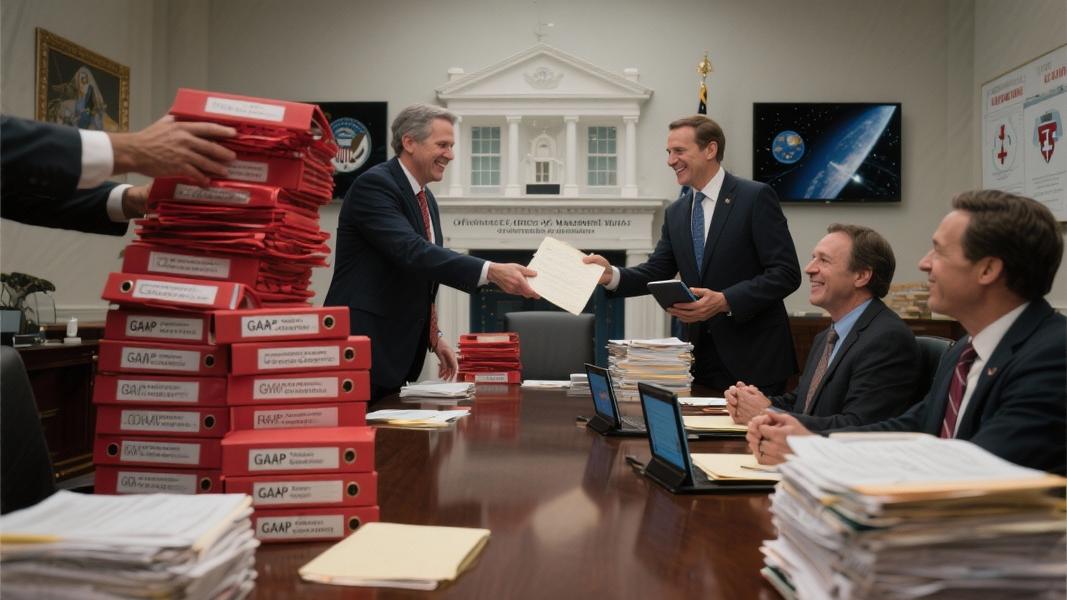
Federal contractors may finally be able to close one of their two sets of books. In a move that could fundamentally reshape government contracting, the Cost Accounting Standards Board has proposed the most sweeping overhaul to federal contract accounting rules in over half a century.
The Office of Management and Budget’s CAS Board announced plans to eliminate more than 60 outdated and overlapping accounting requirements that have forced contractors to maintain parallel accounting systems since the 1970s. The proposed changes aim to align federal cost accounting more closely with Generally Accepted Accounting Principles (GAAP), potentially reducing regulatory burdens across nearly $750 billion in annual federal contracts.
Dual Books, Real Costs
“Holding contractors responsible for properly and transparently accounting for their costs is good stewardship, but forcing contractors to maintain overlapping books and records is wasteful and creates barriers that discourage talented companies from working with the Government,” said Dr. Kevin Rhodes, senior advisor to OMB Director Russell Vought, in a statement released Tuesday.
The current system requires many contractors to keep two separate accounting systems — one that follows CAS for government work and another using GAAP for everything else. This dual-track approach has remained largely unchanged for over 50 years, despite significant evolution in accounting standards and practices.
Why now? The reform comes as part of a broader effort to modernize federal procurement and reduce barriers to entry for new contractors. The CAS Board is advancing a multiyear initiative to update certain standards (CAS 404, 408, 409, 411) and considering new ones (CAS 407, 415, 416) to more fully conform to GAAP.
Dramatic Threshold Increases
Perhaps the most significant change involves raising the monetary thresholds that determine which contracts fall under CAS requirements. The basic threshold could jump from $2 million to as high as $25 million — a move that financial analysts at FORVIS Mazars estimate would reduce the number of contracts subject to CAS by a whopping 70%, while only reducing the amount of contracting dollars under CAS by about 8%.
The Board is also contemplating an increase to the “full CAS coverage” threshold, currently set at $50 million, though the exact figure hasn’t been specified. Under statutory mandate (41 U.S.C. 1501(c)(2)), the Board is required to review these thresholds periodically.
“The board will work to issue a final rule addressing updates to revenue and lease accounting stemming from GAAP changes and signaled accelerated efforts on conformance to reduce unnecessary transaction costs for contracting parties,” according to a July 2025 analysis published in the Federal Register.
Harmonizing Standards
At the heart of these reforms is an attempt to harmonize two accounting worlds that have grown increasingly divergent. CAS requires certain contractors to disclose in writing and consistently follow specific cost accounting practices, while GAAP governs accounting in the private sector.
The overlap creates significant compliance headaches. But hasn’t GAAP become more rigorous over time? Many accounting experts argue that GAAP has evolved substantially since the 1970s, making some CAS requirements redundant or outdated.
“Contractors dealing with government work may soon face less compliance hassle as the Cost Accounting Standards Board proposes aligning CAS 404 and CAS 411 with Generally Accepted Accounting Principles,” noted industry experts at FMF ECPA in their analysis of the proposed changes.
The proposed changes to CAS 404 (Capital Assets) and CAS 411 (Accounting for Acquisition Costs of Material) specifically target areas where current federal requirements significantly diverge from commercial accounting standards, creating unnecessary administrative burdens.
Industry Impact
For the thousands of companies that contract with the federal government, these changes could mean significant cost savings and simplified operations. Small and mid-sized contractors, in particular, stand to benefit from the increased thresholds, potentially allowing them to compete more effectively against larger firms with more robust accounting departments.
The CAS Board is also resuming consideration of harmonizing additional CAS standards with GAAP, a process that began with a Staff Discussion Paper in 2018 but has moved slowly until now. The Board indicated it will review and resume deliberations on ongoing cases related to several standards that have been under consideration.
Public comments on the proposed changes will be accepted for 60 days following publication in the Federal Register. If implemented, these reforms could represent the most significant change to government contract accounting since the establishment of the original CAS Board in 1970.
For contractors who’ve spent decades maintaining two sets of books, the prospect of closing one might be the most welcome accounting news in half a century.
