
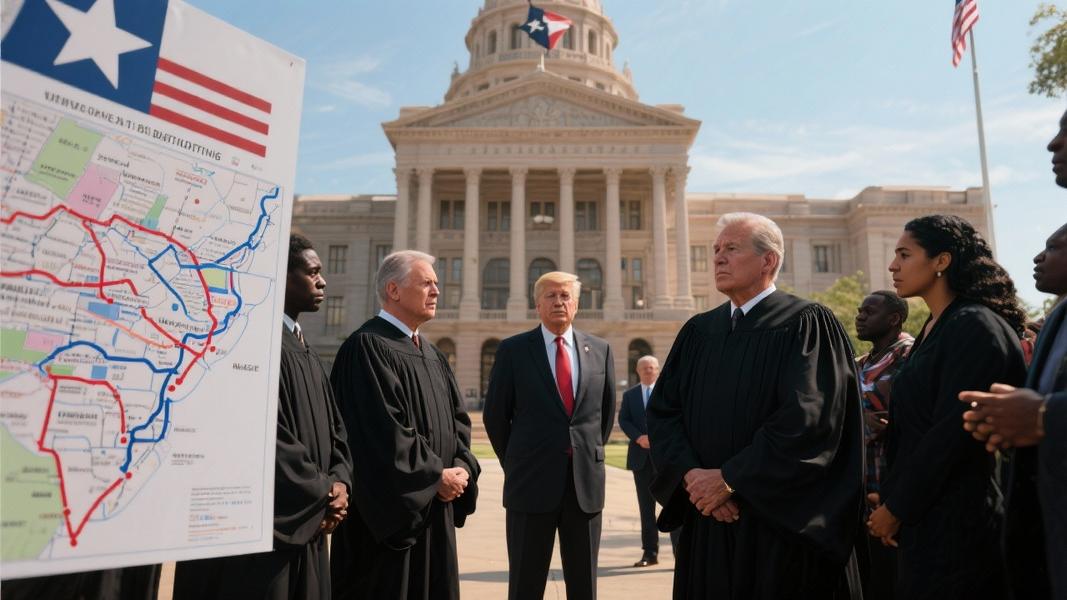
A federal court has thrown a wrench into Texas’s controversial redistricting plans, blocking the state from using its newly drawn 2025 congressional map in upcoming elections after finding it likely discriminates against racial minorities.
The 2-1 ruling from a panel of federal judges on Tuesday ordered Texas to revert to its 2021 district boundaries while the case proceeds, dealing a significant blow to Republican efforts to secure additional U.S. House seats in the 2026 midterms. “The public perception of this case is that it’s about politics. To be sure, politics played a role in drawing the 2025 Map. But it was much more than just politics. Substantial evidence shows that Texas racially gerrymandered the 2025 Map,” the judges wrote in their decision.
A High-Stakes Redistricting Battle
The now-blocked map was signed into law by Gov. Greg Abbott following a special legislative session earlier this year. The redistricting plan was widely seen as a strategic effort backed by President Donald Trump to help Republicans maintain their narrow majority in the House, potentially delivering up to five additional GOP seats.
What made the Texas redistricting particularly contentious? The court found that Republican lawmakers had eliminated five of the state’s nine “coalition” districts — areas where minority groups collectively outnumbered non-Hispanic white voters. The revised map reduced the total number of minority-majority districts from 16 to 14, while adding one new Hispanic-majority and two new Black-majority districts in what critics called a cynical attempt to comply with voting rights requirements while still diluting minority voting power.
“Without an injunction, the racial minorities the Plaintiff Groups represent will be forced to be represented in Congress based on likely unconstitutional racial classifications for at least two years,” the ruling stated, emphasizing the immediate harm that would come from allowing the maps to remain in place.
Racial Gerrymandering Claims
NAACP National President Derrick Johnson didn’t mince words about the redistricting effort. “It’s quite obvious that Texas’s effort to redistrict mid-decade, before next year’s midterm elections, is racially motivated. The state’s intent here is to reduce the members of Congress who represent Black communities, and that, in and of itself, is unconstitutional,” Johnson declared.
The court’s decision also referenced a controversial July 2025 Department of Justice letter that demanded redrawing of four coalition districts, claiming they diluted minority voting power. Five of the six Democratic lawmakers drawn into districts with other incumbents under the new map are Black or Hispanic, a pattern that raised significant red flags for voting rights advocates.
Gov. Abbott has vigorously defended the redistricting plan, insisting that “The Legislature redrew our congressional maps to better reflect Texans’ conservative voting preferences – and for no other reason,” as he asserted following the court’s decision.
National Implications
The Texas case is just one front in an escalating nationwide battle over congressional maps. California voters recently approved a ballot initiative to redraw districts in a way that could give Democrats five additional seats, prompting the Department of Justice to file a lawsuit characterizing the plan as a “brazen power grab that tramples on civil rights.”
Similar redistricting efforts have emerged in Missouri and North Carolina, with both parties accusing the other of manipulating district boundaries to gain partisan advantage. The stakes couldn’t be higher, as control of the House of Representatives in 2026 could hinge on these contested maps.
Complicating matters further is a recent ruling by the 5th U.S. Circuit Court of Appeals, which determined that the Voting Rights Act doesn’t allow separate minority groups to “aggregate their populations” when arguing that a map illegally dilutes their voting power. This interpretation has become central to the controversy around Texas’s coalition districts, with state officials citing it as justification for their approach.
What Happens Next?
Texas officials have signaled they won’t accept defeat. Attorney General Pam Bondi expressed confidence in an eventual victory, posting on X: “Texas’s map was drawn the right way for the right reasons. We look forward to Texas’s victory at the Supreme Court.”
The court’s order means Texas must revert to using its 2021 congressional district boundaries while the legal battle continues. That map, while still controversial among voting rights advocates, maintained more minority coalition districts than the 2025 version.
But the fight is far from over. With both parties treating redistricting as a crucial battleground for control of Congress, and with the Supreme Court likely to have the final say, the Texas case represents just one skirmish in what promises to be a protracted legal war over the fundamental question of who gets represented — and how — in American democracy.
