
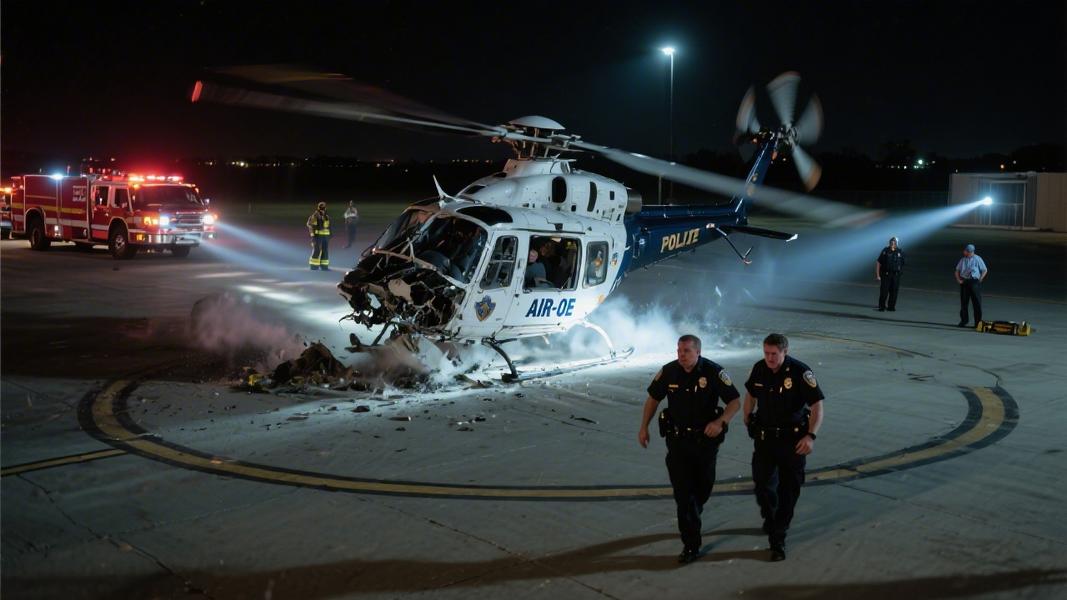
A Fort Worth police helicopter went down Saturday night — and the fact that both crew members walked away is, by any measure, remarkable.
The Fort Worth Police Department’s Bell 505 helicopter, tail number N911FW, made an emergency landing at Meacham International Airport at approximately 10:15 p.m. on Saturday, March 7, 2026, according to initial reports. The aircraft came down hard enough to be classified as a crash by aviation authorities, though both officers aboard survived. In a city where the air unit is a critical piece of law enforcement infrastructure, the incident raises immediate questions about what went wrong — and what happens next.
What We Know About the Incident
The Bell 505 — a light, single-engine helicopter that’s become increasingly common in municipal law enforcement fleets — was operating on a routine patrol when something went sideways. Details on the precise mechanical failure or emergency condition that forced the landing remain limited at this stage, as federal aviation investigators typically take time to work through the evidence before drawing conclusions. Still, the fact that the crew managed to bring the aircraft down at Meacham rather than somewhere far less forgiving says something about their training.
Meacham International, a general aviation airport on Fort Worth’s north side, has long served as the operational base for the city’s air support unit. Landing there under emergency conditions — at night, no less — isn’t a trivial feat. Night operations in a single-engine aircraft experiencing a malfunction are precisely the scenario that separates well-drilled crews from the rest.
The Crew and the Response
Both officers aboard were treated and released, sources confirmed. No names were immediately made public, which is standard practice in the immediate aftermath of officer-involved incidents of any kind. The Fort Worth Police Department’s air support division typically operates with a pilot and a tactical flight officer — one flying, one managing communications, cameras, and ground coordination. Which role each officer was filling Saturday night hasn’t been specified.
Emergency crews responded to the airport quickly. Given that Meacham has on-site infrastructure and crash/fire/rescue resources, the response timeline was favorable — another reason why getting that bird to the airport, rather than setting down on a highway or open field, mattered enormously.
Why This Matters Beyond the Headlines
Here’s the thing about police air units that often gets lost in the noise: they’re expensive, they’re irreplaceable in the short term, and their absence is felt immediately on the ground. The Fort Worth Police air support unit responds to everything from high-speed vehicle pursuits to missing persons searches to active crime scenes. Losing even one aircraft — even temporarily — puts pressure on the entire operation.
The Bell 505 itself is a relatively modern platform, introduced to the market in 2017 and certified by Transport Canada and the FAA. It’s not the workhorse Bell 206 that departments flew for decades, but it’s also not without its own learning curve. Whether the aircraft’s design, maintenance history, or something entirely environmental played a role in Saturday’s emergency is something investigators will untangle over the coming weeks and months.
That said, it’s worth noting that emergency landings — even ones classified as crashes — are sometimes a testament to a system working as intended. Pilots train for engine failures. They train for hydraulic anomalies. They train for the exact kind of moment that apparently unfolded over north Fort Worth Saturday night. The outcome here, two officers alive and ambulatory, suggests that training held.
What Comes Next
The National Transportation Safety Board is expected to investigate, as it does with virtually all aircraft accidents involving certificated aircraft in the United States. The FAA will conduct its own parallel review. Those processes are methodical, often frustratingly slow for a public that wants answers fast — but they’re thorough, and they matter for the broader aviation safety record.
Fort Worth police have not yet issued a formal statement detailing the operational impact to the air unit or the timeline for returning aircraft to service. Whether the department has access to a backup aircraft, a mutual aid agreement with a neighboring jurisdiction, or simply absorbs the coverage gap with ground units is an open question that will become more pressing as days turn into weeks.
How long the investigation takes, and what it ultimately finds, will determine whether this was a one-off mechanical misfortune or something that demands a harder look at the department’s fleet. Either way, the conversation is only just beginning.
Two officers went up Saturday night and came back down in ways no one planned — but they came back down. In aviation, that’s sometimes the whole story, and it’s enough of one.
