
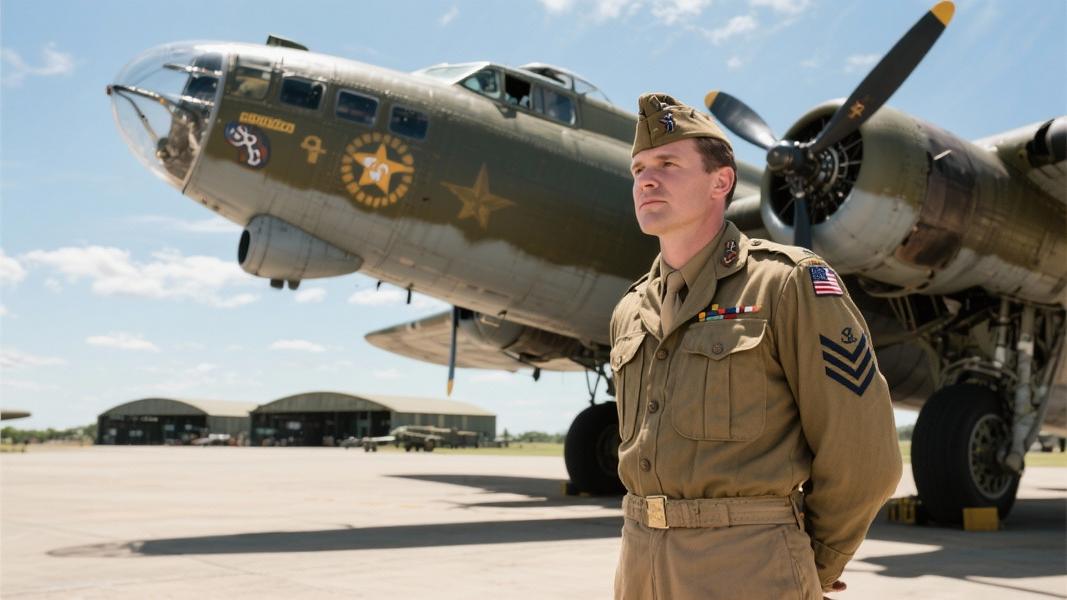
From a tiny Texas town to the skies over Europe, Staff Sergeant Roy Blanton’s journey during World War II traces an arc familiar to many small-town Americans who found themselves thrust into global conflict.
Blanton, who hailed from Knickerbocker in Tom Green County, Texas, served as both nose gunner and mechanic on B-24 bombers after completing specialized training at Buckingham Army Airfield’s Flexible Gunnery School in Florida. His roots in rural Texas couldn’t have been more humble. Knickerbocker, as Blanton himself described it, remarked, “wasn’t any bigger than just a post office.”
From Post Office to War Front
What does it mean when your hometown is barely a dot on the map, yet suddenly you’re navigating the war-torn skies of another continent? For Blanton and countless other rural Americans, the U.S. Army Air Corps represented not just military service but a dramatic expansion of their world.
The B-24 Liberator, where Blanton would serve as nose gunner, was among America’s most important heavy bombers during the conflict. These aircraft required crews of ten men working in perfect coordination — mechanics like Blanton often pulled double duty, maintaining the aircraft between missions and manning gun positions during combat operations.
Training at specialized facilities like Buckingham prepared men like Blanton for the harsh realities of aerial combat. The Flexible Gunnery School’s curriculum was notoriously demanding, with washout rates that reflected the critical nature of the skills being taught. After all, a gunner’s accuracy could mean the difference between a bomber returning to base or being shot down over enemy territory.
The transition from rural Texas — where Blanton likely knew every face in town — to the organized chaos of wartime military service represented a profound shift. Many veterans of his generation spoke of this cultural whiplash throughout their lives.
“Imagine going from a place with just a post office to flying missions where entire cities burned below you,” notes one military historian who’s studied accounts like Blanton’s. “The psychological distance traveled was often greater than the physical one.”
The Texas General Land Office has preserved Blanton’s story through its Voices of Veterans oral history program, ensuring that firsthand accounts from the rapidly diminishing World War II generation aren’t lost to time.
For men like Roy Blanton, the war transformed everything. They left places so small they barely registered on maps and returned as men who had seen the world from heights most couldn’t imagine — carrying experiences that would shape not just their lives, but the character of postwar America itself.
