
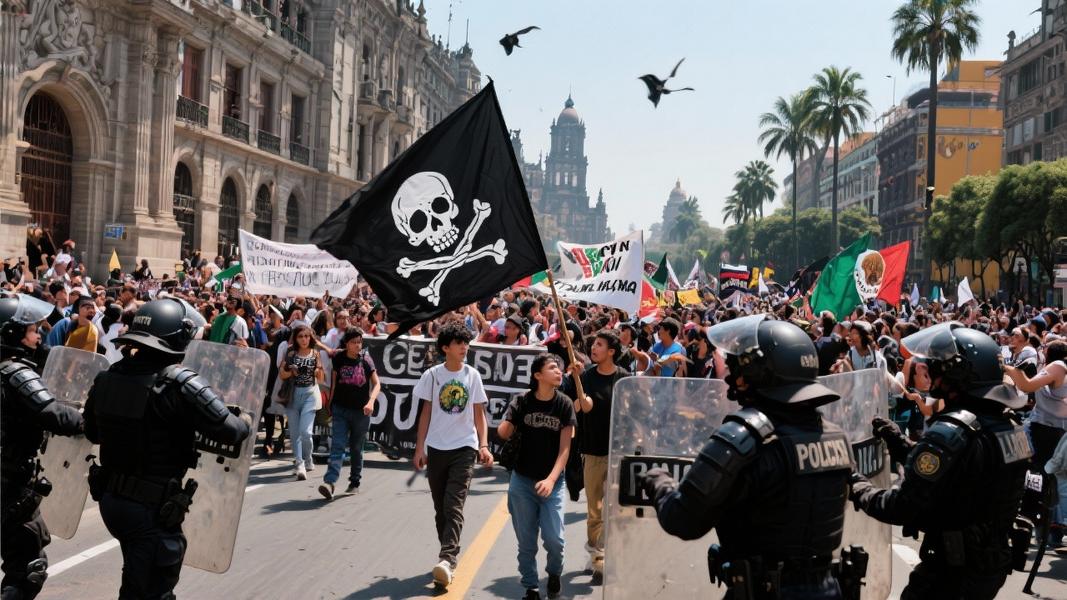
Thousands of Gen Z protesters clashed with police outside Mexico City’s National Palace last week, as a social media-driven movement against cartel violence and government security policies erupted into chaos. What began as an online call to action quickly transformed into street confrontations, with demonstrators wielding the pirate flag from the anime “One Piece” as their unlikely symbol of resistance.
The November protests, planned across more than 50 Mexican cities, represent what organizers call a genuine youth revolt against rising insecurity and violence. But President Claudia Sheinbaum’s administration has dismissed the movement as something else entirely — a “paid, foreign-backed campaign” designed to undermine her government, according to officials.
From Social Media to Street Clashes
An earlier Gen Z demonstration on November 8 drew approximately 300 people, city authorities stated, but subsequent protests have grown dramatically in size and intensity. Last Friday’s demonstrations saw participants attempt to breach barriers at the National Palace, with police responding with tear gas as the situation deteriorated.
“Mexico’s government says the Generation Z march is a paid, foreign-backed campaign; organizers insist it is a real youth revolt over insecurity,” reports indicate, highlighting the stark contrast between official narratives and protesters’ claims.
What’s behind this sudden wave of youth activism? Frustration with President Sheinbaum’s security policies and escalating drug-related violence appears to be the primary catalyst, with many demonstrators carrying signs demanding government action against cartel violence that has plagued the country for years.
A Movement Dividing Mexico’s Youth
Not all young Mexicans support the protests, however. Normalistas — students from teacher training colleges known for their own history of activism — have pointedly refused to participate in the November 15 demonstrations. They’ve criticized the movement, saying “it promotes hatred and arises from” problematic origins, suggesting potential right-wing involvement that conflicts with their own political perspectives.
This internal division reflects broader questions about the movement’s origins and objectives. Are these spontaneous expressions of genuine youth frustration, or something more orchestrated? Social media has certainly amplified the protests, with planning occurring across more than 50 cities through online coordination.
The “One Piece” pirate flag — borrowed from the popular Japanese anime series — has emerged as an unlikely but powerful symbol for protesters. Its adoption speaks to the distinctly Gen Z character of the movement, blending pop culture with political expression in a way that resonates with younger demonstrators.
Government Response and Growing Tensions
President Sheinbaum’s administration has taken a defensive stance, characterizing the protests as manufactured opposition rather than legitimate grievances. This response has only fueled protesters’ anger, with many seeing it as further evidence of government dismissal of serious security concerns.
The clashes represent the first major security challenge for Sheinbaum, who took office promising continuity with her predecessor’s security approach. But that’s precisely what many demonstrators are protesting — a strategy they view as ineffective against cartel violence that continues to plague much of the country.
As tensions escalate, the question remains whether this movement represents a fleeting moment of youth activism or the beginning of a more sustained challenge to Mexico’s security policies. Either way, the sight of tear gas clouding Mexico City’s central plaza and young protesters in straw hats confronting riot police suggests that Mexico’s Generation Z has found its political voice — anime references and all.
