
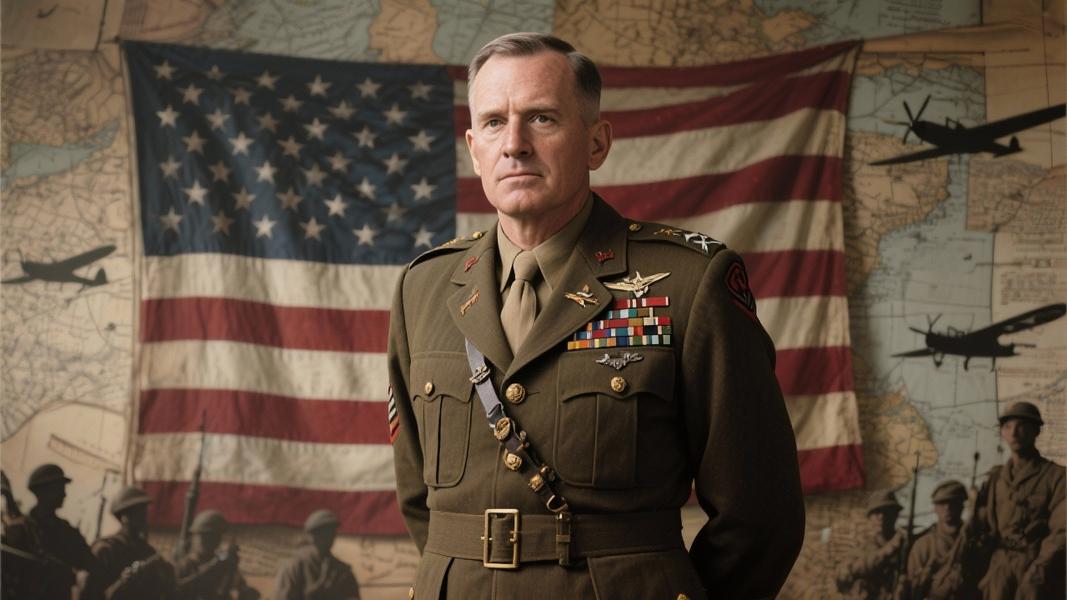
In the pantheon of American military and diplomatic giants, few figures stand as tall as George C. Marshall, the Pennsylvania-born soldier-statesman whose steady hand helped guide the United States through its most tumultuous mid-century challenges.
Born on the last day of 1880 in Uniontown, Pennsylvania, Marshall would go on to craft one of the most consequential careers in American history before his death on October 16, 1959. His remarkable journey took him from military academies to the highest echelons of global power during America’s emergence as a superpower, leaving an indelible mark on the nation and world that still resonates today.
From Soldier to Wartime Leader
Marshall’s most extraordinary achievement might be his transformation of America’s military capabilities. As U.S. Army Chief of Staff from 1939 to 1945, he orchestrated what military historians consider a near-miraculous expansion, building the largest army in history from fewer than 200,000 soldiers to an overwhelming force of more than 8 million, as documented by the Encyclopedia Britannica.
How did one man oversee such a monumental mobilization? Through methodical planning, relentless focus, and an uncanny ability to identify talent. When Marshall took command, the U.S. Army ranked 19th globally in size—behind even Portugal—with approximately 174,000 men. By war’s end, his organizational genius had created a juggernaut that helped secure the Allied victory, as records from the National Museum of the United States Army confirm.
Winston Churchill, never one to offer praise lightly, called Marshall the “organizer of victory” for his leadership during World War II. President Harry Truman went even further, describing him as “the greatest military man that this country ever produced,” according to historians who have studied Truman’s assessments of his contemporaries.
A Statesman Emerges
Yet Marshall’s contributions to American history were just beginning when the guns of World War II fell silent. His remarkable career continued with a series of pivotal roles that would cement his legacy beyond military matters. The George C. Marshall Foundation chronicles his subsequent service as special ambassador to China (1945–1947), Secretary of State (1947–1949), and Secretary of Defense (1950–1951).
It was as Secretary of State that Marshall would craft his most enduring legacy outside the battlefield. The Marshall Plan, as it came to be known, provided a staggering $13 billion in aid—equivalent to roughly $134 billion in 2021 dollars—to rebuild a devastated Europe. This unprecedented initiative not only helped restore economic stability to war-torn nations but also established a bulwark against Soviet expansion during the early Cold War years.
Marshall’s foresight in recognizing that European recovery was essential to American security interests demonstrated his evolution from military strategist to global statesman. His Nobel Prize in Peace, awarded in 1953, recognized this transformation and cemented his unique place in history as both a warrior and peacemaker.
That duality—the ability to excel at organizing war and constructing peace—remains perhaps Marshall’s most remarkable achievement. In an era of increasingly partisan politics and narrowing expertise, his career stands as a reminder of what broad-minded public service once looked like in America.
For a man who helped save democracy abroad, Marshall’s greatest gift may have been demonstrating how it could work at its best at home: through selfless service, strategic vision, and an unwavering commitment to country over self—qualities that seem increasingly rare in today’s political landscape.
