
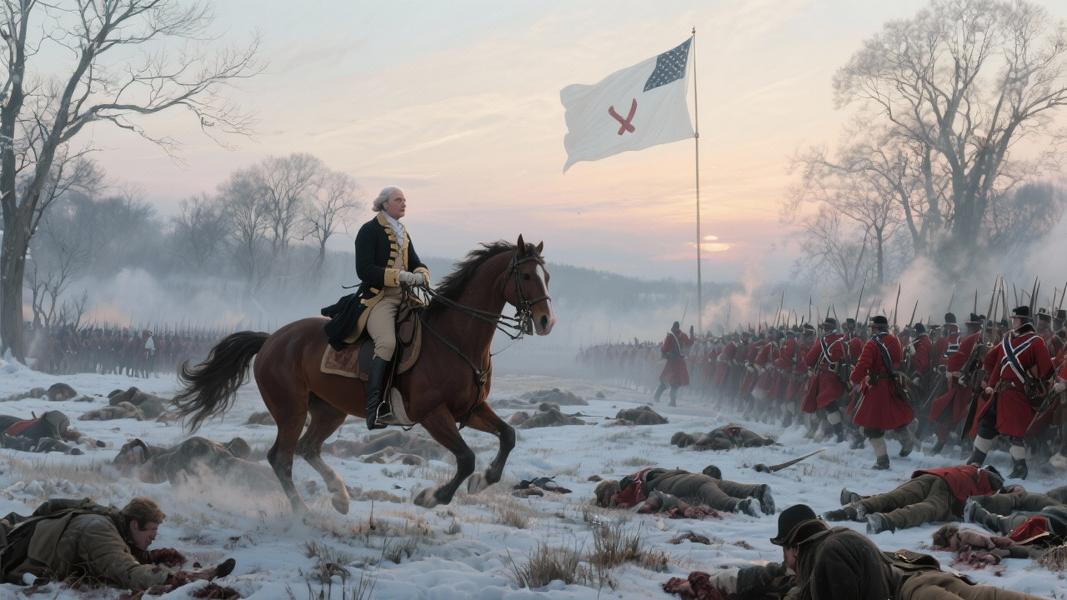
It was the moment that defined not just a battle, but perhaps the American Revolution itself. George Washington, commanding the fledgling Continental Army, rode directly between opposing lines of fire, seemingly oblivious to the mortal danger surrounding him on that frigid January morning in 1777.
The General Who Refused to Retreat
On January 3, 1777, Washington led approximately 6,000 Continental soldiers in a surprise attack against 1,400 British troops near Princeton, New Jersey. The battle came just days after his now-famous crossing of the Delaware River and victory at Trenton, where he had captured 1,500 Hessian mercenaries in a daring Christmas night operation.
But it was at Princeton where Washington’s personal courage would be most dramatically displayed. As American militia began to flee from British counterattacks, the 44-year-old commander did something extraordinary—he rode directly into the chaos.
“At the crucial moment, Washington rode up leading the Virginia Continentals and the Maryland Line, and he rallied the fleeing militia,” according to historical records of the engagement.
Witnesses described Washington advancing to within 30 yards of the British lines, completely exposing himself to enemy fire. “Parade with us, my brave fellows!” he reportedly shouted to retreating soldiers. “There is but a handful of the enemy and we will have them directly!”
Between Two Fires
What makes this moment particularly remarkable? Washington placed himself between two firing lines, with musket balls whizzing past from both American and British positions. His horse reportedly refused to advance further, so close had he come to the enemy formation.
Turning to face his own men, Washington yelled: “Halt!” Then: “Aim,” followed by “Fire!” As volleys erupted from both sides, he remained eerily calm amid the smoke and chaos, somehow emerging unscathed.
The general’s personal intervention proved decisive. One Continental officer later wrote that Washington seemed almost jubilant in the midst of battle, at one point exclaiming, “It is a fine fox chase my boys!”
His presence transformed retreating militia into a coordinated fighting force. With Washington directing the action, American troops including riflemen, Virginia Continentals and New England regiments reformed their lines and delivered devastating fire that sent the British into retreat.
The Darkest Hour
The victories at Trenton and Princeton came after what had been a catastrophic year for Washington and the Revolutionary cause. Just days earlier, the general had been desperately trying to convince exhausted soldiers to extend their enlistments.
How bad were things? Washington himself had summed up 1776 in stark terms, writing: “The year is over, I am heartily glad of it and hope you nor America will ever be plagued with such another.”
The Continental Army had suffered defeat after defeat, being driven from New York and across New Jersey. Morale was collapsing, enlistments expiring, and the Revolution itself seemed on the verge of failure.
That context makes Washington’s personal bravery at Princeton all the more significant. His willingness to risk his life—when his death would likely have meant the end of the Revolution—reveals both his desperation and his determination.
The Turning Point
The twin victories at Trenton and Princeton reversed American fortunes at a crucial moment. They demonstrated Washington’s tactical ingenuity and breathed new life into a cause that had been on life support.
More than that, the image of Washington on horseback, seemingly invulnerable amid flying bullets, became an enduring symbol of American resolve. His personal courage that January morning transformed him from a general with a mixed record into a figure of almost mythic proportions in the eyes of his contemporaries.
Perhaps most remarkably, the man who would later voluntarily relinquish power as America’s first president showed at Princeton that he understood something essential about leadership in desperate times: sometimes, it requires putting everything—including one’s own life—on the line.
