
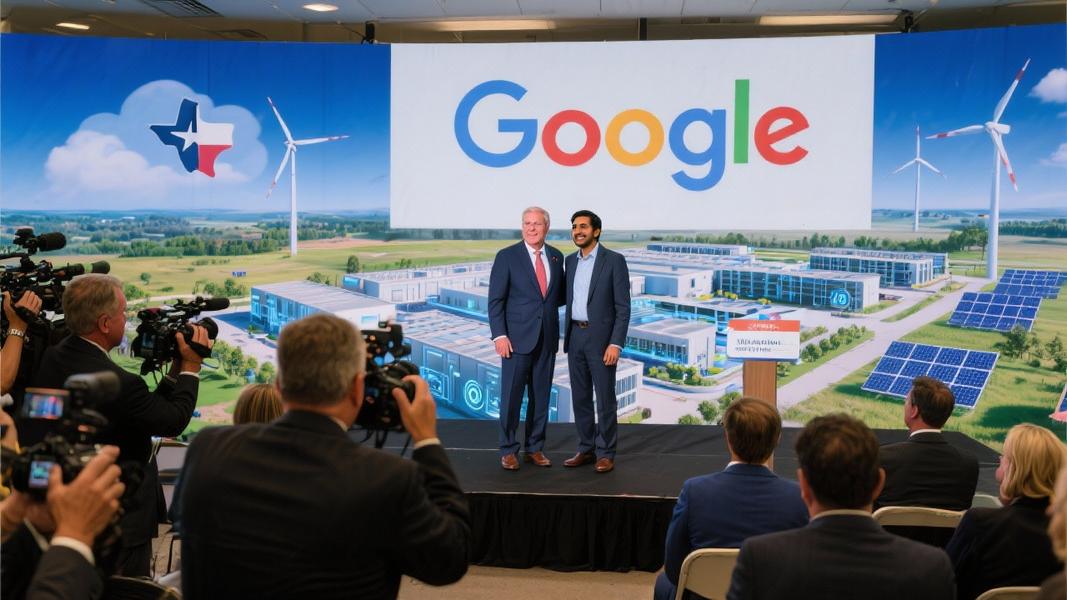
Google is betting big on the Lone Star State — $40 billion big.
The tech giant announced plans Thursday for its largest-ever investment in a single U.S. state, committing to a massive expansion across Texas that will establish three new data center campuses designed specifically for artificial intelligence operations. The investment, scheduled to roll out through 2027, aims to bolster AI infrastructure while creating thousands of jobs and addressing energy concerns in a state already becoming an AI powerhouse.
Texas-Sized Ambitions
“This investment will create thousands of jobs, provide skills training to college students and electrical apprentices, and accelerate energy affordability initiatives throughout Texas,” Alphabet Chief Executive Sundar Pichai said at an event near Dallas, as reported by NewsMax.
The expansion includes development of three AI-optimized data center campuses — one in Armstrong County in the Texas Panhandle and two in Haskell County near Abilene. Notably, one center will be positioned adjacent to a new solar-plus-battery project, a strategic move to help ease stress on the electric grid as these facilities typically consume enormous amounts of power.
Texas Governor Greg Abbott welcomed the announcement enthusiastically. “This is a Texas-sized investment in the future of our great state,” Abbott said. “Texas is the epicenter of AI development, where companies can pair innovation with expanding energy. Google’s $40 billion investment makes Texas Google’s largest investment in any state in the country and supports energy efficiency and workforce development in our state,” he stated.
Why Texas?
What’s drawing tech giants like Google to commit such enormous resources to Texas? The answer lies in a perfect storm of favorable conditions.
“Texas has become a leading destination for massive computing projects, fueled by the explosion of AI workloads and the state’s combination of abundant land and relatively low-cost power,” explained industry analysts.
It’s not just Google staking a claim. Other AI heavyweights like OpenAI and Anthropic have also been attracted to Texas’s business-friendly environment, creating what’s quickly becoming America’s AI corridor.
Pichai framed the opportunity in characteristically Texan terms: “They say that everything is bigger in Texas – and that certainly applies to the golden opportunity with AI,” the CEO remarked. “The $40 billion investment we announced today will bring three new data center campuses to the state to power the new era of AI innovation.”
Jobs and Economic Impact
The investment is expected to create “robust career opportunities across North Texas, West Texas, and the Panhandle,” according to details shared by Audacy.
Beyond the immediate construction jobs, Google’s expansion plans include significant investments in workforce development. The company has committed to skills training programs targeting college students and electrical apprentices, preparing Texans for the technical roles that will be needed to staff and maintain these advanced facilities.
This announcement represents more than just new buildings and servers. It’s part of Google’s broader “Investing in America” initiative and builds upon the company’s existing footprint in the state, including its Midlothian campus and Dallas cloud region.
Global AI Race
The Texas investment positions the state alongside other regions receiving major AI infrastructure investments globally. Google has recently announced similar initiatives in India, Germany, and the UK — though none match the scale of this Texas commitment.
Abbott emphasized the strategic importance of these developments beyond state borders: “We must ensure that America remains at the forefront of the AI revolution, and Texas is the place where that can happen.”
Still, these massive data centers come with challenges. Energy consumption remains a primary concern, which explains Google’s parallel investments in solar-plus-battery projects and energy affordability initiatives throughout Texas.
As AI continues its rapid evolution from promising technology to essential business infrastructure, the companies that can build out computational capacity efficiently and at scale will likely maintain competitive advantages. With this record investment, Google is signaling that when it comes to AI’s future, they’re planting their flag deep in Texas soil.
