
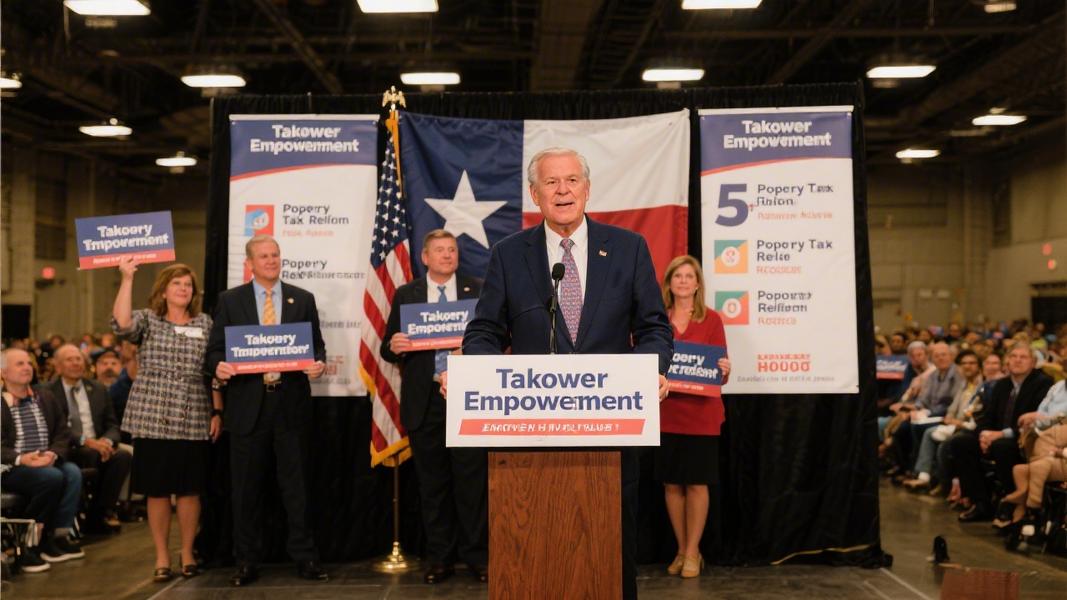
Texas Gov. Greg Abbott has unveiled an ambitious plan to dramatically overhaul property taxes across the Lone Star State, promising to eliminate school district property taxes for homeowners entirely while imposing strict caps on local government spending.
The five-point proposal, detailed at a Taxpayer Empowerment Event in Houston last month, represents one of the most aggressive property tax reform packages in the state’s history. At its core is Abbott’s pledge to abolish school district property taxes for homeowners through a constitutional amendment — a move that would fundamentally reshape Texas’s tax landscape.
Abbott’s Five-Point Plan
“We know the burden Texans are facing because of skyrocketing local property taxes and rising costs,” Abbott said at the Houston event, where he was flanked by GOP lawmakers and Genevieve Collins of Americans for Prosperity. “We are here to cut taxes for families and small businesses and ensure they can keep more of their hard earned money.”
The governor’s plan would cap local government spending growth to population growth plus inflation or 3.5%, whichever is lower. It would also require two-thirds voter approval for any tax increases, allow voters to roll back taxes via petition, cap annual appraisal growth at 3% with appraisals conducted only every five years, and eliminate school district property taxes for homeowners.
Abbott specifically targeted Harris County in his remarks, saying, “What I say we have to do is ensure that every property taxing jurisdiction in the state of Texas must live within spending limits also. Let’s apply this to Harris County, Texas. In Harris County, Texas, that entity alone increased your property taxes by almost 14% in just the last two years.”
Building on Previous Relief
This new proposal builds upon Abbott’s previous property tax relief efforts. Since 2015, his administration has supported over $40 billion in property tax relief, including $18 billion in the last legislative session alone. Recent measures included tax rate compression for school districts and increasing homestead exemptions from $25,000 to $110,000 for seniors.
The governor has also pledged to use a $10 billion surplus for further relief and raise the business personal property exemption to $100,000, providing additional relief for small businesses.
“We are on a path now to eliminate property taxes for every homeowner in Texas,” Abbott promised, making the elimination of school property taxes central to his 2026 reelection messaging.
Republican Divisions
But not all Republicans are fully aligned with Abbott’s vision. Lt. Gov. Dan Patrick, while supporting expanded homestead exemptions and lowering the senior freeze age, has cautioned that fully abolishing property taxes without proper fiscal planning could require significantly higher sales taxes — highlighting a rift within GOP leadership.
How would the state make up for the lost revenue? Abbott insists sales tax increases aren’t necessary. “There’s no reason to raise our sales tax,” the governor stated. “We’ve got the money to reduce… property taxes right now.”
The state has already committed $51 billion over two years for homestead exemptions and to backfill school funding, but critics question the long-term sustainability of this approach.
Potential Impacts and Criticisms
Texas currently has the seventh-highest property taxes in the nation, according to analyses of state tax burdens. The 2025 legislative session already increased homestead exemptions by $40,000 generally and $60,000 for seniors and disabled residents following voter approval.
Critics warn that Abbott’s proposed 3% cap on property value increases — down from the current 10% cap — could have unintended consequences. Policy experts suggest the plan might disproportionately benefit wealthy property owners and businesses while potentially disrupting the housing market and local government revenues.
The plan offers little relief for renters, who make up a substantial portion of Texas residents but would not directly benefit from homeowner-focused tax cuts.
Economic analysts have also raised concerns about the sustainability of Abbott’s proposal, noting it relies heavily on temporary budget surpluses fueled by federal aid and inflation-driven sales tax growth — both potentially unstable funding sources for permanent tax cuts.
Whether Abbott can navigate these challenges and unite his party behind this ambitious tax overhaul remains to be seen. What’s clear is that property taxes will be a defining issue as Texas heads toward the 2026 election cycle, with homeowners, businesses, and local governments all watching closely to see how this high-stakes tax reform plays out.
