
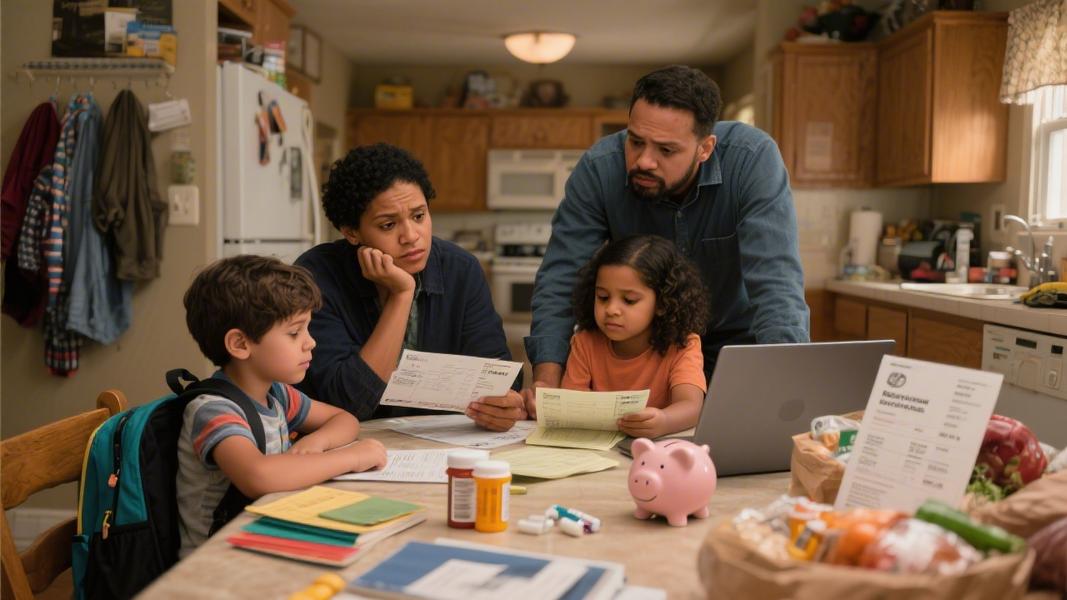
Nearly half of all Americans can’t afford to live — at least not by any honest accounting of what modern life actually costs. That’s the striking conclusion of a sweeping new analysis from the Urban Institute, and the numbers are hard to shake.
Released on March 16, 2026, the Urban Institute report reframes what it means to be economically secure in the United States — and finds that the traditional federal poverty line, long criticized as outdated, isn’t just imprecise. It’s nearly unrecognizable compared to the real cost of keeping a family afloat. The report calculates that a family with children needs at least $145,000 annually to cover the true ingredients of economic security. By that measure, 49% of Americans fall short. That’s not the struggling poor by Washington’s official definition. That’s roughly half the country.
What ‘Economic Security’ Actually Means
The threshold isn’t built on luxury. It’s built on a checklist that most people would recognize as baseline: adequate food, clothing, housing, health care, child care, transportation, postsecondary education, student loan repayments, and enough left over for emergency savings, retirement, and basic personal care products. Not vacations. Not a second car. The fundamentals.
Still, the figure is jarring when set against reality. The median household income for married couples sits at $128,700 — a number that sounds comfortable until you measure it against the $145,000 bar. Even two-income married households, statistically the most financially stable family unit in America, are falling nearly $16,000 short of what it takes to genuinely get ahead. The math doesn’t lie, even when the economy pretends otherwise.
Not every household faces the same threshold, to be fair. Under-65 households without children need roughly $95,900 — child care, as anyone with a toddler knows, is its own financial catastrophe. Families with at least one adult over 65 face a different squeeze: elevated health care costs push their threshold to $108,500. The variables shift, but the underlying pressure doesn’t.
The Hamster Wheel Economy
Gregory Acs, vice president of the Urban Institute’s tax and income supports division and a co-author of the report, has a phrase for what median earners are experiencing — and it’s blunter than most economists tend to get. “They feel like they’re on the hamster wheel economy,” he said.
It’s an apt image. Bills get paid. The lights stay on. But nothing accumulates. There’s no cushion, no trajectory, no sense that working harder translates into anything beyond treading water. “That is consistent with the experiences that we’re hearing from people — that they might not be destitute, but some of them are skipping bills — and some of them are making their bills on a regular basis, but they’re not getting ahead,” Acs explained.
The contrast with the federal poverty line is almost absurd. The official threshold for a family of four sits at roughly $33,000. The Urban Institute’s economic security measure is more than four times that figure. Acs is careful not to conflate the two concepts — poverty and security are different things — but the gap between them tells its own story about how disconnected official metrics have become from lived experience.
Who’s Most Exposed
How bad is it for single parents? Staggering. Nine in ten single-parent households — 90% — fall below the economic security threshold. Compare that to the already-alarming 49% overall rate and the scale of the disparity becomes clear. Family structure, it turns out, is one of the most powerful determinants of financial vulnerability in America.
Renters fare almost as badly. Eight in ten renters, or roughly 80%, live below the threshold — double the rate of homeowners. That’s not surprising, exactly, given the relentless climb of rents in most American cities over the past several years. But it’s a useful reminder that homeownership isn’t just a wealth-building tool; it’s increasingly a prerequisite for basic financial stability. Renters are, in a real sense, playing a different game entirely.
Among households with at least one member over 65, 45% lack economic security — a figure that will likely worsen as health care costs continue their long, grinding ascent. The Urban Institute projects that the same approximate share of Americans will remain below the threshold into 2026, as wages and inflation continue rising in rough tandem, leaving the gap stubbornly intact.
A Viral Post and an Unlikely Convergence
The Urban report didn’t emerge in a vacuum. In 2025, writer and social entrepreneur Michael Green published a widely circulated piece on Substack arguing that an income below roughly $140,000 effectively constitutes poverty when measured against the actual cost of necessities — housing, child care, food, and the rest. The post spread quickly, partly because it confirmed what a lot of middle-income families had quietly suspected about their own finances.
Acs addressed the comparison directly, and with a degree of intellectual generosity that’s somewhat rare in policy circles. “He called it a poverty rate — I think it actually was more of an economic security rate,” Acs noted. “His intuition, in his back-of-the-envelope calculation, is broadly consistent with the way we added things up.” The alignment between a rigorous institutional study and a writer’s napkin math is either reassuring or alarming, depending on your disposition.
But it’s not that simple. Green’s framing and the Urban Institute’s are doing slightly different analytical work. Green was making a rhetorical point about how poverty is perceived versus experienced. Urban is constructing a policy-relevant benchmark. The fact that they land in nearly the same place — $140,000 to $145,000 — suggests both are pointing at something real.
The Broader Squeeze
The report lands against a backdrop of compounding financial stress for middle-income Americans. The expiration of enhanced Affordable Care Act premium tax credits in January 2026 has already begun pushing health insurance costs higher for households that don’t qualify for traditional subsidies — precisely the kind of families the Urban threshold is designed to describe. It’s one more weight on a scale that was already tipping the wrong way for tens of millions of people.
Acs frames the stakes in terms that go beyond household budgets. Economic security, in his telling, isn’t just about paying bills. It’s about what becomes possible when you’re not constantly managing scarcity. “If you have more people feeling that their efforts are rewarded, that they have a stronger sense of autonomy, they are able to devote more time to their own communities, to their own families,” he observed. “Parents can invest more in their kids — time, energy, money.”
That’s the version of America the $145,000 threshold is trying to describe — not a wealthy country, just a functional one. The fact that half its residents can’t reach it is less an indictment of individual choices than a measure of how far the floor has dropped beneath the people trying to stand on it.
The hamster wheel keeps spinning. Whether anyone in a position to slow it is paying attention is, for now, a different question entirely.
