
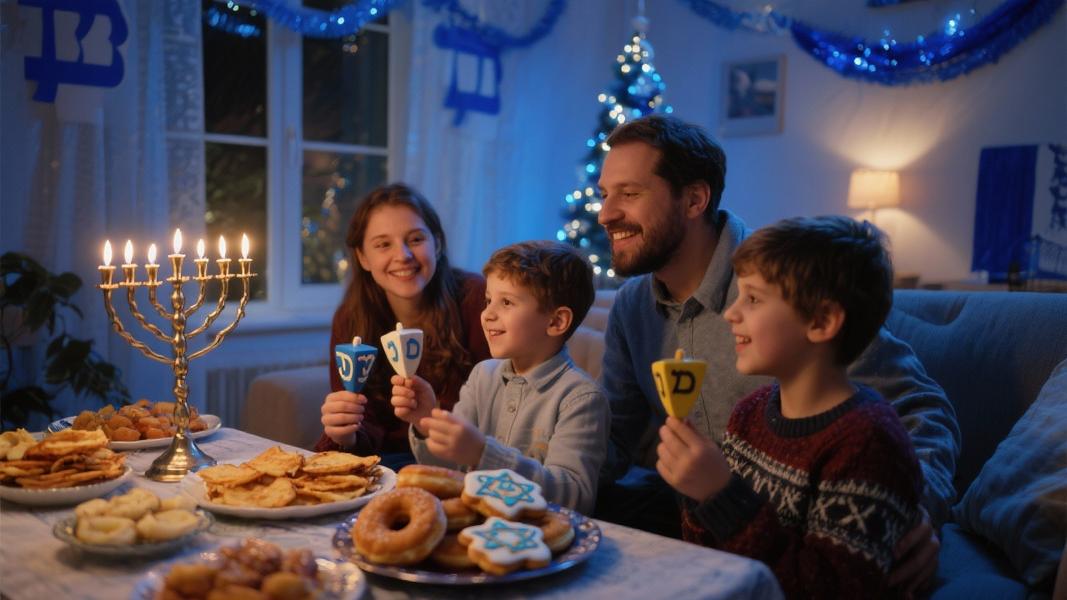
Hanukkah 2025 will light up homes across America starting December 14, bringing eight nights of candles, celebration, and commemoration to Jewish communities nationwide. The holiday concludes on December 22, marking one of Judaism’s most widely observed traditions.
The Festival of Lights, as it’s commonly known, commemorates a pivotal moment in Jewish history: the successful Maccabean revolt against Syrian forces who had defiled the Second Temple in Jerusalem during the 2nd century BCE. Following their victory, Jewish fighters discovered only enough sacred oil to light the temple’s menorah for a single day — yet miraculously, the oil burned for eight full nights, allowing time to prepare more purified oil. This miracle forms the spiritual heart of what many celebrate as a triumph of religious freedom.
How Hanukkah Is Observed
Each evening of Hanukkah, families gather to light the hanukkiah (also called a menorah) — a nine-branched candelabrum where one additional candle is lit each night. “Lighting the lamps during the eight days of Hanukkah is a religious duty imposed by the sages,” according to information documented in historical texts. The ninth branch holds the shamash, a “helper candle” used to light the others.
Why does Hanukkah fall on different dates each year? The holiday always begins on the 25th of Kislev in the Hebrew calendar, which follows a lunisolar system rather than the Gregorian calendar most Americans use. For 2025, the Hebrew calendar indicates Hanukkah “begins at sundown on Sunday, 14 December 2025 and ends at nightfall on Monday, 22 December 2025.”
Beyond the lighting ceremony, Hanukkah traditions have evolved to include spinning the dreidel (a four-sided top used in a game of chance), exchanging gifts, and enjoying foods fried in oil. Potato latkes (pancakes) and sufganiyot (jelly doughnuts) have become culinary staples of the celebration, their oil-based preparation symbolizing the Temple’s miraculous oil. “We observe Hanukkah at home by lighting the menorah, playing dreidel, and eating foods that are special to Hanukkah,” as one family tradition is described by Jewish cultural organizations.
American Context
In the United States, Hanukkah has taken on additional cultural significance, particularly as it often falls near Christmas. Though a relatively minor holiday in the religious calendar compared to Yom Kippur or Passover, its December timing has elevated its profile in American culture.
That said, Hanukkah remains a minority celebration in America. A 2019 AP-NORC survey found that approximately 5% of Americans identify as celebrating the holiday — reflecting the Jewish population in the United States.
For the Jewish community, however, the holiday carries deep meaning beyond its festive elements. The tradition of Hanukkah emphasizes themes of religious liberty, perseverance against oppression, and the endurance of faith against overwhelming odds — messages that continue to resonate across generations.
As families prepare their menorahs for December 2025, they’ll participate in a ritual that has illuminated Jewish homes for over two millennia — a small light against darkness that speaks to something universal: the human capacity to find hope in the most unexpected places.
