
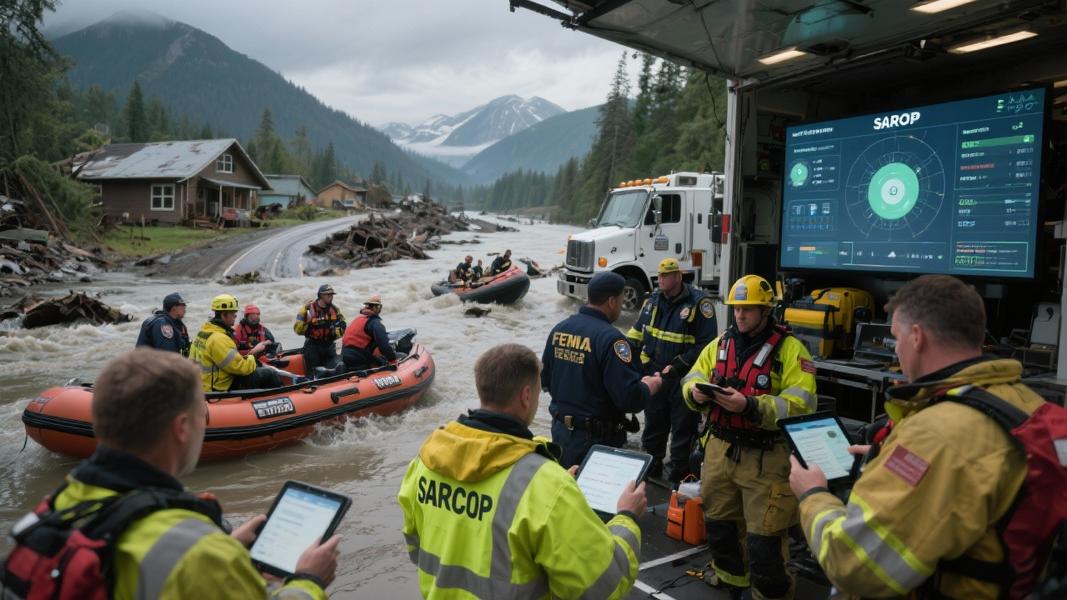
As historic floodwaters swept through western Washington this December, emergency responders turned to an unlikely hero: a digital platform quietly revolutionizing disaster response across four counties.
The Search and Rescue Common Operating Platform (SARCOP) has become the backbone of the massive flood response effort, with over 500 users coordinating assessments of more than 1,200 structures damaged by what officials are calling one of the region’s worst flooding events in decades. The technology, developed by the Department of Homeland Security’s Science and Technology Directorate, is proving its worth in real-time as communities battle rising waters.
When Minutes Matter: The Race Against Rising Waters
December’s catastrophic flooding came courtesy of a powerful atmospheric river that dumped more than a foot of rain across parts of western Washington. Rivers including the Skagit, Snohomish, Nooksack, and Puyallup reached historic levels, forcing as many as 100,000 residents to evacuate their homes.
“Go now” orders echoed through communities in Skagit Valley, Snohomish County, and parts of King and Pierce counties as waters rose at alarming rates. The deluge transformed neighborhoods into islands, closed schools, halted public transit, and turned major highways — including stretches of I-90 — into impassable waterways. Landslides further complicated evacuation efforts as thousands lost power.
What makes this response different from previous disasters? The unprecedented coordination enabled by technology.
Digital Command Center in Action
SARCOP creates a shared digital environment that connects responders from different agencies, visualizes ongoing operations, and reports mission status in real-time. The platform has been instrumental in supporting situational awareness, information sharing, and resource allocation during the chaotic first days of the flood response.
Local fire departments, law enforcement, and even citizen volunteers served as the initial lifesaving responders on the ground. But as the scope of the disaster expanded, the response grew to include teams from California and Oregon working alongside federal resources from the U.S. Coast Guard and FEMA’s Urban Search & Rescue Program.
That’s where SARCOP’s value becomes clear. The platform gives emergency managers full visibility of teams in the field regardless of which agency they belong to — effectively breaking down the communication silos that have historically hampered disaster response.
Technology Meets Tragedy
This isn’t SARCOP’s first rodeo. The platform was previously deployed during the July 4 floods in Texas earlier this year. Now in the fourth and final year of research, development, testing, and evaluation, the system is scheduled to transition to FEMA in September 2026.
The Washington deployment has become something of a proving ground. By combining field reports with imagery and FEMA geospatial data, emergency managers can make more informed decisions about where to send precious resources — and perhaps more importantly, which areas to avoid putting additional responders at risk.
National Guard units have joined the effort, assisting with rescues and sandbagging operations throughout the affected regions under the state of emergency declared by Washington’s governor.
Will this digital approach to disaster response become the new standard? Officials seem to think so.
As the waters begin a slow retreat in some areas, the focus will shift to recovery — and the data collected through SARCOP during these critical days will likely inform rebuilding efforts for months to come. For the communities still underwater, however, the platform’s true value is measured in the most precious metric of all: lives saved when every minute counts.
