
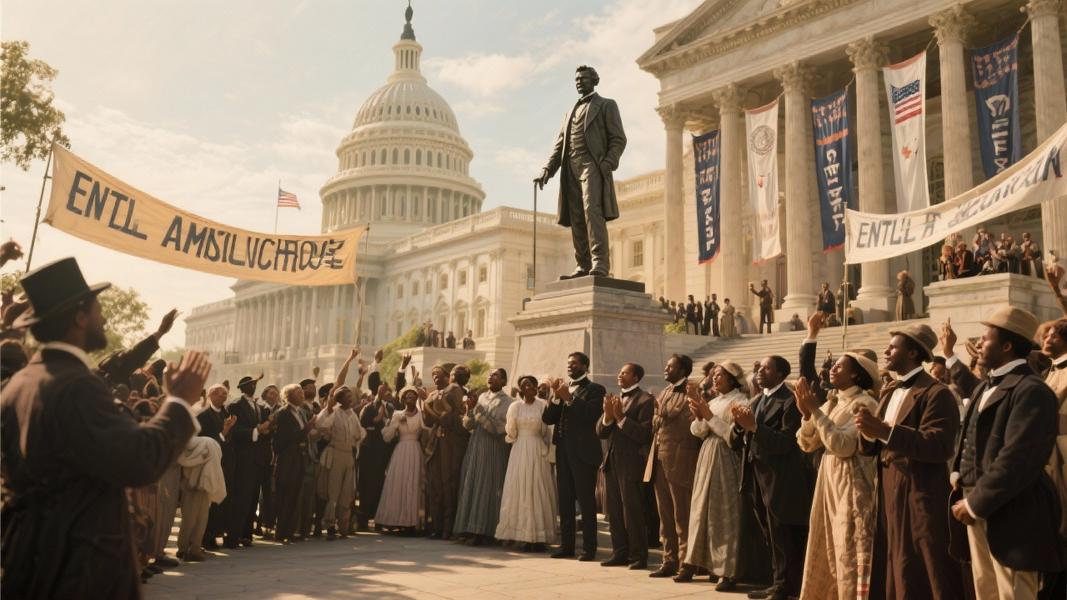
On December 6, 1865, America finally delivered on a long-overdue promise. Georgia became the 27th state to ratify the 13th Amendment to the Constitution, crossing the three-fourths threshold required for adoption and legally abolishing slavery throughout the United States. The moment marked the culmination of a brutal civil war and decades of moral struggle that had torn the nation apart.
The amendment’s straightforward yet profound language — “Neither slavery nor involuntary servitude, except as a punishment for crime whereof the party shall have been duly convicted, shall exist within the United States, or any place subject to their jurisdiction” — permanently altered the country’s legal foundation, though its journey to ratification had been anything but simple. The House of Representatives initially failed to pass the amendment in June 1864, before finally approving it on January 31, 1865.
Presidential Intervention
President Abraham Lincoln, fresh off his re-election victory in November 1864, had thrown his political weight behind the amendment, personally lobbying for its passage. In an unusual move, Lincoln even signed the amendment before its ratification by the states, despite no constitutional requirement to do so. “Following his re-election in November 1864, Lincoln threw his weight behind the amendment. He persuaded eight House Democrats to switch their votes,” historical records from the Gilder Lehrman Institute indicate, making it “the only constitutional amendment to be later ratified that was signed by a president.”
What many Americans don’t realize is that while Georgia’s ratification on December 6th fulfilled the constitutional requirement, Secretary of State William Seward didn’t officially certify the amendment until December 18, 1865. The National Archives confirms that “on December 6, 1865, slavery throughout the United States became illegal when Georgia ratified the 13th Amendment to the Constitution.” Twelve days later, Seward issued a formal proclamation declaring the amendment adopted.
Beyond the Milestone
The path to full ratification didn’t end with Georgia. Iowa became the 31st state to ratify the amendment on January 15, 1866, with other states following suit in subsequent years. According to the National Museum of African American History and Culture, “On December 6, 1865, nearly twelve months after President Lincoln had ceremoniously signed the document, Georgia became the 27th state to ratify the 13th Amendment. The three-quarters of the states needed to make the amendment law had finally been reached.”
Was this the definitive end of slavery in America? Not entirely. The amendment contained a critical exception clause — “except as a punishment for crime whereof the party shall have been duly convicted” — that would later enable systems of convict leasing and forced prison labor that disproportionately affected Black Americans. Research shows that while the 13th Amendment “brought a final and definitive end to slavery in the United States,” it “did not by itself confer civil rights on former slaves.”
The U.S. National Archives and Records Administration has preserved the original document, noting its immense historical importance as the first of three Civil War amendments that would fundamentally reshape American society. The 13th Amendment stands as “the first alteration to the Constitution since 1804,” according to NARA documents.
In the end, the 13th Amendment represents both an extraordinary achievement and an incomplete promise. Its ratification closed one dark chapter in American history while simultaneously opening new struggles for equality and justice that continue to this day — a constitutional milestone whose true meaning the nation is still working to fulfill.
