
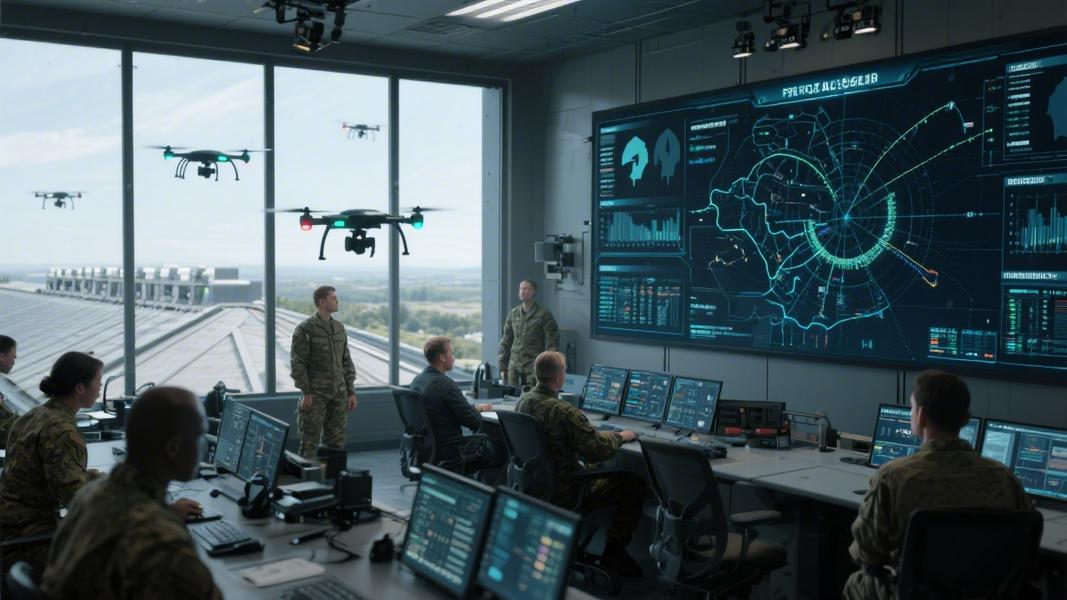
The U.S. military has a drone problem — and for the first time, it’s spelling out exactly how it plans to fix it on home soil.
In a flurry of policy updates, training exercises, and newly published guides stretching from late 2025 into early 2026, Joint Interagency Task Force 401 has quietly been reshaping how the Pentagon approaches counter-unmanned aerial systems, or C-UAS, defense across domestic military installations and critical infrastructure. The scope is broader than most people realize — and the urgency, officials say, is real.
“Countering drones is not just a battlefield problem — it’s a homeland defense imperative,” said Brig. Gen. Matt Ross, director of JIATF-401, whose task force has become the central engine behind Washington’s domestic drone defense posture.
New Rules, Bigger Reach
The cornerstone of the shift is a policy update signed on December 8, 2025, by Secretary of War Pete Hegseth — a directive that fundamentally expands the protective authority of installation commanders. Gone is the old fence-line limitation that required a drone to physically breach a perimeter before action could be taken. documented widely among defense observers, the new framework allows commanders to assess threats based on a “totality of circumstances,” meaning a suspicious drone loitering near a base — but not yet over it — can now trigger a defensive response.
“With this new guidance installation commanders are empowered to address threats as they develop,” Ross stated, adding that unauthorized drone flights constitute a surveillance threat “even before they breach an installation perimeter.” That’s a notable legal and operational shift. It essentially reframes the threat calculus entirely — from reactive to preemptive.
Under the updated policy, service secretaries are now authorized to designate covered facilities based on risk assessments, a power delegable down to service chiefs. Installation commanders, meanwhile, are directed to issue local implementing procedures within 60 days. It’s a tight timeline — but the threat environment, officials argue, doesn’t exactly wait around.
Eyes in the Sky — Without Crossing Legal Lines
How do you watch everything without watching everyone? That’s the tension sitting at the center of any domestic surveillance technology rollout, and JIATF-401 appears acutely aware of it.
On March 9, 2026, the task force published a detailed guide titled Counter-UAS Operations: Safeguarding Freedoms and Preserving Privacy — a title that seems almost deliberately reassuring. The guide outlines a suite of sensor technologies, including Radar, Electro-Optical/Infrared, and Radio Frequency Detection, and takes pains to explain how each complies with federal surveillance law. The key mechanism: systems analyze signal fingerprints rather than intercepting content, sidestepping wiretapping statutes while still building a detailed picture of drone activity.
The emphasis, Ross explained, is on passive, non-intrusive sensors designed to maintain airspace awareness without interfering with civilian drones. Data minimization — collecting only what’s operationally necessary — is baked into the framework. “This guide is part of our commitment to transparency, ensuring that as we deploy these critical technologies, we do so in a way that is responsible, respects privacy, and maintains public trust,” he said. Civil liberties advocates will likely scrutinize that claim. But the operational logic, at least, is coherent.
Hardening the Ground Beneath the Sky
Still, technology alone isn’t the answer — and JIATF-401 is refreshingly blunt about that. A separate guide focused on the physical protection of critical infrastructure leans heavily on low-tech, immediately actionable measures. Think overhead netting, tensioned cables, hardened roofs, layered perimeters, and good old-fashioned patrol routes designed to locate ground control stations.
The framework organizing these measures is called “Harden, Obscure, Perimeter” — a deliberately accessible structure aimed not just at military bases but at civilian venues like stadiums and major public gatherings. The 2026 FIFA World Cup, hosted partly in the United States, is cited as exactly the kind of high-profile event these measures are designed to protect. “Countering the drone threat is about more than exquisite systems,” the guide notes plainly. “You can take steps now to prepare and protect critical infrastructure.” It’s the kind of sentence a general writes when they’re tired of waiting for the perfect solution.
Training People, Not Just Machines
None of this works without the humans behind it. In a notable field exercise, JIATF-401 supported Joint Task Force – National Capital Region in a C-UAS threat simulation that tested eleven sensor systems and three mitigation devices across dozens of simulated small UAS incidents — conducted both day and night. The exercise was as much about coordination as it was about capability.
“This training is about more than just technology; it’s about people and partnerships,” said Col. Brian Reynolds, provost marshal of JTF-NCR, in remarks released after the exercise. That sentiment is more than boilerplate. The interagency dimension of JIATF-401’s mission is growing rapidly. Under provisions of the FY2026 National Defense Authorization Act, the task force is now authorized to share UAS activity data with both DHS and DOJ, and can bring in certified contractors to support C-UAS operations — a significant expansion of the civilian-military interface.
On the education side, JIATF-401 and the Joint Counter-Small UAS University have developed three specialized courses — tailored for operators, planners, and force protectors — updated regularly to reflect current tactics, techniques, and procedures. In a domain evolving as fast as drone warfare, a course that’s six months out of date might as well be ancient history.
The Bigger Picture
What JIATF-401 is building, piece by piece, is a layered domestic defense architecture — one that blends sensors, physical hardening, legal guardrails, interagency coordination, and human training into something resembling a coherent national posture. Whether it’ll be enough depends heavily on how fast the threat evolves. Commercial drone technology is getting cheaper, smarter, and more accessible by the quarter.
That’s the uncomfortable arithmetic underneath all of this policy activity. The Pentagon can expand perimeters, publish guides, and run exercises — but the drone proliferation curve doesn’t care about bureaucratic timelines. What JIATF-401 seems to understand, at least, is that the answer can’t be purely technical. It has to be institutional. It has to be people.
As Brig. Gen. Ross put it, the goal is a framework that is “responsible, respects privacy, and maintains public trust.” Whether those three things can coexist under the pressure of a genuine homeland threat — that’s the question every democracy eventually has to answer for itself.
