
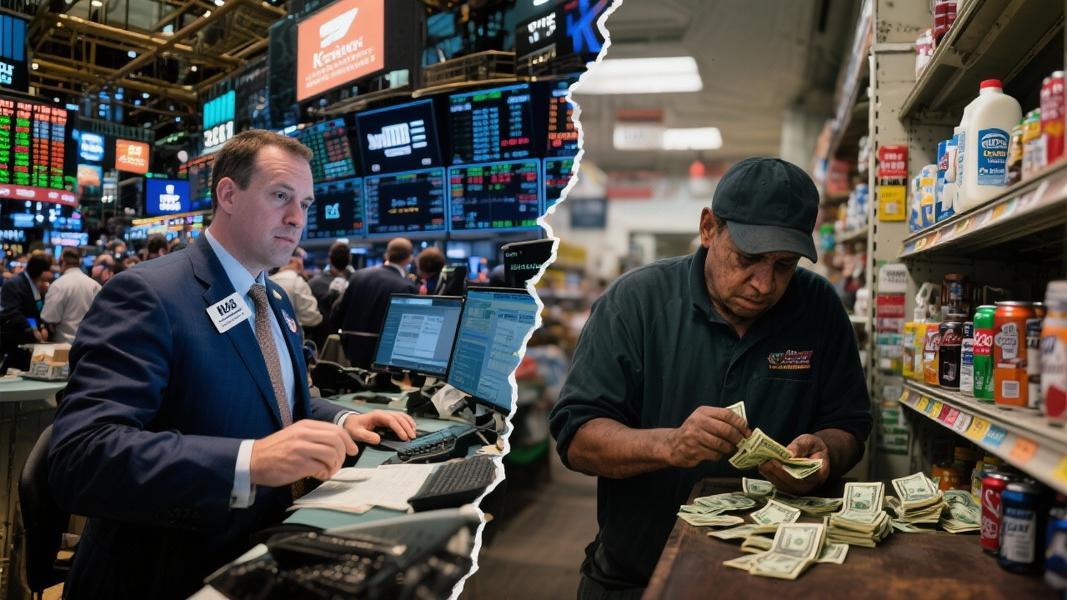
America’s widening wealth gap has a name, and it’s shaped like the letter K. The term “K-shaped economy” has entered the mainstream as economists, corporate executives, and politicians grapple with a stark reality: while some Americans are thriving, others are barely surviving.
The concept, which gained traction during the pandemic, describes divergent financial trajectories — with higher-income Americans seeing their wealth climb upward while lower-income households trend downward. “Simply put, the upper part of the K refers to higher-income Americans seeing their incomes and wealth rise while the bottom part points to lower-income households struggling with weaker income gains and steep prices,” economic experts explain.
From Alphabet Soup to Economic Reality
Remember when economists were debating whether the post-COVID recovery would be V-shaped (quick recovery), U-shaped (gradual rebound), or the dreaded L-shaped (prolonged stagnation)? Peter Atwater, an economic analyst, popularized a different letter entirely after seeing the term on social media — one that better captured America’s uneven economic reality.
That split has only deepened. Recent data shows inflation-adjusted wage growth has weakened as hiring has slowed, with the drop hitting lower-income Americans hardest. Their wage growth has plummeted to an annual rate of just 1.5%, compared to 2.4% for the highest-earning quarter of workers, according to the Minneapolis Fed’s findings.
The spending patterns tell the same story. Bank of America’s credit and debit card data revealed that higher-income households increased their spending by 2.7% in October compared to a year earlier, while lower-income groups managed just 0.7% growth.
Corporate America’s Two-Pronged Strategy
How are companies responding? By catering to both ends of the economic spectrum.
Take Coca-Cola, for instance. Chief Operating Officer Henrique Braun acknowledged the company is pursuing both “affordability” and “premiumization” simultaneously. While pushing high-end products like Smartwater and Fairlife filtered milk to affluent consumers, they’re also introducing mini cans for budget-conscious shoppers.
The travel industry shows similar trends. Delta Air Lines CEO Ed Bastian noted that first- and business-class tickets have been fueling the airline’s revenue and profit, even as lower-end consumers are “clearly struggling.”
Best Buy CEO Corie Barry put it bluntly when she stated that the top 40% of all U.S. consumers are driving two-thirds of all consumption. The remaining 60%? They’re hunting for deals and increasingly dependent on a stable job market.
The AI and Stock Market Factor
Another dimension of the K-shaped economy comes from the massive investment in artificial intelligence and data centers. This technological boom has sent stock prices soaring for the “Magnificent 7” tech companies competing in the AI space. The problem? These investments aren’t creating many jobs or lifting incomes for Americans who don’t own stocks.
And who owns stocks? The distribution is dramatically uneven. The wealthiest 10% of Americans own approximately 87% of the stock market, according to Federal Reserve data. Meanwhile, the poorest 50% own just 1.1%.
This concentration of wealth creates a troubling feedback loop. Those already wealthy benefit from stock market gains, while those without investments fall further behind.
A Sustainable Path Forward?
Many economists are raising red flags about the long-term viability of an economy propelled primarily by the wealthy. Economic experts warn that if layoffs worsen and unemployment rises, middle- and lower-income Americans could dramatically reduce spending, triggering a broader economic downturn.
That scenario would eventually impact even the companies currently thriving. Revenue for tech giants like Apple and Amazon would fall. Advertising revenue — the lifeblood of Google and Facebook parent Meta — typically plunges during economic downturns.
The K-shaped economy might seem like just another economic buzzword, but for millions of Americans, it’s the daily reality of watching others prosper while they struggle to keep up with rising costs. And that divergence, if left unchecked, may ultimately prove unsustainable for everyone — regardless of which direction their part of the K is pointing.
