
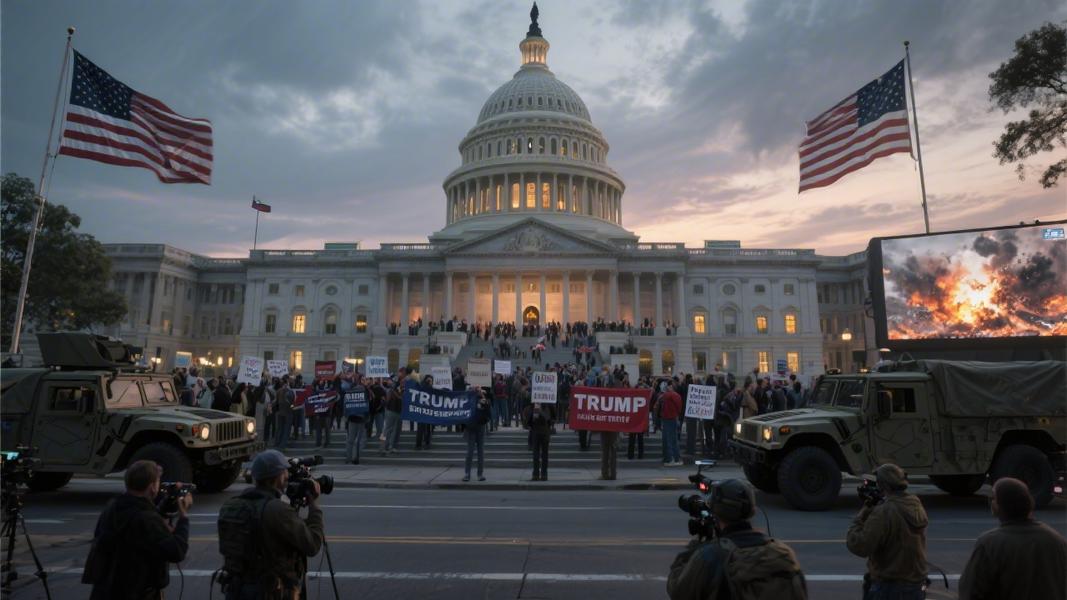
The bombs were already falling before Congress had a chance to ask whether they should be. That’s where things stand as the United States finds itself in the opening days of what may be the most consequential military operation in a generation.
Operation Epic Fury — the U.S.-led air campaign against Iran — began at 1:15 a.m. ET on February 28, 2026, striking more than 1,000 Iranian targets in the first 24 hours alone. Tomahawk cruise missiles, B-2 stealth bombers, attack drones, and a new class of one-way strike systems called LUCAS drones were all part of the opening salvo. By the time the sun came up over Tehran, Iranian Supreme Leader Ali Khamenei and a number of senior Iranian officials were dead. The operation was described by military officials as historic in scope and ambition.
A War Already Underway
Back in Washington, lawmakers are scrambling to catch up. Congress is now preparing to formally debate President Trump’s war powers — but the debate feels a little like closing the barn door after the horses have bolted, and the barn is on fire. As one constitutional framing that’s been circulating on Capitol Hill puts it, noted observers have warned: “The Constitution is intended to prevent the accumulation of power in any one branch of government — and in any one person in government.” Whether that principle holds in practice, in wartime, with this president, is another question entirely.
The operation wasn’t unilateral. It’s a joint effort with Israel, which launched its own parallel campaign under the codename Operation Roaring Lion. Together, U.S. and Israeli forces targeted key military commanders, nuclear infrastructure — including the Natanz nuclear site — and struck into Tehran’s Pasteur district, the heart of the regime’s administrative power. The stated goal, as documented in emerging accounts of the operation’s planning, was nothing short of regime change.
The Weapons Being Used
How exactly do you hit over a thousand targets in a single day? With a lot of hardware and years of contingency planning. CENTCOM’s Task Force Scorpion Strike coordinated fighters, guided-missile destroyers launching Tomahawks, and what military officials are calling “special capabilities” — a phrase that tends to mean exactly what you think it does. Perhaps most notably, the operation marked the first-ever combat deployment of one-way attack drones, with officials stating plainly: “CENTCOM’s Task Force Scorpion Strike — for the first time in history — is using one-way attack drones in combat during Operation Epic Fury.”
That’s not a small footnote. It signals a shift in how the U.S. military intends to fight future wars — fast, overwhelming, and with technology that doesn’t come home.
American Lives Already Lost
Still, wars have a way of reminding everyone what they actually cost. At least three U.S. service members were killed in the opening phase of the operation. By March 2, 2026, a fourth had died. The Pentagon held a press conference — Defense Secretary Pete Hegseth and acting Joint Chiefs Chairman Dan Caine at the podium — where the mission was framed in stark, almost binary terms. The objective, officials explained, was direct: “Destroy Iranian missiles, destroy Iranian missile production, destroy their navy and other security infrastructure and they will never have nuclear weapons.”
No hedging. No diplomatic softening. Just a statement of intent that would have seemed extraordinary even six months ago.
Iran Strikes Back
And Iran hasn’t sat still. Following the opening U.S. and Israeli strikes — which included explicit calls for the Iranian government to be overthrown — Tehran launched retaliatory strikes on Tel Aviv. The full scale of those counterattacks is still being assessed, but the message from Iran was clear enough. This isn’t a one-night operation that ends with a press release and a carrier group sailing home. It’s a conflict, and it’s escalating.
CENTCOM’s own framing of the mission, as captured in video briefings released since the strikes began, leaves little ambiguity about the scope: “CENTCOM forces are striking targets to dismantle the Iranian regime’s security apparatus, prioritizing locations that pose an imminent threat.” Dismantling a regime’s security apparatus is, to put it plainly, a war aim — not a defensive posture.
What Comes Next
That’s the question no one in Washington seems fully prepared to answer. The constitutional debate over war powers will play out in committee rooms and on cable news, but the operational reality is already moving faster than the political process can follow. Congress can debate authorization. It can hold hearings. It can issue strongly worded letters. Meanwhile, B-2s are flying over Persian airspace and the body count is rising on multiple sides.
President Trump ordered the strikes on a Friday afternoon — a timing that, intentionally or not, gave the operation a full weekend head start before the full weight of congressional scrutiny could land. Whether that matters legally is something lawyers will argue over for years. Whether it matters strategically depends on what the next 72 hours look like in Tehran, Tel Aviv, and the Strait of Hormuz.
What’s already clear is that the United States has crossed a threshold it hasn’t approached in decades — a direct, sustained military campaign aimed at eliminating an adversary’s leadership and dismantling its government. The architects of that decision are betting it works quickly and decisively. History, unfortunately, has a long record of what happens when that bet doesn’t pay off.
