
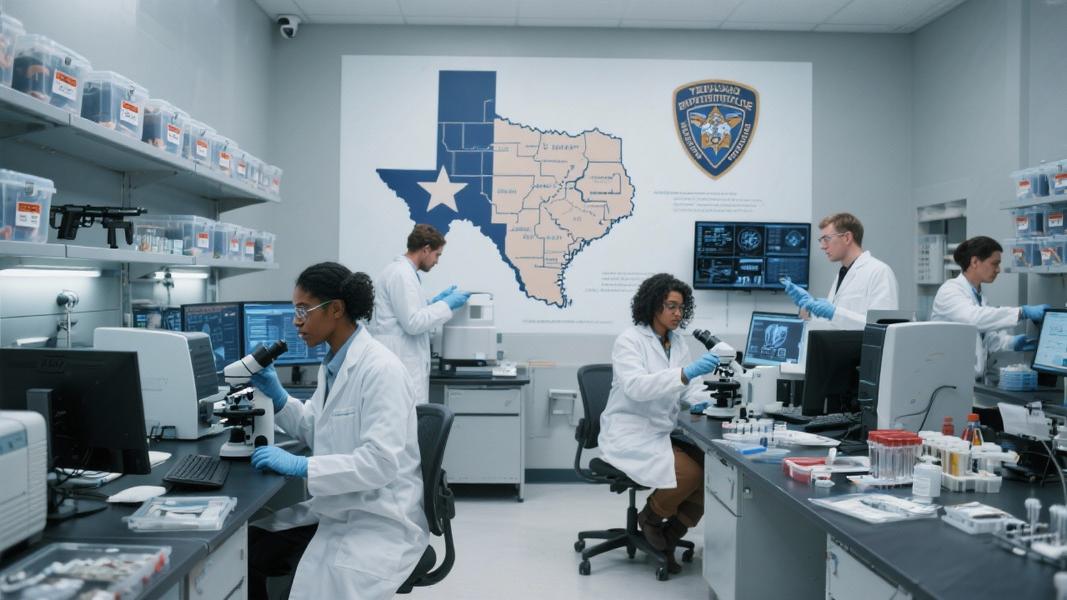
From a modest one-chemist operation in 1937 to a sprawling network of 16 laboratories and over 700 personnel today, the Texas Department of Public Safety’s Crime Laboratory Division has evolved into a forensic powerhouse that’s reshaping criminal investigations across the Lone Star State.
The division, celebrating its achievements during National Forensic Science Week, processed an astounding 115,472 requests for forensic testing in the past year alone while adding over 117,000 DNA samples to national databases, according to information released by DPS officials.
Modernizing Texas Forensics
“The men and women of the Crime Laboratory Division work tirelessly behind the scenes to provide answers, support justice and ultimately protect and serve the people of Texas every day,” said Crime Laboratory Chief Brady Mills. “Their work is vital to the operations of law enforcement agencies across this state, and we are proud to be able to assist our partners in this way.”
What began at Camp Mabry in Austin has transformed into a comprehensive forensic system spanning disciplines from trace evidence analysis to cutting-edge DNA technology. The labs now offer specialized services including digital evidence examination, firearms and toolmarks analysis, friction ridge identification, document examination, and toxicology – all strategically positioned throughout Texas for maximum accessibility.
Recent legislative changes have dramatically expanded the lab’s capabilities. House Bill 3956, which took effect September 2023, now requires DNA collection from all felony arrestees – a change that has already generated 1,726 additional hits in the Combined DNA Index System (CODIS). Meanwhile, a $15 million allocation has helped slash the toxicology backlog by nearly 7,375 cases, according to DPS.
Rapid DNA and Sexual Assault Kit Tracking
Perhaps most revolutionary is Senate Bill 1723’s establishment of a Rapid DNA Pilot Program, which has slashed processing times from 72 hours to as little as 90 minutes at booking stations. This technological leap allows investigators to identify suspects and eliminate innocent persons from inquiries at unprecedented speeds.
The division has also made significant headway addressing previously untested sexual assault evidence. Since March 2022, technicians have completed testing on 1,432 previously untested sexual assault kits that had been stored in property rooms across the state. Their Sexual Assault Evidence Tracking program now monitors over 61,500 kits statewide, with 10,644 collected in 2025 alone.
“Every day our crime labs across the state are doing extraordinary work,” said DPS Director Steven McCraw. “Without the expertise and commitment of these men and women, we would not be able to protect and preserve public safety in Texas. We owe a tremendous amount of gratitude to these individuals who work tirelessly behind the scenes,” he stated.
Beyond the Lab: Emergency Response
The division’s work extends beyond routine analysis. In July 2025, Crime Laboratory personnel deployed to Kerr County to assist Texas Rangers with victim identification following catastrophic floods. Using fingerprint analysis and coordinated laboratory work, they provided crucial answers to families affected by the disaster.
Beyond forensic casework, the division oversees Texas’s breath alcohol testing program, which certified 930 new breath test operators through 63 schools last year. The Breath Alcohol Laboratory and Office of the Scientific Director maintain what officials describe as “a statewide judicially acceptable forensic breath alcohol test program” that serves both DPS and external programs.
Opening Doors to the Public
Curious about forensic science beyond what shows like CSI portray? The labs are opening their doors during National Forensic Science Week with free public tours across multiple Texas regions from September 16-19.
At the Abilene Crime Lab’s recent open house, Sgt. March Couch emphasized the educational value of these tours. “This is just a great opportunity for these students who maybe have an interest in forensics and science,” Couch told local media. “This lab is mostly a drug lab where we’re analyzing narcotics and different things that are illegal substances.”
The tours aim to show the scientific reality behind forensic work, which often differs substantially from its dramatized television counterparts. They also highlight career opportunities in this growing field that bridges science and criminal justice.
From its humble beginnings almost 90 years ago to today’s sophisticated network, the transformation of Texas’s Crime Laboratory Division reflects the ever-increasing importance of forensic science in solving crimes, exonerating the innocent, and bringing closure to victims’ families – one scientific analysis at a time.
