
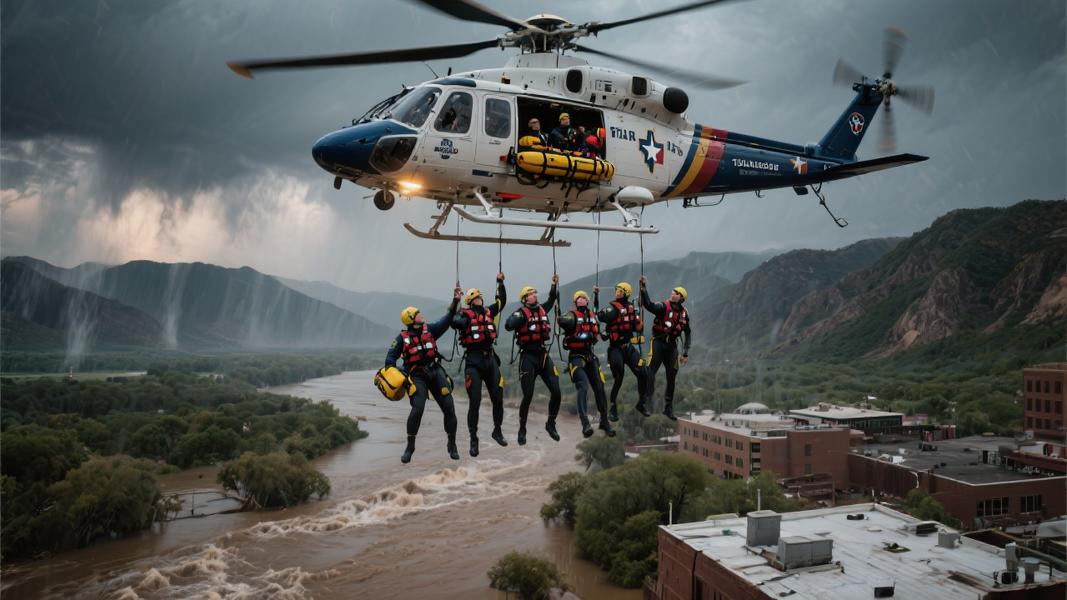
Texas Department of Public Safety recognized its elite six-member Rescue Swimmer Unit on National Aviation Day, showcasing a specialized team that’s become increasingly vital as the state faces extreme weather events and challenging rescues across diverse terrain.
The unit, strategically positioned across six locations in Texas — Austin, Dallas, Houston, San Antonio, Alpine, and Edinburg — recently transitioned from the Texas Highway Patrol to the Aircraft Operations Division (AOD) in summer 2024, a move designed to enhance emergency response capabilities throughout the state. The change comes as Texas continues to face increasingly unpredictable weather patterns and natural disasters, from hurricanes along the coast to flash flooding in the Hill Country.
Elite rescuers stationed across the Lone Star State
“Texas is home to some of the most challenging terrain and unpredictable weather in the nation,” said DPS Aircraft Operations Division Chief Pilot Stacy Holland in a statement. “Our Rescue Swimmer Unit ensures we can reach people in distress no matter the conditions and bring them to safety.”
These aren’t your average first responders. Each member of the unit is assigned to specific hoist-equipped aircraft, enabling rapid deployment during emergencies. They maintain their edge through monthly team training in diverse environments — from open water rescues to mountainous terrain extractions, urban settings, and swift-moving waters — environments that reflect the varied landscapes across Texas’s 268,000 square miles.
Already in 2024 and 2025, the team has demonstrated its critical importance. They’ve executed numerous high-risk missions, including lifesaving hoist rescues during Hurricanes Beryl and Milton, recovery of stranded hikers in rugged terrain, and emergency responses during devastating floods.
“In response to the tragic floods that recently impacted parts of Texas, including Kerr County, their swift and skilled efforts were crucial in rescuing those stranded and in danger,” Holland noted regarding one of their most recent operations.
An aerial force with impressive reach
The specialized unit is just one component of what has become one of the nation’s largest airborne law enforcement operations. The DPS Aircraft Operations Division maintains 13 duty stations across Texas, operates 27 advanced aircraft, and employs more than 100 personnel — including 50 police pilots and 35 Tactical Flight Officers.
What’s in their impressive fleet? The division operates 15 Airbus A-Stars (nine equipped with hoist capabilities), one Airbus EC145 C2, one Bell 412, two Pilatus PC-12NGs, four Cessna Caravans, two Cessna 206s, and one Beechcraft King Air 350. This diverse array of aircraft allows the team to respond to virtually any scenario across Texas’s vast and varied landscape.
Beyond manned aircraft, the division has embraced modern technology. AOD oversees licensing, training, and regulation of all 350 UAS Remote Pilots in Command and manages over 350 unmanned aerial systems — drones that play crucial roles in border security, traffic accident reconstruction, crime scene investigations, and other specialized missions.
Training for the worst, hoping for the best
The unit doesn’t operate in isolation. Earlier this year, the 2025 Search and Rescue Exercise (SAREX) in Houston brought together the Texas Army National Guard and multiple agencies including DPS, focusing intensively on hurricane response preparedness.
“I’m extremely impressed with how our soldiers performed throughout the exercise with over 150 hoists and 82 flight hours in total,” said Chief Warrant Officer 5 Rick Dillenbeck, command chief of the 36th Combat Aviation Brigade, TXARNG, who participated in the multi-agency drill.
Such collaboration has become increasingly important as Texas faces more frequent severe weather events. The Rescue Swimmer Unit’s integration with aircraft operations represents a strategic evolution in how the state approaches emergency response.
As climate patterns continue to shift and Texas’s population grows, particularly in flood-prone areas, the specialized skills of these six rescue swimmers — suspended from helicopters above raging floodwaters or lowered into remote canyons — may prove to be the difference between life and death for Texans caught in nature’s fury.
