
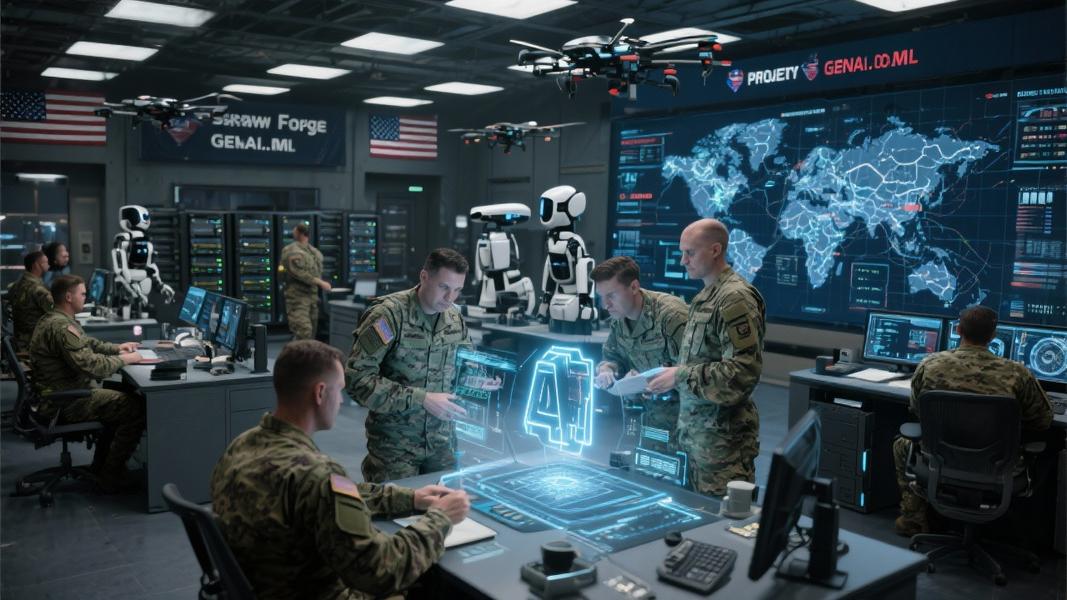
In a decisive push to maintain military supremacy, the Department of War unveiled its comprehensive AI Acceleration Strategy Tuesday, establishing a roadmap to transform America’s fighting force into an “AI-first” powerhouse across all combat domains.
The January 12 initiative, mandated by President Trump, aims to position the United States as the world’s leading AI-enabled military through aggressive implementation timelines and streamlined bureaucracy. “We will unleash experimentation, eliminate bureaucratic barriers, focus our investments and demonstrate the execution approach needed to ensure we lead in military AI,” said Secretary of War Pete Hegseth in the strategy document. “We will become an ‘AI-first’ warfighting force across all domains.”
Three-Pronged Approach to Military AI Dominance
The strategy rests on three fundamental tenets: warfighting, intelligence, and enterprise operations. It’s designed to support over three million Department personnel through seven Pace-Setting Projects (PSPs), each with a single accountable leader driving toward ambitious deadlines, according to defense industry analysts.
At the heart of this transformation is GenAI.mil, a platform providing department-wide access to frontier generative AI models, including Google’s Gemini for Government. The system is available to DoW personnel at Impact Level 5 and above, aligning with the White House’s broader AI Action Plan, as outlined by the Council on Foreign Relations.
“Speed defines victory in the AI era, and the War Department will match the velocity of America’s AI industry,” said Emil Michael, Under Secretary of War for Research and Engineering, in a department release. “We’re pulling in the best talent, the most cutting‑edge technology, and embedding the top frontier AI models into the workforce — all at a rapid wartime pace.”
Practical Applications Already Emerging
What does this mean on the ground? The Army has already begun leveraging platforms like Project Maven for AI/ML in intelligence, surveillance, and reconnaissance, while also implementing Advana for enterprise data analytics. These developments come as China continues to advance its own “intelligentized” warfare capabilities with aggressive AI integration, the Association of the United States Army warns.
GenAI.mil enables rapid drafting of battle plans, intelligence analysis, and mission briefings, according to a DefenseScoop examination of the platform. The system is reportedly evolving as a secure platform that will eventually extend AI capabilities to the tactical edge.
The strategy represents a significant shift in how the Department approaches technology adoption. Gone are the days of multi-year procurement cycles for military technology. Instead, the DoW is embracing modular AI approaches that can be rapidly deployed and updated, as detailed in supporting documentation.
Industry Convergence at Defense IT Summit
The military’s AI push will take center stage at the upcoming 2026 Defense IT Summit on February 26 in Arlington, Virginia. The gathering will focus on AI priorities for DoW mission readiness, including accelerating AI integration into warfighting systems, according to event organizers.
But challenges remain. While the strategy lays out ambitious goals, questions persist about training requirements, ethical guidelines, and the pace at which frontline units can meaningfully adopt these technologies. The Department faces the delicate balance of moving quickly while ensuring AI systems are reliable enough for combat situations where lives are at stake.
As America’s military establishment races to harness AI’s potential, the world is watching closely. The strategy makes one thing abundantly clear: in the DoW’s vision of future warfare, artificial intelligence isn’t just another tool in the arsenal—it’s becoming the foundation upon which all other capabilities will rest.
