
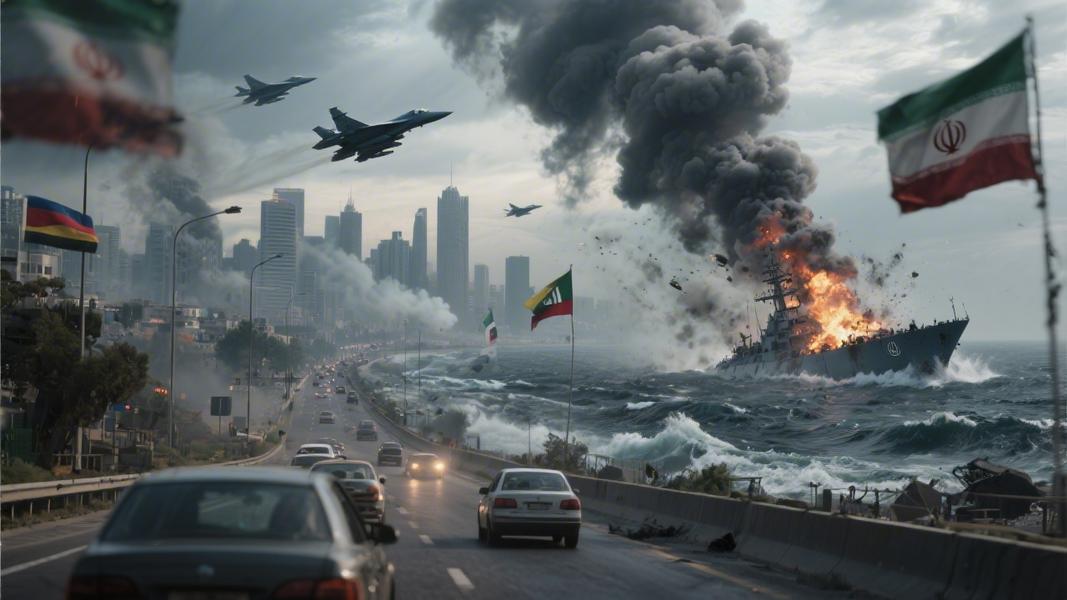
Iran struck back hard on Thursday — and it didn’t stop at Israel. In a sweeping escalation that rattled capitals from Beirut to Baku, Tehran launched coordinated attacks against Israeli positions, American military bases, and targets scattered across the broader region, deepening what is already shaping up to be one of the most consequential conflicts of the 21st century.
The March 5, 2026 offensive came just days after U.S. and Israeli forces launched Operation Epic Fury — a massive joint strike campaign that, by Washington’s own account, killed Supreme Leader Ayatollah Ali Khamenei and decimated Iran’s military infrastructure. The war, which has now touched 14 countries and claimed more than 1,300 lives, shows no signs of cooling. If anything, Thursday made clear it’s getting hotter.
A Warship Sunk, Sailors Dead, and a Warning
The flashpoint that appeared to trigger Thursday’s barrage was the sinking of the IRIS Dena, an Iranian frigate sent to the bottom of the Indian Ocean by a U.S. submarine on March 4. At least 87 Iranian sailors were killed. Defense Secretary Pete Hegseth confirmed the strike without apparent hesitation — a blunt acknowledgment that the U.S. is now in open naval warfare with Iran.
Iranian Foreign Minister Abbas Araghchi was furious. “Mark my words: The U.S. will come to bitterly regret (the) precedent it has set,” he warned, in remarks that carried the weight of someone who knows his country’s options are narrowing fast. Whether Tehran can actually make good on that threat is another question entirely — but the anger is real, and it’s driving decisions.
Iran’s Revolutionary Guard went even further, threatening the “complete destruction of the region’s military and economic infrastructure.” That’s the kind of language that makes diplomats sweat and markets shudder.
What ‘Operation Epic Fury’ Actually Did
Back up four days. On March 1, the U.S. and Israel launched what President Donald Trump called “one of the largest, most complex, most overwhelming military offensives the world has ever seen.” Hundreds of targets were hit — Revolutionary Guard facilities, naval assets, missile production sites, and, fatally for the Iranian state, the office of the Supreme Leader himself. “Over the past 36 hours, the United States and its partners have launched Operation Epic Fury,” Trump announced, with the cadence of a man who’d clearly been rehearsing the line.
The objectives, as laid out by the administration, are sweeping — almost breathtakingly so. Trump spelled them out himself: “First though, number one, destroy the regime’s deadly ballistic missiles and completely raise their missile industry to the ground. Number two, annihilate the Iranian regime’s navy. And so far, we have destroyed more than 20 Iranian ships.” That’s not a limited strike. That’s a dismantlement campaign.
The broader goal, Trump has said, is to “ensure that the Iranian regime cannot continue to arm, fund and direct terrorist armies outside of their borders.” In other words — regime change, or something close enough that the distinction barely matters. He’s cited Iran’s decades of hostage-taking, proxy wars, brutal suppression of domestic protesters, and its relentless pursuit of nuclear weapons as justification. “The lives of courageous American heroes may be lost and we may have casualties,” he acknowledged. “That often happens in war.”
Allies, Casualties, and a Conflict That Won’t Stay Contained
How bad is it, really? Consider this: the war has now directly impacted 14 countries — Lebanon, Syria, Qatar, Bahrain, the UAE, Jordan, Saudi Arabia, Kuwait, Iraq, Turkey, Cyprus, Oman, Azerbaijan, and even the waters off Sri Lanka’s coast. That’s not a regional skirmish. That’s a regional war, full stop.
American blood has already been spilled. Six U.S. soldiers were killed in a devastating attack in Kuwait, and their names have now been released — among them Major Jeffrey O’Brien and Chief Warrant Officer 3 Robert Marzan. They join a growing list of American servicemembers who didn’t come home from a conflict that, just weeks ago, many still hoped could be avoided.
The overall death toll paints a grim picture: more than 1,230 killed in Iran, over 70 in Lebanon, and roughly a dozen in Israel. Those numbers will almost certainly rise. They always do.
Still, Israel’s Prime Minister Benjamin Netanyahu is framing this as a moment of historic necessity. For “47 years, the Ayatollah regime has called out ‘Death to Israel’ and ‘Death to America,'” he said, using the strikes as an opportunity to call on ordinary Iranians to rise up and “overthrow tyranny.” Whether that message lands inside Iran — or simply inflames more nationalism — remains to be seen.
What Comes Next
That’s the question nobody can answer cleanly right now. The U.S. has set out an ambitious and extraordinarily aggressive set of war aims. Iran, its navy battered and its supreme leader dead, is still fighting — and Thursday’s attacks proved it hasn’t been broken. The Revolutionary Guard’s threat of regional infrastructure destruction isn’t idle posturing from a position of strength, but it’s not nothing, either. Desperate actors do desperate things.
What’s clear is that the Trump administration made a calculated bet: that overwhelming, rapid force could collapse Iran’s military capacity before the costs — human, political, economic — became unbearable. Whether that bet pays off, or whether the region is about to get a lot darker, is a question that Thursday’s attacks did nothing to resolve.
As one Iranian official’s warning echoed across the wire services, it was hard not to sit with the weight of it — bitterly regret the precedent. Wars have a way of making everyone regret something, eventually. The question is just who gets there first.
