
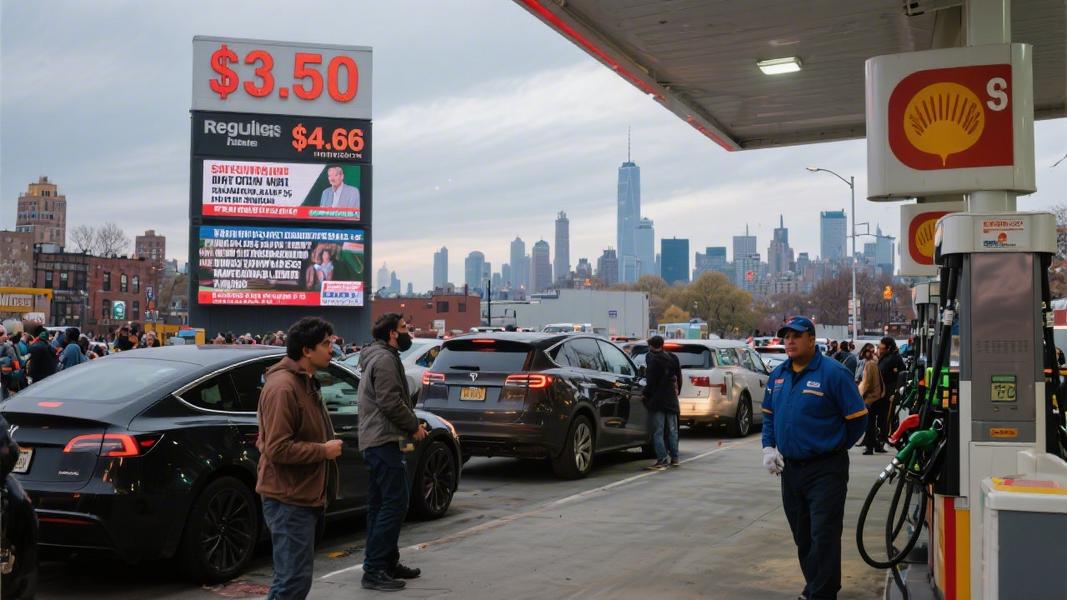
The war in Iran is now hitting Americans at the pump — hard, fast, and with no relief in sight. Oil markets are in near-freefall chaos, gas prices have surged almost overnight, and the world’s most critical energy chokepoint is effectively paralyzed.
Here’s the situation in plain terms: as U.S. and allied military operations against Iran enter their tenth day, the conflict has sent shockwaves through global energy markets that are being felt from trading floors in London to gas stations in Tulsa. Brent crude and West Texas Intermediate both rocketed toward $120 per barrel — levels not seen in years — while the average American driver is now paying nearly $3.48 per gallon for regular gasoline, a jump of close to 50 cents in a single week. Diesel has climbed to $4.66 per gallon, a number that’s going to sting truckers, farmers, and anyone who depends on freight. Which, to be clear, is everyone.
Markets in Freefall, Barrels in Limbo
The opening bell Monday was ugly. Brent crude surged to $119.50 per barrel in early trading before pulling back to around $107.80 — still a staggering figure by any recent standard. West Texas Intermediate told a similar story, hitting $119.48 before settling near $103 per barrel, up more than 13% on the day. That kind of intraday volatility doesn’t happen in a vacuum. It happens when traders genuinely don’t know how bad things are going to get.
And right now, nobody does. The Strait of Hormuz — that narrow ribbon of water through which roughly a fifth of the world’s oil supply flows every single day — is no longer functioning as a reliable passage. Ships carrying millions of barrels are stranded in the Persian Gulf, unwilling or unable to transit safely. Kuwait has already begun reducing production as a precautionary measure. Analysts warn that as many as 4 million additional barrels per day could be effectively shut out of global supply by the end of the week if conditions worsen.
Strikes From Iraq to Tehran
How did we get here so fast? The short answer: the military campaign has been broader and more disruptive than markets initially priced in. Strikes have targeted oil infrastructure stretching from Iraq to Tehran, rattling producers across the region and triggering the kind of supply-shock fears that energy economists have long warned about as a worst-case scenario. Fortune noted that oil prices climbed to nearly $120 per barrel as the Iran war continues — language that, just a few months ago, would have read like a geopolitical thriller plot point.
It’s not just crude. The ripple effects are moving fast through the entire energy supply chain, and CBS News documented the week-over-week jump in pump prices with a level of specificity that makes it hard to dismiss as noise. Fifty cents a gallon in seven days. That’s not a market adjustment. That’s a shock.
Trump: A “Small Price to Pay”
Still, the White House isn’t flinching. President Trump, facing mounting pressure over the economic fallout, pushed back on critics this week with characteristic bluntness — calling $100-per-barrel oil “a small price to pay for safety and peace.” It’s a framing that may play well with some audiences, but it’s a harder sell at a gas station in suburban Ohio when you’re filling up a minivan.
That said, neither side is showing any signs of pulling back. ABC News reported that the conflict is showing no signs of letting up, with escalations continuing and diplomatic off-ramps looking increasingly narrow. Ten days in, and the trajectory is still pointed in one direction.
What Comes Next
The uncomfortable reality is that the markets may not have fully priced in the worst-case scenarios yet. If the Strait of Hormuz remains effectively closed — even partially — the pressure on global supply will compound week by week. Kuwait cutting production is one data point. Four million barrels a day potentially offline is another. At some point, those numbers stop being abstractions and start being recessions.
For now, Americans are watching the conflict unfold on the news at night and feeling it in their wallets every morning. The war is ten days old. The economic consequences are just getting started.
As one analyst put it privately this week: the Strait of Hormuz has always been the world’s most expensive bottleneck — it just never cost this much to find out.
