
Texas is pitching itself as the financial capital of America — and it’s got the numbers to back it up, at least some of them.
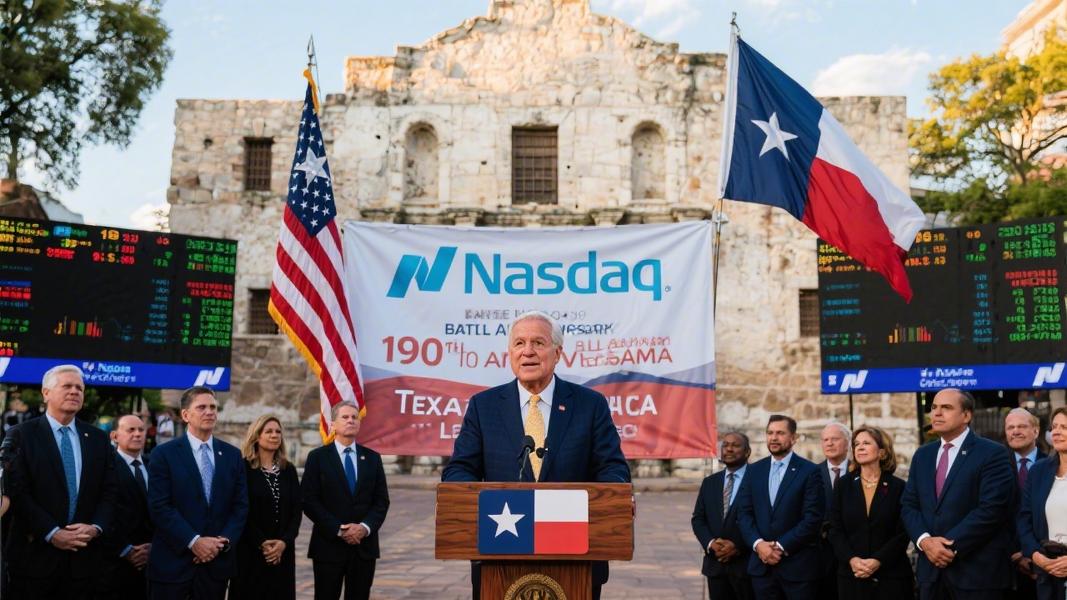
At a virtual Nasdaq closing bell ceremony marking the 190th anniversary of the Battle of the Alamo, Governor Greg Abbott declared that the Lone Star State had reached a new economic milestone, touting Texas as the nation’s leader in financial sector employment, capital investment, and what he called “capitalism itself.” It’s the kind of moment Texas politicians live for — a symbolic flourish tied to real economic momentum. But behind the fanfare, the full picture is more nuanced than a bell-ringing ceremony might suggest.
The Headlines Abbott Wants You to Read
“Texas now ranks number one for having more employees working in the financial sector than any other state in the entire country,” Abbott declared at the ceremony. “Texas will lead the way in protecting capitalism and all that it can achieve in the United States of America.” Strong words. And for a governor who has made economic dominance a cornerstone of his brand, the Nasdaq backdrop was a deliberate choice — a statement as much as a celebration.
The broader jobs picture does support some of that confidence. Texas added 19,700 nonfarm jobs in December 2025, bringing total nonfarm employment to 14,341,000 positions. The civilian labor force hit a record 15,964,000, and annual job growth of 0.9 percent technically outpaced the national average. “Texas added more than 19,000 jobs in December, with growth spread across a majority of major industries,” said Texas Workforce Commission Chairman Joe Esparza. The unemployment rate settled at 4.3 percent.
But 2025 Was a Rough Year — Let’s Be Honest About That
That’s the catch. Zoom out from December’s encouraging snapshot, and 2025 as a whole tells a different story. The Dallas Fed’s Texas Employment Forecast projects jobs will increase 1.1 percent in 2026, adding roughly 154,600 positions to reach 14.4 million by December — but that optimism comes after a year that was, in the Dallas Fed’s own words, essentially flat.
“Texas employment was essentially flat in 2025,” said Luis Torres, Dallas Fed senior business economist. “Higher productivity suppressed labor demand, and slower immigration constrained supply. In addition, employers were more cautious about hiring as a result of high policy uncertainty.” Torres noted job losses across energy, manufacturing, government, information, and professional and business services — sectors that form the spine of the Texas economy. Not exactly a triumphant year.
Still, construction held up. Education and health services grew. Financial activities expanded. And trade and transportation services added jobs. The state wasn’t in freefall — it was recalibrating. Whether that recalibration becomes a launchpad or a plateau is the question 2026 will answer.
What’s Driving the Rebound Forecast
So why the optimism for the year ahead? A few forces are converging. Data centers and artificial intelligence activity are pumping new energy into the Texas economy, particularly around the Dallas-Fort Worth corridor and emerging tech hubs. The Dallas Fed identified these drivers as central to the improved 2026 forecast, alongside what analysts describe as an easing tax environment that’s keeping businesses from looking elsewhere.
Technology-driven finance roles are part of that story too. Automation specialists and ERP integration professionals — the unglamorous but essential backbone of modern financial operations — are expected to see steady growth through the year. It’s not the flashiest sector headline, but it reflects a deeper structural shift: Texas isn’t just attracting companies anymore. It’s building the technical workforce that keeps them running.
A State That’s Getting Easier to Start Something In
Entrepreneurship rankings are adding to the bullish narrative. Texas climbed to the No. 3 spot nationally for starting a new business in 2026 — up from 8th place in 2024 and 4th last year, according to analysts tracking employment growth and entrepreneurship rates. That kind of upward trajectory in business formation rankings tends to attract more of the same: investors, founders, and capital that feeds further job creation. Fort Worth reported the jump as a point of particular local pride, given its own rapid economic expansion.
The Texas Economic Outlook from Texas A&M’s Real Estate Research Center shows the unemployment rate dipping to 4.3 percent in December alongside month-over-month recovery signals and improved business sentiment. Year-over-year growth still trails the national average in some measures — a fact that tends to get glossed over in the more triumphalist readings of the data. But the direction of travel, most economists agree, is upward.
The Bigger Picture
Here’s what makes Texas’ current moment genuinely interesting, beyond the political theater of Nasdaq ceremonies: the state is navigating a transition that most large economies struggle with. The old Texas — oil, ranching, sprawling government contracts — is giving way to something more diversified, more tech-integrated, more financially sophisticated. That shift creates turbulence. It explains the flat 2025. It also explains why the 2026 forecast feels more grounded than cheerleading.
Abbott’s “number one for capitalism” framing is the kind of line that plays well in certain rooms and makes economists wince in others. But strip away the rhetoric, and the underlying story is a state working hard to earn the rankings it’s already claiming.
Whether Texas can hold that No. 1 financial sector title while simultaneously rebuilding momentum in the sectors that lost ground in 2025 — that’s the real test. A closing bell is easy. Keeping the market open is harder.
