
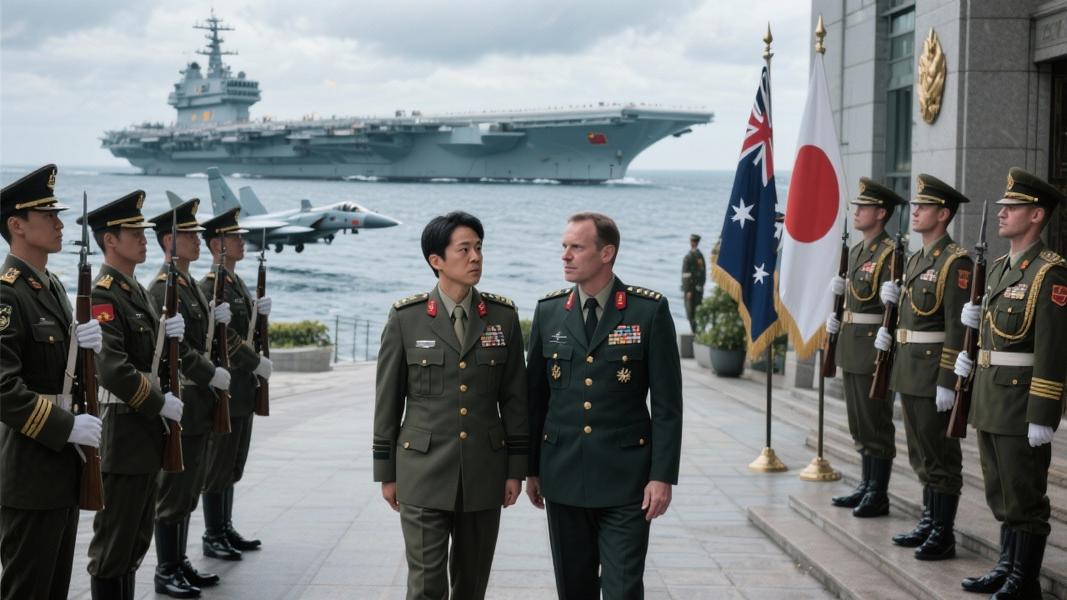
Japan has lodged a formal protest after Chinese fighter jets locked their fire-control radar onto Japanese aircraft near Okinawa, marking a dangerous escalation in military tensions between the two Asian powers.
The incident, which occurred Saturday, involved Chinese J-15 fighter jets launched from the aircraft carrier Liaoning that twice targeted Japanese F-15s with their weapons-targeting systems — once for approximately three minutes in the late afternoon and again for about 30 minutes in the evening. It’s believed to be the first such radar-locking incident between Chinese and Japanese military aircraft.
A “Dangerous Act”
Japanese Defense Minister Shinjiro Koizumi didn’t mince words about the confrontation. “We have lodged a strong protest with the Chinese side and demanded strict preventive measures,” Koizumi said, describing the radar lock as a “dangerous act” that went far beyond what’s necessary for safe aircraft operations.
What exactly happened in the skies near Okinawa? Japanese officials confirmed their F-15 jets were pursuing the Chinese aircraft at a safe distance and took no provocative actions. No Japanese airspace was breached, and no injuries or damage occurred during the encounter.
But the use of fire-control radar — which indicates targeting ahead of a possible missile launch — represents a serious military escalation. Fighter jets typically use radar for search operations or targeting, and locking such systems onto another nation’s aircraft is widely interpreted as a threatening action.
China’s Response
Beijing has pushed back against Japan’s characterization of events. Senior Colonel Wang Xuemeng, a Chinese navy spokesperson, defended the Chinese aircraft’s flight training near Miyako island and instead accused Japanese aircraft of harassment.
“We solemnly asked the Japanese side to immediately stop slandering and smearing, and strictly restrain its frontline actions,” Wang said. “The Chinese Navy will take necessary measures in accordance with the law to resolutely safeguard its own security and legitimate rights and interests.”
The incident comes amid deteriorating relations between Japan and China following Japanese Prime Minister Sanae Takaichi’s remarks in early November suggesting Japan’s military could intervene if China were to take action against Taiwan.
Regional Ripple Effects
Australia has quickly weighed in on the confrontation. Defense Minister Richard Marles expressed “deep concern” over China’s actions while emphasizing the need for safe and professional military interactions.
“We expect those interactions to be safe and professional,” Marles stated. “Australia does not want to see any change to the status quo across the Taiwan Straits… We continue to advocate to China about these issues again, in a very calm, sensible and moderate way.”
The timing is particularly notable. Just a day after the radar incident, Japan and Australia agreed to bolster military ties and lead the region’s multilateral defense cooperation. The two nations plan to form a comprehensive “framework for strategic defense coordination,” signaling deepening security cooperation that extends beyond their alliances with the United States.
Broader Pattern of Tension
This isn’t the only recent maritime confrontation in the region. Separately, the Philippine coast guard reported that Chinese forces fired three flares toward a Philippine fisheries bureau plane patrolling in the South China Sea on Saturday — the same day as the Japan incident.
Chinese forces regularly use flares as warnings to aircraft entering what Beijing claims as its airspace over disputed waters, adding another layer to the complex web of territorial disputes in the region.
The radar-locking incident represents a concerning development in an already tense regional security environment. As nations across the Indo-Pacific strengthen their defense postures and alliances, the risk of miscalculation — or worse — continues to grow in these contested waters.
