
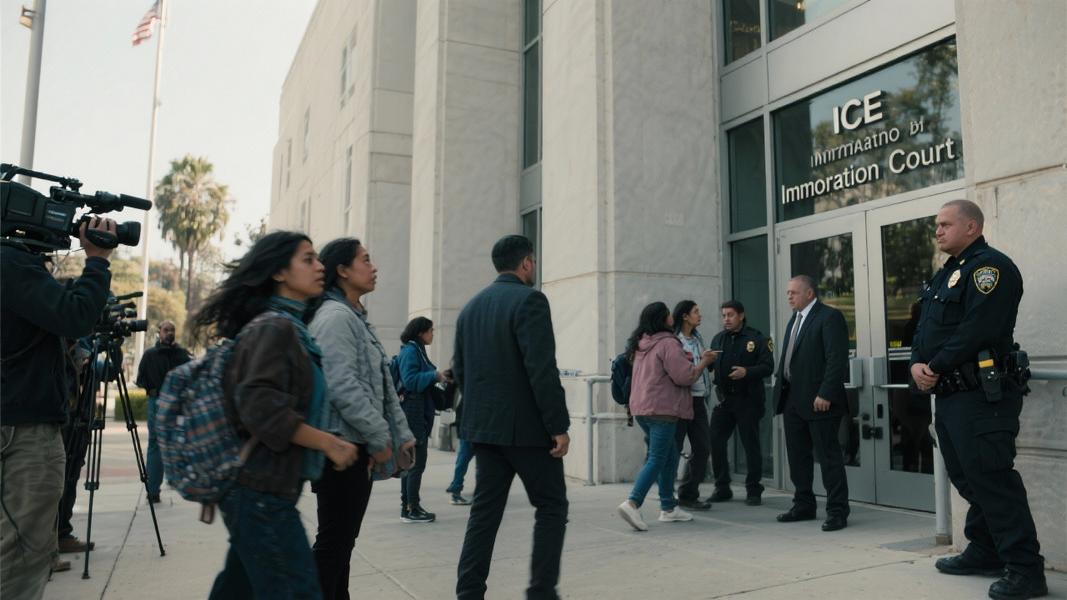
Immigration and Customs Enforcement (ICE) agents can no longer make arrests in Northern California immigration courthouses, at least for now, after a federal judge ruled the practice violates constitutional rights and creates a “chilling effect” on court attendance.
U.S. District Judge P. Casey Pitts issued the unprecedented ruling this week, temporarily halting ICE from conducting arrests at immigration courts across the San Francisco region — including facilities in San Francisco, Concord, Sacramento, Central California, Hawai’i, Guam, and Saipan.
The decision marks the first time a federal court has blocked such courthouse arrests in the jurisdiction of ICE’s San Francisco headquarters. “This circumstance presents noncitizens in removal proceedings with a Hobson’s choice between two irreparable harms,” Pitts wrote in his 38-page ruling, noting that immigrants must either risk arrest by attending their hearings or face automatic deportation by skipping them.
A Departure From Previous Policies
Judge Pitts highlighted how the current enforcement approach represents a significant shift from past practices. Under both the Obama and Biden administrations, policies had been in place that specifically limited courthouse arrests. But since May 2025, ICE has conducted what the judge described as “widespread” arrests at courthouses across Northern California.
These operations have had tangible consequences. According to court documents, the arrests have created a “‘chilling effect on noncitizens’ participation in removal proceedings” and severely limited their ability to contest deportation orders, Pitts stated in his ruling.
Why does this matter? The judge found that such practices likely violate the Fifth Amendment’s due process protections by essentially forcing immigrants to choose between attending their legally mandated hearings and avoiding detention.
Legal Challenge Continues
The temporary halt to courthouse arrests comes as part of the broader case Sequen v. Albarran, which challenges the legality of ICE’s enforcement tactics. In his ruling, Judge Pitts determined that the policy appears to be “arbitrary and capricious” — a legal standard indicating the government failed to provide adequate reasoning for its actions.
“Plaintiffs have established a likelihood that members of the courthouse-arrest class will suffer irreparable harm in the absence of a stay,” Pitts wrote, justifying his decision to issue the preliminary injunction.
The ruling specifically blocks both ICE and the Executive Office for Immigration Review (EOIR) from conducting or facilitating arrests at immigration courts while the full legal challenge proceeds through the system.
Immigration advocates have praised the decision as a critical protection for due process rights. Critics of the practice have long argued that courthouse arrests effectively deny immigrants their day in court — a fundamental principle of the American legal system regardless of immigration status.
For now, at least, immigrants attending court hearings in Northern California can do so without the immediate fear of being detained on the spot. But the battle over ICE’s enforcement tactics is far from over, as the Biden administration must now decide whether to appeal the ruling or adjust its policies to comply with the court’s interpretation of constitutional requirements.
