
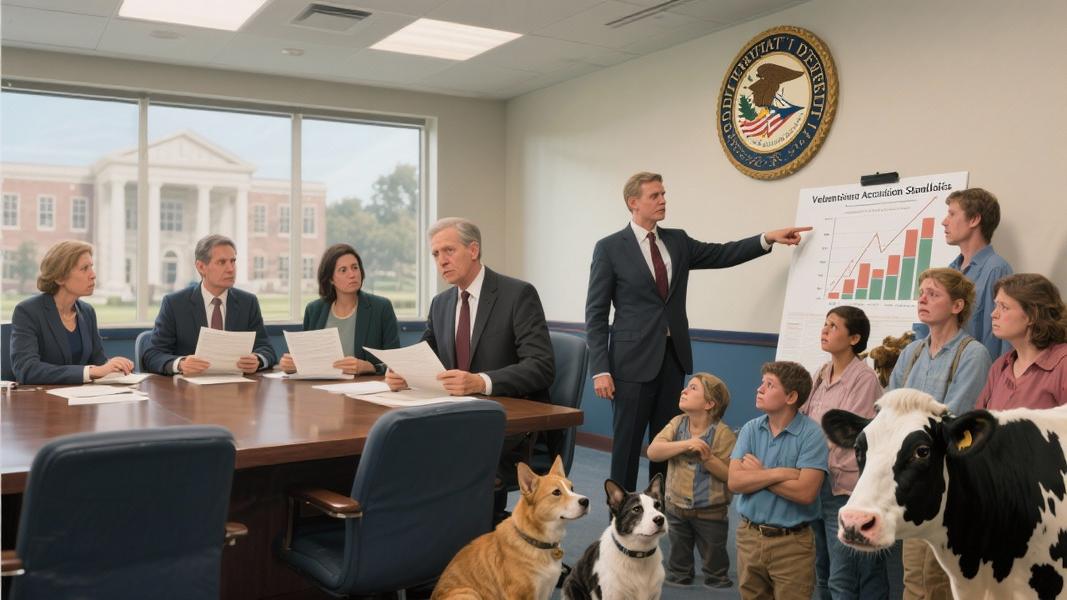
The Justice Department has thrown its weight behind a high-stakes legal battle challenging veterinary education monopolies, filing a statement of interest that could reshape how America trains its animal doctors.
The December 15 intervention supports a private lawsuit against the American Veterinary Medical Association (AVMA), whose accreditation standards are now facing intense antitrust scrutiny. At the heart of the dispute: whether the veterinary establishment has created artificial barriers that limit competition, drive up costs, and worsen nationwide shortages of animal healthcare providers.
“Pets and animals give us so much in life and form the backbone of American food security, but their healthcare needs can add up over time,” said Deputy Assistant Attorney General Dina Kallay of the Justice Department’s Antitrust Division. “The Justice Department is committed to supporting pet owners, livestock farmers, and aspiring veterinarians by ensuring that accreditation standards and procedures do not unnecessarily restrict competition in veterinary education and services.”
Schools Fight Back Against Veterinary Establishment
The government’s move follows a bombshell lawsuit from Lincoln Memorial University (LMU), which claims the AVMA’s Council on Education (COE) imposes unreasonable barriers on new veterinary schools. As the nation’s largest veterinary program, LMU alleges these standards—particularly requirements for costly research infrastructure—artificially restrict the pipeline of new veterinarians during a critical shortage.
It’s not the only educational institution battling the AVMA. Tuskegee University has filed a federal lawsuit and emergency motion to prevent the organization from potentially stripping accreditation from its historic College of Veterinary Medicine, one of the oldest veterinary programs in the country.
Why does accreditation matter so much? Without it, graduates can’t obtain licenses to practice in most states, effectively giving the AVMA gatekeeper status over who can and cannot enter the profession.
Pay Disparities and Match Programs Under Fire
The scrutiny extends beyond school accreditation. A separate class action lawsuit brought by veterinarians Riley Amore and Caroline Parker targets the Veterinary Internship and Residency Matching Program (VIRMP), alleging it violates the Sherman Antitrust Act by restricting competition for post-graduate positions.
The numbers tell a striking story. Between 70% and 75% of veterinary specialty positions are exclusively offered through VIRMP, with interns earning an average of just $56,705—far below the $106,963 starting salaries their peers make by skipping internships and going directly into practice.
The AVMA’s own 2025 Economic State of the Veterinary report has become evidence in this proposed class action against the American Association of Veterinary Clinicians (AAVC) and other defendants. The suit challenges VIRMP rules that prohibit any negotiation or commitments before match results are released.
Defenders of the current system strongly dispute these characterizations. “Nothing could be further from the truth,” said Andrew Connors, a lawyer representing AAVC from Darkhorse Law. “As Congress has specifically recognized, matching programs like the VIRMP are pro-competitive, serving the interests of both graduates and internship/residency programs by removing the pressure and chaotic nature that would exist absent this program.”
Broader Implications for Pet Owners
For pet owners facing rising veterinary costs and difficulty finding appointments, these legal battles could have real-world consequences. With fewer veterinarians entering the workforce than needed and concentrated control over educational pathways, critics argue the current system ultimately harms consumers and animals alike.
The Justice Department seems to agree. “Free markets succeed when there is robust competition unhindered by unnecessary restrictions,” Kallay noted in the DOJ statement. “Veterinarian services are no exception to this rule.”
As these cases make their way through the courts, they represent the most significant challenge to veterinary education governance in decades—and could ultimately determine whether America’s struggling animal healthcare system can meet the growing demands of its pet-loving population.
