
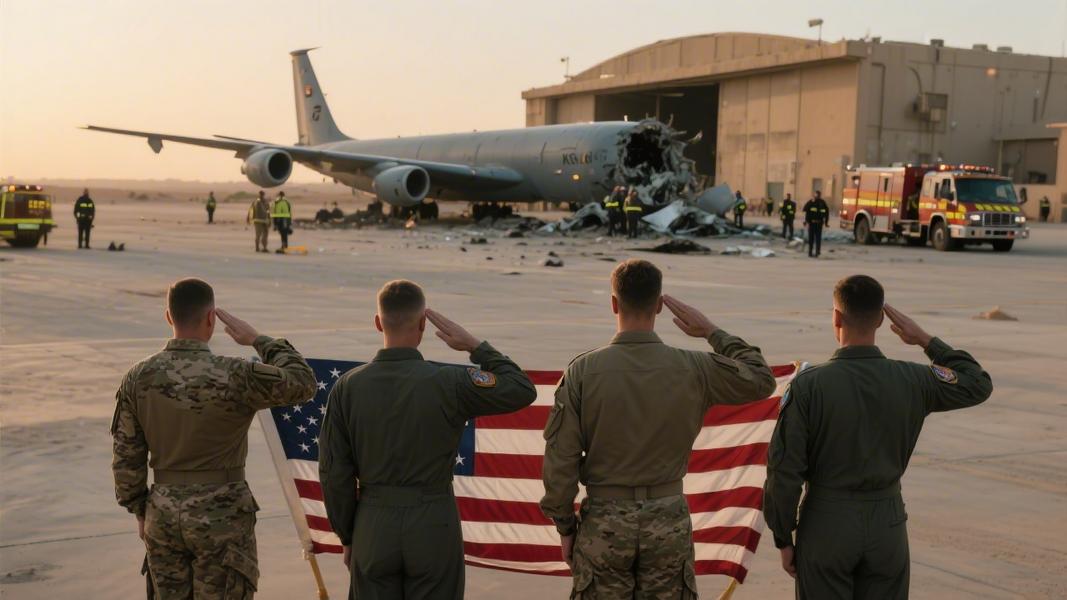
Four U.S. airmen are dead after a KC-135 Stratotanker refueling aircraft crashed in western Iraq on Thursday, the military confirmed — the latest blow to American forces in a war with Iran that is barely two weeks old and already carrying a grim toll.
U.S. Central Command said the aircraft went down at approximately 2 p.m. ET on March 12 near Turaibil, a remote stretch of desert along the Iraqi-Jordanian border. A second KC-135 — tail number 63-8017 — was involved in the incident and managed to land safely, though it sustained damage. Of the six crew members aboard the downed aircraft, four have been confirmed killed. The remaining two were the subject of ongoing rescue and recovery operations as of Thursday evening.
“At approximately 2 pm ET on March 12, a U.S. KC-135 refueling aircraft went down in western Iraq,” Central Command stated in an official release. “Four of six crew members on board the aircraft have been confirmed deceased as rescue efforts continue. The circumstances of the incident are under investigation. However, the loss of the aircraft was not due to hostile fire or friendly fire. The identities of the service members are being withheld until 24 hours after next of kin have been notified.”
Not Enemy Fire — But That Doesn’t Make It Simpler
Officials were quick to rule out both hostile and friendly fire as causes, a distinction that carries real weight given the chaos of the broader conflict. But what brought the plane down remains officially unknown. The crash marks the first KC-135 loss since 2013, when one went down shortly after takeoff, killing three crew members. That incident, too, was non-combat. The pattern offers little comfort.
The KC-135 is not a fighter jet. There are no ejection seats. When something goes catastrophically wrong at altitude or on approach, the crew’s options are brutally limited — a stark contrast to the three F-15E Strike Eagles lost on March 1, just 11 days earlier, when all six crew members ejected safely after those aircraft were downed by friendly fire from Kuwait. The tanker crew had no such out. That difference in survivability, quiet and structural, has become impossible to ignore as Operation Epic Fury grinds forward.
Military teams deployed HC-130J Combat King II aircraft to conduct what the Pentagon calls TRAP missions — Tactical Recovery of Aircraft and Personnel. These are not routine search-and-rescue operations. TRAP crews race to crash sites in potentially hostile territory, trying to reach survivors and sensitive equipment before anyone else does. Even in “friendly” airspace, in a region as volatile as western Iraq, that’s a dangerous assignment.
An Aging Workhorse, Pushed Hard
The KC-135 Stratotanker has been the backbone of U.S. aerial refueling for more than six decades. It’s a big, unglamorous machine — a 130-foot wingspan, capable of carrying up to 200,000 pounds of fuel — and it makes the rest of the air war possible. Without tankers, the F-15s and B-52s launching strikes deep into Iranian territory simply can’t get there and back. The KC-135 is the reason long-range missions are long-range at all.
A standard crew runs three people: pilot, copilot, and boom operator. Thursday’s aircraft carried six, suggesting additional personnel for the mission profile — not unusual for complex operational environments, but worth noting as investigators piece together what happened.
The fleet is old. Most KC-135s in service were built in the late 1950s and early 1960s, and while they’ve been extensively modernized, there’s no getting around the math of airframe age. The Air Force is replacing them with the KC-46 Pegasus, but that transition is slow — KC-135s are expected to remain in service until at least 2050. In the meantime, a shooting war with Iran is putting extraordinary strain on a fleet that was already being worked hard before the first missile flew.
Social media speculation has swirled around wear-and-tear and the operational tempo of the past two weeks, though none of that has been confirmed by any official source. Still, the questions aren’t unreasonable. Since February 28, U.S. and Israeli forces have conducted a surge of strikes on Iranian targets, and tankers have been central to sustaining that pace. Whether that tempo contributed to Thursday’s crash is something investigators will have to answer.
The Broader Toll of Operation Epic Fury
This is the fourth U.S. aircraft lost since Operation Epic Fury began. A cleaner picture of the war’s costs so far:
| Event | Date | Aircraft Lost | Casualties | Notes |
|---|---|---|---|---|
| F-15E Friendly Fire (Kuwait) | March 1, 2026 | 3 F-15Es | 0 deaths — 6 ejected safely | Initial phase of operation |
| KC-135 Crash (Iraq) | March 12, 2026 | 1 KC-135 (+ 1 damaged) | 4 of 6 crew dead | Not hostile fire; under investigation |
| Total War Losses | Feb. 28, 2026 — present | 4 aircraft | 7 killed, 140–150 wounded | Operation Epic Fury |
Seven Americans killed. Between 140 and 150 wounded. Fourteen days in. The numbers are not abstract — and they’re climbing.
Mixed Signals From the Commander in Chief
President Trump’s public posture on the war has been, to put it diplomatically, a little hard to track. Speaking to CBS News on Monday, he described the war as “very complete.” The day before, addressing Republican lawmakers in Florida, he reportedly told them “we haven’t won enough” in Iran. Both statements can’t fully be true at once, and the disconnect has done little to clarify what strategic endgame the administration is working toward.
That ambiguity matters on the ground. Operational tempo — how hard and how fast forces are pushed — flows from the top. If the message from Washington is that more needs to be done, the aircraft and the crews flying them will feel that pressure first.
What Comes Next
How long before investigators have answers? That’s unclear. The 2013 KC-135 crash took months to fully analyze. This one involves a second aircraft and an active war zone, which complicates access to the site and the wreckage. CENTCOM has confirmed the investigation is underway but offered no timeline.
In the meantime, the remaining KC-135 fleet will keep flying. It doesn’t have a choice. The strikes on Iran require it, the mission requires it, and there’s no ready substitute waiting in the wings. The KC-46 transition is years from completion. So the old tankers will keep going up, crewed by men and women whose names the Pentagon isn’t yet allowed to release — not until their families have been told.
Four flag-draped transfer cases. A second aircraft limping home with damage. And a war that, whatever the president says about its completeness, is very much ongoing.
The boom operator’s job is to connect the tanker to the fighter in midair — to keep the mission alive, miles above the earth, while everything else is moving. On Thursday, somewhere over western Iraq, that connection broke in a way no one has fully explained yet. Four families are waiting to find out why.
