
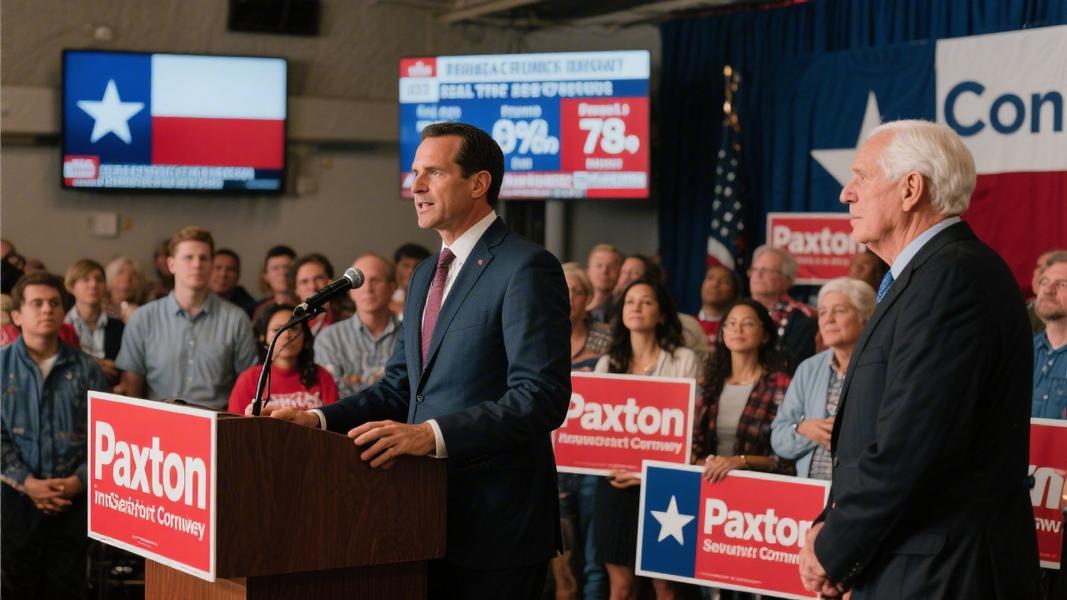
Ken Paxton is leading John Cornyn in virtually every poll that matters — and if Donald Trump decides to weigh in, the numbers could get a whole lot uglier for the incumbent senator.
With Texas Republicans headed toward a May 26, 2026 runoff, a cascade of new polling shows the state’s embattled attorney general holding a consistent edge over one of the Senate’s longest-serving members. The Associated Press confirmed neither candidate cleared the 50% threshold needed to avoid a runoff — Cornyn pulling roughly 43%, Paxton at 41% with about 60% of votes counted in the primary. What happens next could reshape Texas’s political identity for years to come.
The Polling Picture
It’s not a single outlier. Across three separate surveys, Paxton leads — sometimes narrowly, sometimes decisively. A Texas Public Opinion Research poll of 781 Republican voters puts Paxton ahead 49% to 41% in the hypothetical runoff matchup, with 11% still undecided. The University of Houston’s Hobby School found a similar spread — 51% to 40% — with 72% of Republican primary voters viewing Paxton favorably. That’s a remarkably warm number for a man who was impeached by the Texas House in 2023.
Emerson College Polling’s numbers are a bit tighter, showing Paxton up 40% to 36% over Cornyn in a three-way primary race that still included Rep. Wesley Hunt — but the trajectory is what’s striking. Paxton has climbed 13 points since January, according to Emerson’s own tracking. The average across major polls sits at Paxton 40.7%, Cornyn 41.9%, and Hunt at 13.5% — close enough that the runoff is genuinely competitive, but the momentum clearly belongs to one man.
Who’s Voting for Whom
The coalition Paxton is assembling tells you a lot about where the Republican Party’s center of gravity now sits. He’s winning men at 53%, voters ages 18 to 34 at a remarkable 61%, and non-college Republicans by a wide margin. Among voters who supported Wesley Hunt in the primary, 48% say they’ll move to Paxton in the runoff, compared to just 31% for Cornyn. That’s a significant advantage in a race that could easily be decided by a handful of percentage points, as Fox4 noted.
Cornyn isn’t without a base. As Emerson’s Spencer Kimball observed, “Senator Cornyn performs strongest among Republican Primary voters with college degrees, leading Paxton 43% to 32%, and voters over 70, 52% to 35%, while Paxton leads with voters under 50, 38% to 22%, and voters in their 50s and 60s, 44% to 30%.” In other words, Cornyn is winning the Texas Republican electorate of fifteen years ago. The question is whether that electorate still exists in sufficient numbers.
The Trump Variable
Here’s where it gets genuinely consequential. Trump has said he’ll make an endorsement “soon” — a word that in Trump’s political vocabulary can mean anywhere from tomorrow to never. But the polling suggests his choice will be decisive in a way that’s almost uncomfortable for Cornyn.
If Trump backs Paxton, the Texas Public Opinion Research numbers explode to 58% Paxton, 32% Cornyn. That’s not a race anymore — that’s a rout. But even if Trump endorses Cornyn, Paxton still leads, 44% to 43%, with 13% undecided. Still. Even a Trump endorsement of his opponent might not be enough to pull Cornyn across the finish line. That’s a brutal position for a four-term senator who has spent years cultivating a relationship with the former president.
What It All Means
Cornyn isn’t down yet — incumbency, institutional money, and a deep donor network mean he’s far from finished. But the numbers paint a picture of a senior senator who has drifted out of sync with the voters he needs most, at precisely the wrong moment in American political history. Paxton, for his part, has survived impeachment, federal indictment, and years of headlines that would have ended most political careers — and he’s somehow emerging stronger.
The May runoff will ultimately be a test of whether old-guard Republican establishment politics can hold on in Texas, or whether the MAGA wave has finally crested high enough to sweep away even the most entrenched incumbents. Either way, Trump’s phone call — whenever it comes — might be the most important one he makes all year.
