
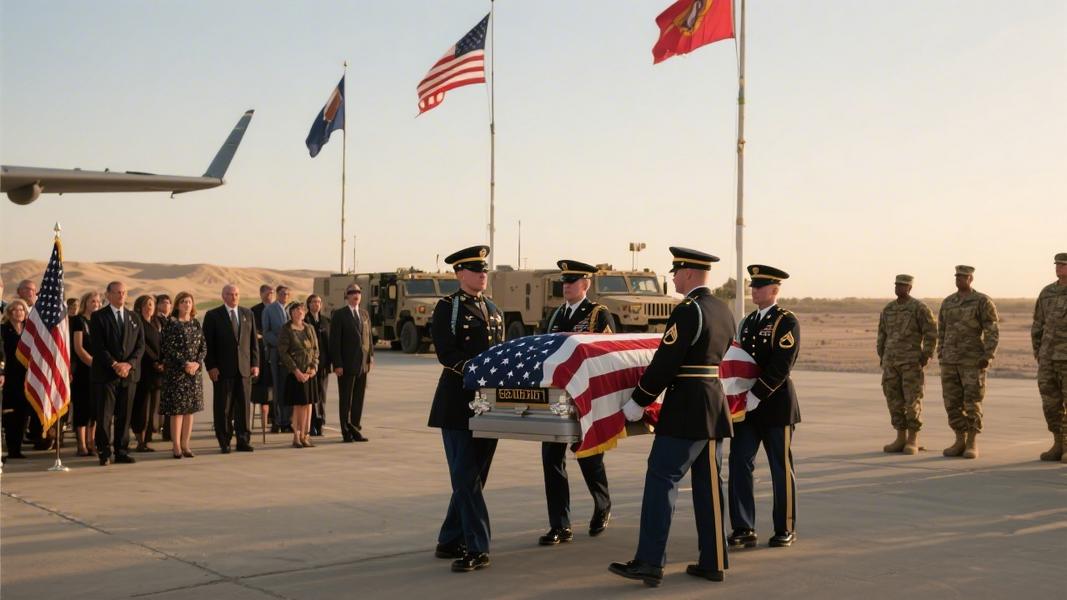
A Kentucky soldier who survived the opening salvo of Operation Epic Fury didn’t make it home. Sgt. Benjamin N. Pennington, 26, of Glendale, Kentucky, died March 8, 2026 — seven days after an enemy attack at Prince Sultan Air Base in Saudi Arabia left him fighting for his life.
His death makes him the seventh U.S. service member killed since the operation launched on February 28, a conflict that has already carved a brutal toll into communities from Des Moines to the Bluegrass State. Pennington had been assigned to the 1st Space Battalion, 1st Space Brigade, out of Fort Carson, Colorado — a unit that operates at the cutting edge of Army space and missile defense operations. He was 26 years old.
The First Weekend’s Deadly Arithmetic
The losses came fast. On March 1 — the same day Pennington sustained his wounds in Saudi Arabia — a drone strike tore through a command center in Port Shuaiba, Kuwait, killing six U.S. Army Reserve soldiers assigned to the 103rd Sustainment Command, based in Des Moines, Iowa. Those soldiers were Sgt. 1st Class Nicole Amor, Capt. Cody Khork, Sgt. Declan Coady, Chief Warrant Officer 3 Robert Marzan, Maj. Jeffrey O’Brien, and Sgt. 1st Class Noah Tietjens. Six names. Six families. One afternoon.
In total, eight additional service members were seriously injured during that first wave of Iranian counterstrikes between February 28 and March 1. The Defense Department has confirmed no additional deaths or serious injuries since that period — a grim kind of relief, if it can be called that.
A Soldier Nine Years in the Making
Pennington wasn’t a newcomer to military service. He’d enlisted back in 2017 as a 92Y unit supply specialist — the kind of logistical backbone role that keeps armies functioning and rarely gets headlines. Over nearly a decade, he built a record that spoke for itself: three Army Commendation Medals, two Army Good Conduct Medals, the Korea Defense Service Medal, the Global War on Terrorism Service Medal, and several other decorations that trace the geography of a career spent far from home.
He’d only recently made the transition to the space domain. On June 10, 2025 — less than nine months before his death — Pennington was assigned to the Army Space and Missile Defense Command. It was a new chapter. It turned out to be a short one.
He was also promotable. The Army will posthumously promote him to staff sergeant.
The Words Left Behind
What do commanders say when a soldier dies? Sometimes the statements feel hollow — bureaucratic condolence wrapped in rank. But the words offered for Pennington carried something more specific. Lt. Gen. Sean A. Gainey, commanding general of U.S. Army Space and Missile Defense Command, said plainly: “He gave the ultimate sacrifice for the country he loved. That makes him nothing less than a hero, and he will always be remembered that way.”
Col. Michael F. Dyer, commander of the 1st Space Brigade, offered a portrait of the man rather than just the rank. “Sgt. Pennington was a dedicated and experienced noncommissioned officer who led with strength, professionalism and sense of duty,” Dyer said. “We will forever honor his legacy and ultimate sacrifice for our nation.” It’s the kind of statement that, when you read it against the backdrop of nine years of service and a posthumous promotion, lands differently than it might otherwise.
Glendale, Kentucky, Receives Its Fallen
Glendale is a small town — the kind of place where everybody knows somebody who served. It’s in Hardin County, about an hour south of Louisville, and it’s the sort of community that feels losses like this in a particular, intimate way. The Pentagon formally identified Pennington on Monday, giving a name and a hometown to a casualty number that had already been reported in the days prior.
Operation Epic Fury is still young. Seven soldiers dead, eight seriously wounded, and a conflict that by any measure is only beginning to reveal its costs. Pennington’s death — coming a full week after the attack that wounded him — is a reminder that the casualty count from any single day of war doesn’t always close when the sun goes down.
He was 26. He’d been in the Army since he was 17. He made staff sergeant on the way out.
