
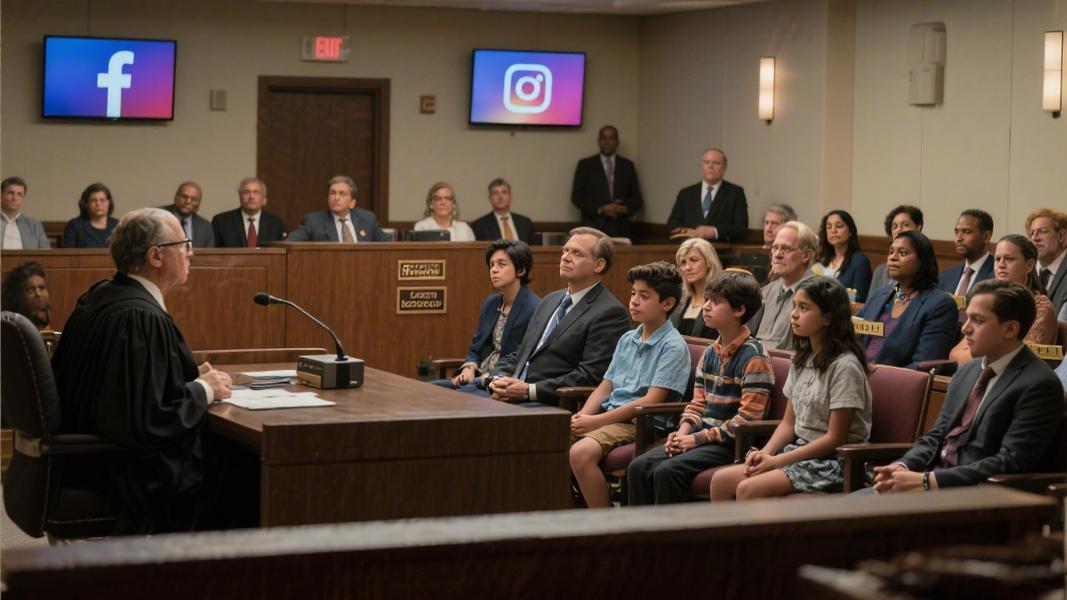
For the first time in his career, Mark Zuckerberg sat before a jury and answered for what his platforms allegedly did to a child. That moment — February 18, 2026, in a Los Angeles courtroom — may end up being one of the most consequential in the history of social media litigation.
The case is KGM v. Meta & YouTube, a bellwether trial now actively underway in Los Angeles Superior Court. It centers on a young woman — identified by her initials — who alleges that prolonged, algorithmically-driven exposure to Instagram and YouTube beginning in early childhood left her psychologically damaged. The trial formally kicked off February 10, 2026, following jury selection that began January 27. Its outcome could shape how thousands of similar lawsuits proceed across the country.
A Childhood Spent Scrolling
The plaintiff’s story is, by now, a familiar one to anyone who has followed the wave of social media harm litigation — and yet the specifics here are striking. She allegedly began using YouTube at age 6. By age 9, she was on Instagram. At her worst, she was spending up to 16 hours in a single day on the platform, a compulsive pattern her legal team argues wasn’t accidental — it was engineered. Lawyers for the plaintiff have detailed how specific design features — beauty filters, infinite scroll, and the platforms’ underlying recommendation algorithms — worked in concert to hook a child and keep her hooked.
That framing is central to the entire case. It’s not just about screen time. It’s about whether Meta and Google knowingly built products that exploit developing brains, and whether they should be held liable for the psychological deterioration that allegedly followed. That’s a harder argument to dismiss than it might have seemed even five years ago.
Zuckerberg Takes the Stand
Still, nothing in the trial so far has commanded more attention than what happened on February 18th. Zuckerberg, who has spent years navigating congressional hearings and regulatory scrutiny with the practiced composure of someone who has been media-trained within an inch of his life, testified before a jury for the very first time. No friendly moderator. No senator running out the clock with a speech. Just questions, a jury box, and a plaintiff’s legal team that has spent months preparing for exactly this moment.
What did he say? His position hasn’t shifted much from what he told Congress in 2024 — that the existing body of research simply doesn’t establish a causal link between social media use and mental health harm. It’s a defensible scientific claim, technically. But it’s also the kind of answer that can land differently when the person asking the question is a juror, not a senator — and when there’s a real plaintiff sitting across the room.
Why This Trial Matters Beyond L.A.
Bellwether trials exist for a reason. In mass tort litigation, they’re used to test legal theories, gauge jury reactions, and — often — pressure defendants toward settlement. A plaintiff’s verdict here wouldn’t automatically mean billions in liability, but it would send a very loud signal to the thousands of families whose cases are pending in MDL 3047 and related proceedings nationwide.
How bad is the backlog? Enormous. Tens of thousands of families have filed claims alleging that social media platforms contributed to eating disorders, depression, self-harm, and suicide in minors. The KGM trial is, in many ways, the first real stress test of those claims in front of an actual jury — with an actual tech CEO on the witness stand.
That’s not nothing. And the companies involved know it.
The Bigger Question Hanging Over All of It
Beyond the legal strategy and the courtroom theater, there’s a question that this trial keeps circling back to: at what point does a product’s design become a form of harm? Infinite scroll doesn’t feel dangerous the way a defective airbag does. Beauty filters don’t come with warning labels. But the plaintiff’s team is arguing — and will continue to argue — that the absence of obvious danger was itself part of the design. That the whole point was for it not to feel like a trap while you were in it.
Whether a Los Angeles jury buys that argument remains to be seen. But the fact that Mark Zuckerberg has now had to look twelve strangers in the eye and defend his platforms’ design choices suggests that, whatever the verdict, something has already shifted. The days of deflecting these questions from a Senate dais may be coming to an end.
