
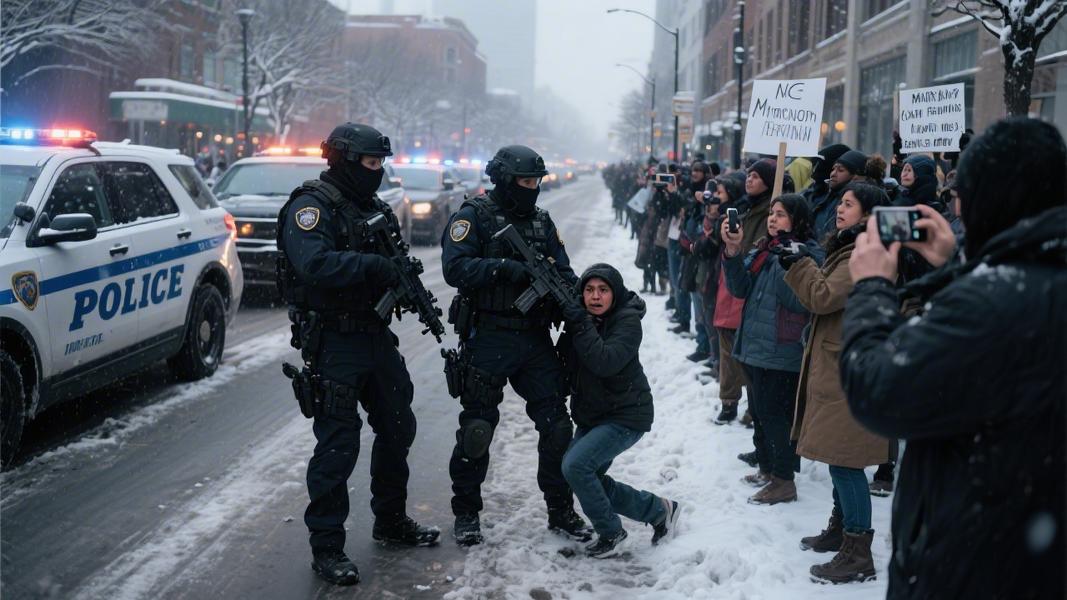
Federal immigration authorities have concluded a controversial 10-week enforcement surge in Minnesota that resulted in more than 4,000 arrests and left communities reeling from what critics call militarized tactics and constitutional violations.
Operation Metro Surge, launched by the Department of Homeland Security in December 2025, sent thousands of federal agents into the Minneapolis-St. Paul metropolitan area before ending in mid-February 2026 amid escalating legal challenges and community outcry. The operation, which at its peak deployed 2,700 Immigration and Customs Enforcement (ICE) officers, concluded with a phased withdrawal announced by Tom Homan on February 12.
Legal Battles and Constitutional Questions
The enforcement action sparked immediate legal challenges from Minnesota officials who argued the Trump administration had overstepped federal authority. “They’re trying to hijack the state’s legislative process,” said Brian Carter, a lawyer with the Minnesota Attorney General’s office. “They’re trying to get us to turn over voter rolls. What does that have to do [with immigration?] The federal government is attempting to bend the state’s will to its own and that is not allowed under the Constitution,” Carter added.
Despite these arguments, a Biden-appointed federal judge ultimately rejected Minnesota’s bid to halt the operation, ruling that claims about punishment or unfair treatment were insufficient grounds to block the enforcement actions. Within days of this ruling, however, federal authorities began scaling back the operation, first removing 700 officers on February 4 before announcing its complete termination the following week.
Communities “Under Siege”
What was the human impact of this massive enforcement action? According to civil liberties advocates, the operation left deep scars on immigrant communities, particularly Somali and Latino neighborhoods.
“For the past two months, Minneapolis and St. Paul have felt like cities under siege,” said Deepinder Mayell, Executive Director of the ACLU of Minnesota, which documented shootings, deaths, and constitutional rights violations allegedly committed by masked federal agents in military gear.
The operation, described in the Encyclopedia Britannica as “large-scale” and carried out primarily by ICE, resulted in more than 4,000 arrests according to federal authorities. But critics argue the damage extends far beyond those directly detained.
Minnesota Governor Tim Walz didn’t mince words about the operation’s aftermath. “They left us with deep damage, generational trauma. They left us with economic ruin in some cases,” Walz stated, highlighting concerns about long-term repercussions for affected communities.
Withdrawal and Accountability
The federal withdrawal began in earnest after Tom Homan announced on February 4 a reduction of 700 immigration officers, bringing the total deployed force down to 2,000. Just over a week later, on February 12, Homan announced the operation would end completely, with withdrawal continuing into the following week, according to reports that confirmed more than 4,000 people had been arrested during the operation.
But the end of Operation Metro Surge leaves unanswered questions about accountability for alleged abuses and the fate of those detained. Civil liberties organizations continue to document cases and prepare potential legal challenges related to what they characterize as constitutional violations during the two-month enforcement action.
As federal agents depart Minnesota, they leave behind communities struggling to rebuild trust — and state officials grappling with what some see as an unprecedented federal intrusion that blurred the lines between immigration enforcement and state sovereignty.
