
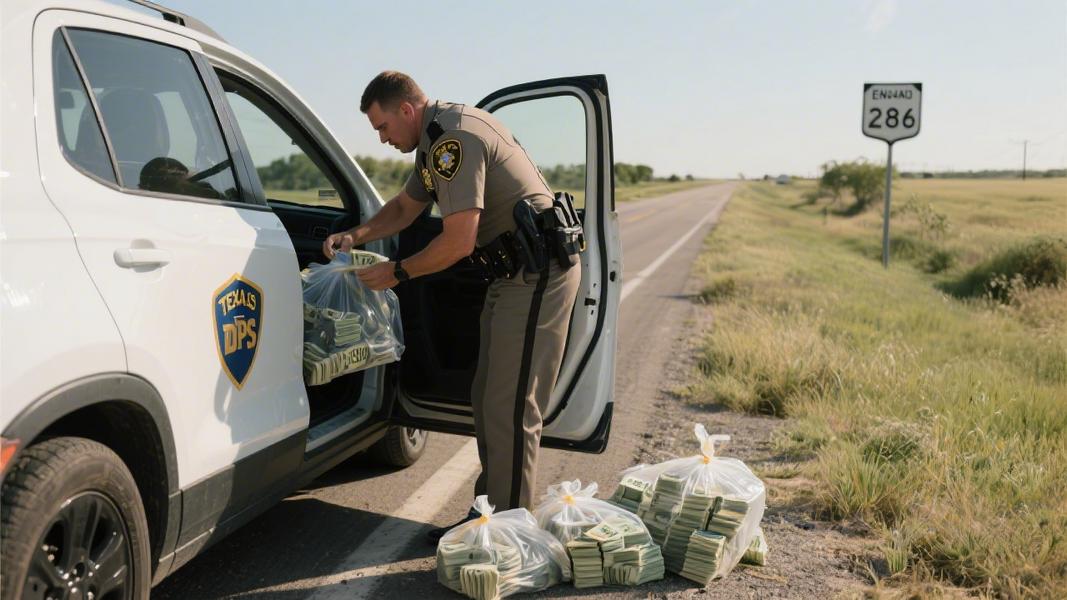
Millions of dollars in drugs and cash. One busy stretch of South Texas border country. And federal and state agents who say they’re barely keeping up.
A series of seizures in and around Hidalgo County has laid bare just how relentlessly smugglers are testing the southern border — moving cocaine by the pound and cash by the bundle, often hidden in plain sight inside ordinary vehicles crossing ordinary checkpoints. Taken together, the incidents paint a picture of a corridor under sustained pressure, where the stakes are measured in kilos and hundred-dollar bills.
A Traffic Stop, a Chevy Tracker, and $83,000 in Cash
It started, as so many of these cases do, with a routine traffic stop. On February 23, 2026, Texas Department of Public Safety troopers pulled over a white 2021 Chevrolet Tracker on US 281 near Encino in Hidalgo County. What they found inside wasn’t routine at all — $83,855 in cash, bundled and ready to move. The driver, Daniel Roel Gomez Quirin, a 36-year-old Mexican national from Reynosa, Tamaulipas, was arrested on the spot and charged with felony Money Laundering, Texas DPS disclosed.
Reynosa sits just across the Rio Grande from McAllen — a city that knows this story well. Gomez Quirin’s alleged route, if that’s what it was, followed a well-worn path. Cash flows south. Drugs flow north. And investigators on both sides of the border spend their careers trying to interrupt that loop.
Hidden Packages, a Honda, and a Bridge Under Watch
That same corridor — the Hidalgo International Bridge — has been a consistent flashpoint. U.S. Customs and Border Protection officers there seized $79,392 in unreported currency from a 2008 Honda on September 23, the cash stuffed into five separate packages concealed within the vehicle, according to records reviewed by legal analysts tracking the case. CBP’s Hidalgo Port of Entry has seen this kind of concealment before. But that doesn’t make it any less brazen.
Smugglers, it seems, are counting on volume — the sheer number of vehicles crossing daily — to give them cover. And sometimes it works. Often, though, it doesn’t. Officers at the bridge also discovered 24 packages of alleged cocaine weighing 63.80 pounds hidden inside another vehicle, a separate incident that CBP uncovered during routine inspections. The street value ran well into the hundreds of thousands.
Nearly 300 Pounds of Cocaine in a Tractor Trailer
How bad is it? Consider this: on October 11, CBP officers at the Hidalgo Port of Entry pulled nearly 300 pounds of cocaine from a tractor trailer — a haul valued at more than $4 million. That’s not a suitcase. That’s a commercial load, the kind that requires planning, coordination, and the kind of infrastructure that doesn’t get built overnight.
Port Director Carlos Rodriguez didn’t mince words. “This significant cocaine seizure underscores the reality of the drug threat our officers face every day,” he said, as noted in reporting on the bust. It’s the kind of statement that sounds like a press release — and it is — but that doesn’t make it less true.
A Pattern That’s Hard to Ignore
Still, context matters here. These are the seizures that worked — the ones where officers found what they were looking for. Experts who study border enforcement have long argued that every successful bust represents a fraction of what actually gets through. That’s not a knock on the agents working these crossings. It’s just math, and geography, and the stubborn economics of a black market worth billions.
What’s striking about this cluster of incidents isn’t any single case. It’s the variety — cash in a Tracker on a state highway, cocaine in a semi at a commercial port, currency stuffed into packages inside a Honda. Different methods. Different vehicles. Different entry points. Same general destination. The smuggling playbook, it turns out, doesn’t have just one chapter.
CBP and DPS have both flagged these seizures as evidence that enforcement efforts are working. And they’re not wrong. But the arrests keep coming, the loads keep showing up, and the Hidalgo corridor keeps humming — quietly, relentlessly, and largely out of view of anyone not paying close attention. As one defense attorney tracking currency seizure cases noted, the volume of these incidents in a single region over just a few months is difficult to dismiss as coincidence.
The drugs and money will keep moving until the incentive to move them doesn’t. Nobody on either side of the border is holding their breath for that day.
