
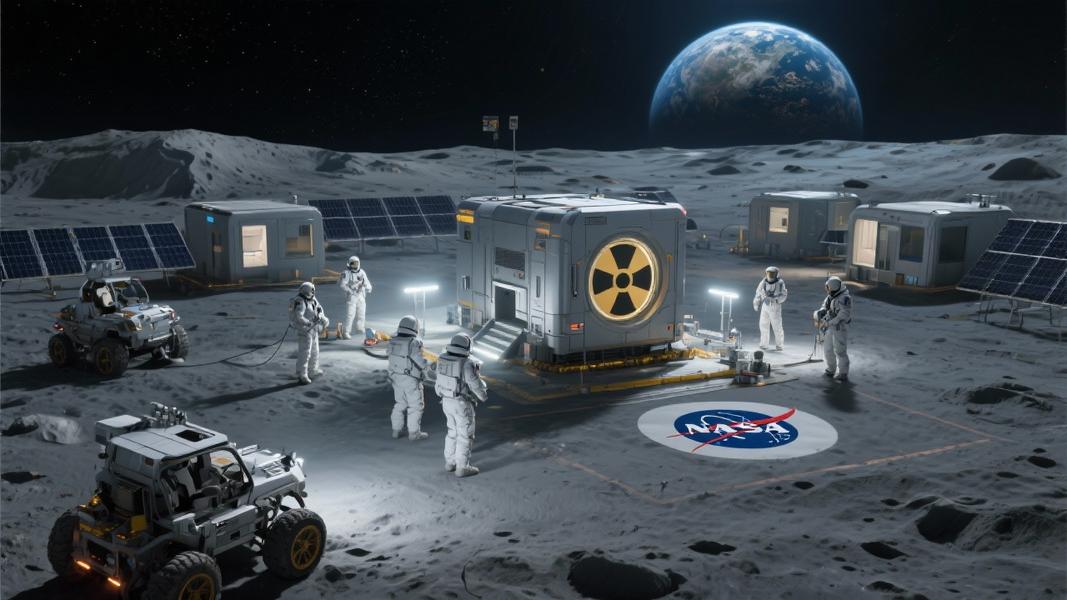
NASA’s latest moonshot isn’t just about getting there — it’s about staying power. The space agency has inked a deal with the Department of Energy to develop a nuclear fission reactor on the lunar surface by 2030, bringing sustainable power to humanity’s next great outpost.
The memorandum of understanding, part of the broader Artemis campaign, aims to create an energy solution that can withstand the Moon’s harsh environment while providing consistent power regardless of sunlight conditions. “Under President Trump’s national space policy, America is committed to returning to the moon, building the infrastructure to stay, and making the investments required for the next giant leap to Mars and beyond,” officials stated.
Why Nuclear Power?
The Moon presents unique challenges for power generation. Its day-night cycle consists of approximately two weeks of daylight followed by two weeks of darkness, making solar power unreliable for continuous operations. A nuclear solution bypasses this limitation entirely.
“Achieving this future requires harnessing nuclear power,” NASA leadership explained. “This agreement enables closer collaboration between NASA and the Department of Energy to deliver the capabilities necessary to usher in the Golden Age of space exploration and discovery.”
The planned reactor isn’t just a power source — it’s a lifeline. Designed to operate for years without refueling, the system would generate at least 40 kilowatts of electricity, enough to continuously power approximately 30 households for a decade. More ambitious proposals call for a 100-kilowatt reactor capable of powering about 80 homes, according to reports.
Technical Hurdles
Building a nuclear reactor for the Moon isn’t simply a matter of transplanting Earth-based technology. Engineers face significant challenges unique to the lunar environment.
How do you manage waste heat in the Moon’s extreme temperature swings? What about radiation shielding for lunar explorers? And perhaps most critically — how do you design a system that requires minimal maintenance when the nearest repair shop is 238,855 miles away? These questions represent just a few of the obstacles scientists are working to overcome.
The partnership between NASA and the Department of Energy builds on more than five decades of collaboration. Their joint efforts have already powered multiple deep-space robotic missions including Cassini, Curiosity, and Perseverance — all using radioisotope thermoelectric generators as power sources, as noted by space experts.
Strategic Placement
Where exactly will this nuclear reactor go? The plans are ambitious and multi-faceted. Beyond the surface-based reactor targeted for 2030 deployment, the vision includes placing additional reactors in lunar orbit, according to sources familiar with the project.
Strategic positioning matters tremendously. One compelling option involves placing reactors near permanently shadowed regions where water ice has been detected — providing power exactly where future explorers might need to access vital resources.
“Fission surface power can provide abundant and continuous power regardless of environmental conditions on the Moon and Mars,” officials emphasized, highlighting the technology’s versatility for both lunar and eventual Martian applications.
“History shows that when American science and innovation come together, from the Manhattan Project to the Apollo Mission, our nation leads the world to reach new frontiers once thought impossible,” a statement reads.
As the 2030 target date approaches, this nuclear-powered vision represents more than just an engineering challenge — it’s a declaration that humanity’s return to the Moon won’t be a brief visit, but the beginning of a sustained presence powered by the atom.
