
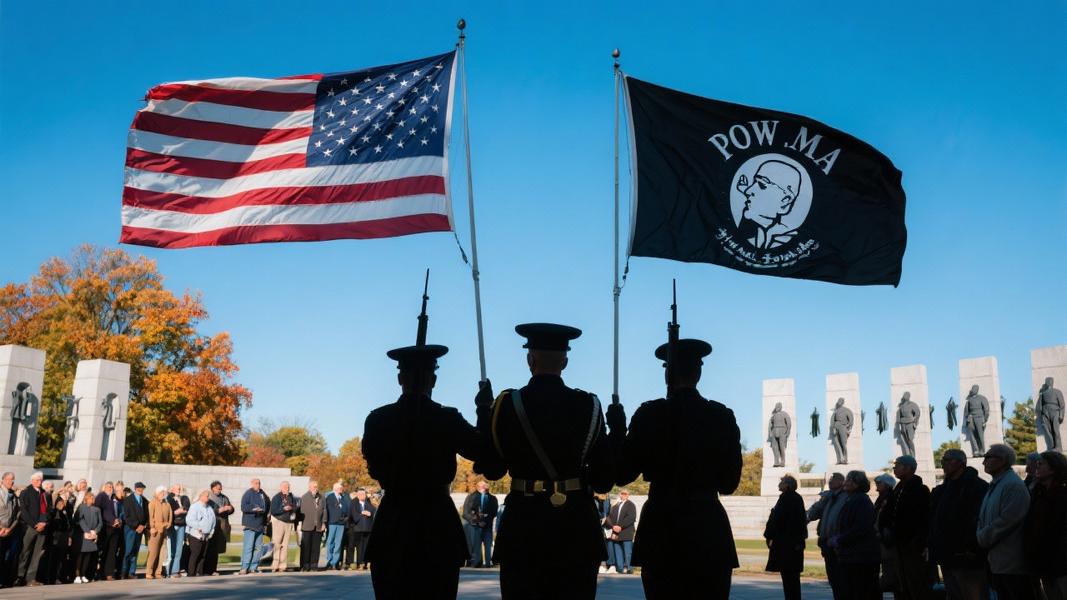
With more than 80,000 American military personnel still unaccounted for from past conflicts, National POW/MIA Recognition Day serves as a solemn reminder of an ongoing mission that spans generations and transcends politics.
Observed on the third Friday of September each year, this day of remembrance — officially established in 1979 through a proclamation signed by President Jimmy Carter — honors those who endured captivity and those who never returned home. The day has become a fixture in America’s calendar of military observances, with ceremonies held nationwide to commemorate the sacrifices of prisoners of war and those missing in action.
A Legacy of Commitment
“From the battlefields of the Revolutionary War to the trenches of World War II to the sprawling jungles of Vietnam, thousands of our patriotic service members have been horrifically captured by the enemy and forced to endure excruciating torture, agony, and distress in the service of our Nation,” reads a recent presidential proclamation released by the White House.
The black and white POW/MIA flag, now a recognizable symbol across America, represents this enduring commitment. “This black and white banner, symbolizing America’s missing, is a stark and powerful reminder to people around the world that our Nation will keep faith with those who have served and sacrificed,” notes a statement from the Department of Defense, which emphasizes that America “will not rest until we receive the fullest possible accounting of every American missing in service to our country.”
What began as a day of remembrance has evolved into an ongoing mission of accountability. The federal government vows “full accountability for the more than 80,000 heroes still missing from the wars and conflicts of the past” — a staggering figure that spans conflicts from World War II to more recent engagements.
Recent Progress
Efforts to recover and identify remains continue decades after conflicts end. In a significant milestone, March 2025 saw the 100th service member identified from remains repatriated from North Korea. These remains, believed to be of at least 250 individuals who sacrificed their lives during the Korean War, were secured through diplomatic efforts, bringing closure to families who had waited generations for answers.
“During my first term, I secured the repatriation of remains from North Korea, believed to be at least 250 individuals who paid the ultimate sacrifice during the Korean War,” the White House stated, noting the March identification “ended decades of uncertainty for the families of the fallen.”
The 2019 National POW/MIA Flag Act further cemented the nation’s commitment by requiring the distinctive black and white flag to be flown alongside the American flag at certain federal locations. This legislation, signed during the Trump administration, elevated the symbol’s prominence at government buildings, military installations, and national cemeteries.
A Day of Reflection
Since its establishment, “every U.S. president has declared the third Friday in September as National POW/MIA Recognition Day,” according to municipal records from communities that host remembrance ceremonies. These events often include military flyovers, candlelight vigils, and the symbolic “missing man table” — a poignant display representing those who never returned.
For many families of the missing, the day represents both heartache and hope. Each identification of remains, even decades later, demonstrates the government’s commitment to its promise that no service member will be forgotten.
The ongoing accounting mission involves painstaking work by forensic anthropologists, historians, and recovery teams who often venture into remote locations where American service members were lost. Modern DNA analysis techniques have dramatically improved identification capabilities, bringing closure to families who had almost abandoned hope.
Still, with tens of thousands remaining unaccounted for, the mission continues. For many Americans, the black and white POW/MIA flag flying alongside Old Glory serves not just as a remembrance of sacrifice, but as an active promise to those still waiting for answers.
