
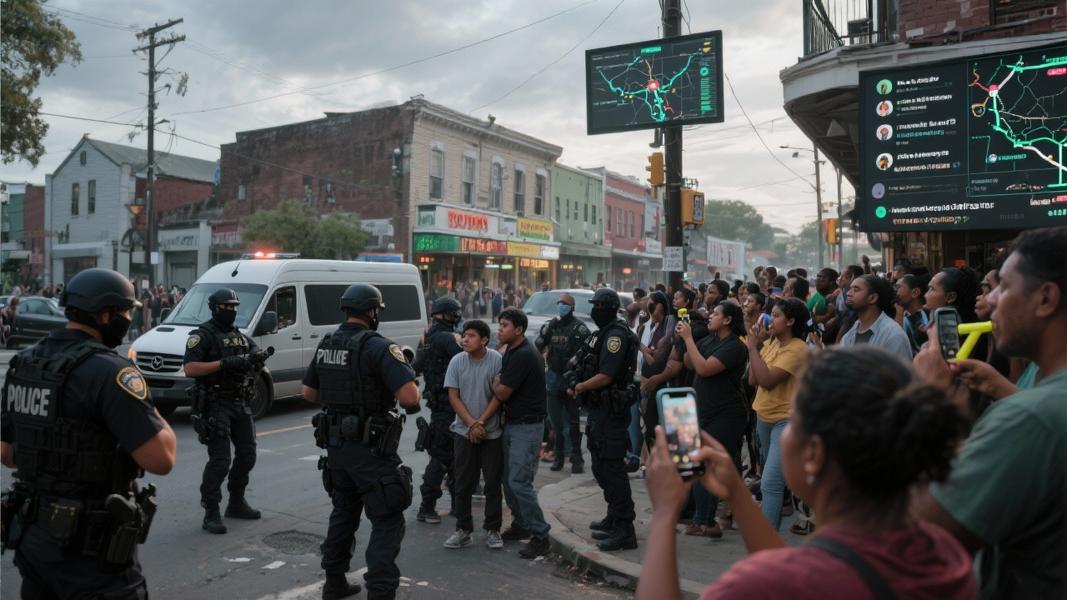
Federal immigration agents have descended on New Orleans in a sweeping enforcement operation that has triggered both intense monitoring of public reaction and sharp criticism from local officials who say the crackdown targets people based on appearance rather than criminal history.
Around 200 Border Patrol agents are now conducting arrests throughout the city as part of “Operation Catahoula Crunch,” while state and federal authorities maintain round-the-clock surveillance of online discussions and protests related to the raids, according to law enforcement records obtained by The Associated Press.
Criminal Dragnet or Indiscriminate Sweep?
The Department of Homeland Security has publicly characterized the operation as targeting “criminal illegal aliens,” highlighting six arrests of individuals with serious criminal histories including homicide and sexual assault. But internal records paint a different picture.
Of the first 38 people arrested during the initial days of the operation, less than a third had criminal histories beyond minor offenses, the documents show. DHS has offered only vague descriptions of the most serious cases while providing no details about the majority of those detained.
“It confirms what we already knew — this was not about public safety, it’s about stoking chaos and fear and terrorizing communities,” said state Sen. Royce Duplessis, a Democrat representing New Orleans, who criticized the lack of transparency surrounding the operation.
New Orleans City Council President J.P. Morrell and other officials have pointed to viral videos showing what appears to be racial profiling, including masked agents pursuing a 23-year-old U.S. citizen returning from grocery shopping — evidence of what they describe as a “dragnet focused on people with brown skin” rather than targeted enforcement against dangerous criminals.
Digital Surveillance Operation
Behind the scenes, an elaborate monitoring apparatus has been established to track public sentiment about the crackdown. The Louisiana State Analytical and Fusion Exchange, an intelligence center, has embedded agents from the FBI and Customs and Border Protection to monitor social media discussions 24/7, including Reddit threads where locals share information about raid locations and tactics.
The fusion center has actively worked to counter narratives it deems false, including a report that claimed a pedestrian was fatally struck during the operation. “It has been confirmed that this actually did not occur,” the center told law enforcement on Saturday.
Is this level of monitoring justified? Louisiana State Police spokesperson Trooper Danny Berrincha defended the approach, saying the agency “remains vigilant in monitoring social media activity related to protests, activism and other forms of public response,” while warning that anyone assaulting federal agents or causing criminal property damage would face arrest.
The briefings acknowledge both support and criticism for the operation online, with one noting that even among supporters, videos showing “children crying in the background as their parents are placed under arrest, is weighing heavy on their hearts.”
Communities Respond
Activists have pushed back against the surveillance, saying they’re simply documenting legitimate public interest activities. “They can monitor me all they want,” said Rachel Taber, an organizer with the New Orleans-based grassroots advocacy group Union Migrante, which shares crowdsourced reports and videos of the enforcement operations. “We are not doing anything illegal.”
Beth Davis, another local organizer, emphasized that filming and publicly documenting federal agents’ activities are protected rights that shouldn’t be treated as threatening behavior.
The operation comes as immigration has become a central issue in the presidential campaign, with the Trump administration doubling down on enforcement actions. Yet the gap between official rhetoric focusing on dangerous criminals and the reality of who’s being arrested has fueled skepticism about the operation’s true purpose.
As the raids continue and monitoring intensifies, the question remains whether the resources deployed to track both migrants and those documenting the operation might be better spent on the “criminal illegal aliens” officials claim to be targeting — or if, as local leaders suggest, the entire operation is less about public safety and more about political theater at the expense of communities of color.
