
The NFL is raising its game — literally. The league announced that all stadium playing surfaces must meet new enhanced standards by the 2028 season, part of an extensive initiative to improve field quality and consistency across all venues, regardless of whether they use natural grass, synthetic turf, or hybrid systems.
New Field Standards Coming to an NFL Stadium Near You
“The playing surfaces at every NFL stadium will have to meet new enhanced standards set through lab and field testing by the start of the 2028 season,” the NFL confirmed in its announcement. Teams will have two years to upgrade their fields, with a library of approved and accredited options becoming available starting next season.
Nick Pappas, who helps oversee the league’s playing surface initiatives, explained the frequent turnover rate of different field types. “Most artificial surfaces are replaced every two or three years,” he noted. “Natural fields can be replaced several times a season.”
What’s behind this push for better fields? Player safety concerns have long simmered, with many NFL players expressing preferences for natural grass. But the league isn’t mandating one surface type over another. Instead, it’s focusing on measurable quality standards that can be applied to any field type.
Testing, Testing
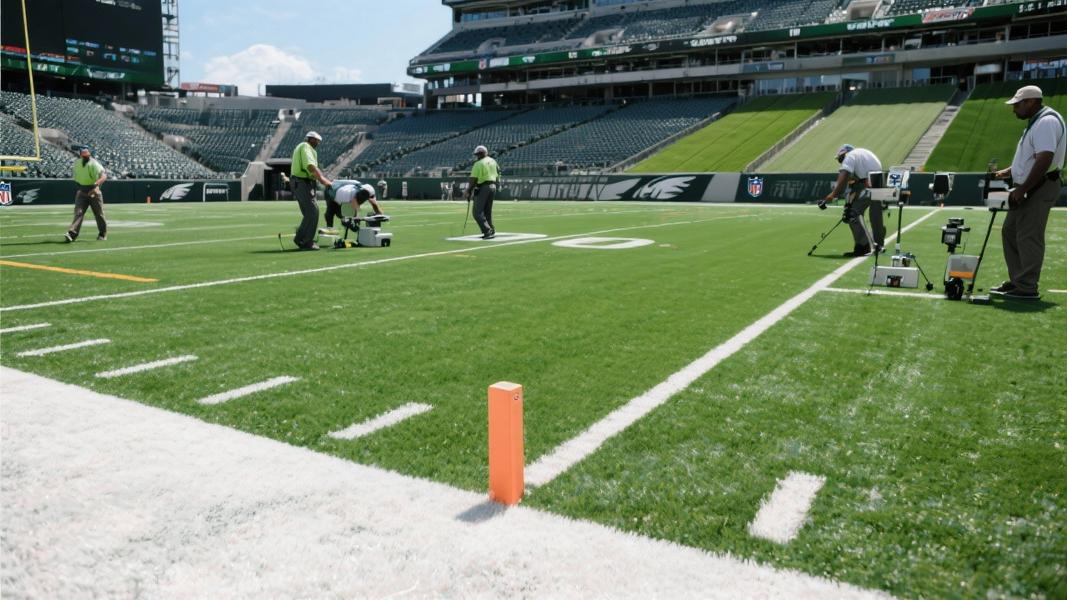
The NFL isn’t leaving field quality to guesswork. Fields will undergo rigorous evaluation using two specialized tools with appropriately intimidating names. One is called the BEAST — a traction testing device that simulates NFL player movements. The other, the STRIKE Impact Tester, helps determine field firmness. These measurements will guide a rating system that Pappas described as a “red, yellow, green effect, where we’re obviously trying to phase out fields that we have determined to be less ideal than newer fields coming into the industry.”
A joint committee that includes representatives from both the NFL and the NFL Players Association will approve fields after extensive lab and on-site testing to ensure quality standards. This collaborative approach signals recognition of player input in the process.
The goal, according to league officials, is consistency. Not just from stadium to stadium, but throughout the entire season at each venue. Pappas identified the “key pillars” for field evaluation as optimized playability, reduced injury risk, and player feedback.
Grass vs. Synthetic: The Debate Continues
Despite persistent calls from some players for all-natural grass fields, the NFL isn’t heading in that direction. The league’s chief medical officer, Dr. Allen Sills, stated there are no “statistically significant differences” in lower extremity injuries or concussions that can be attributed specifically to playing surface type.
“The surface is only one driver of these lower extremity injuries,” Sills explained. “There are a lot of other factors, including player load and previous history and fatigue and positional adaptability and cleats that are worn. So surfaces are a component, but it is a complex equation.”
Instead of mandating a single surface type, the NFL is taking a more nuanced approach. “Now we can say for any individual surface, let’s look at the biophysical properties of that surface. How might those correlate with injury? And then, obviously, how do we optimize them?” Sills added.
Super Bowl Prep Already Underway
Meanwhile, preparations for the biggest game of the year are already in motion — quite literally in the form of growing grass. Pappas revealed that the field for Super Bowl LVIII at Levi’s Stadium in Santa Clara has been growing at a sod farm about two hours east of San Francisco. He’s been monitoring its progress with several visits over the past 18 months, with installation planned for around the third week of January, though that timeline could shift if the 49ers make a deep playoff run.
For players who’ve long complained about field inconsistencies, these new standards represent a meaningful step. But the proof will ultimately be in the playing. Will standardized testing translate to fewer injuries and better performance? That’s a question only time — and the next few NFL seasons — will answer.
