
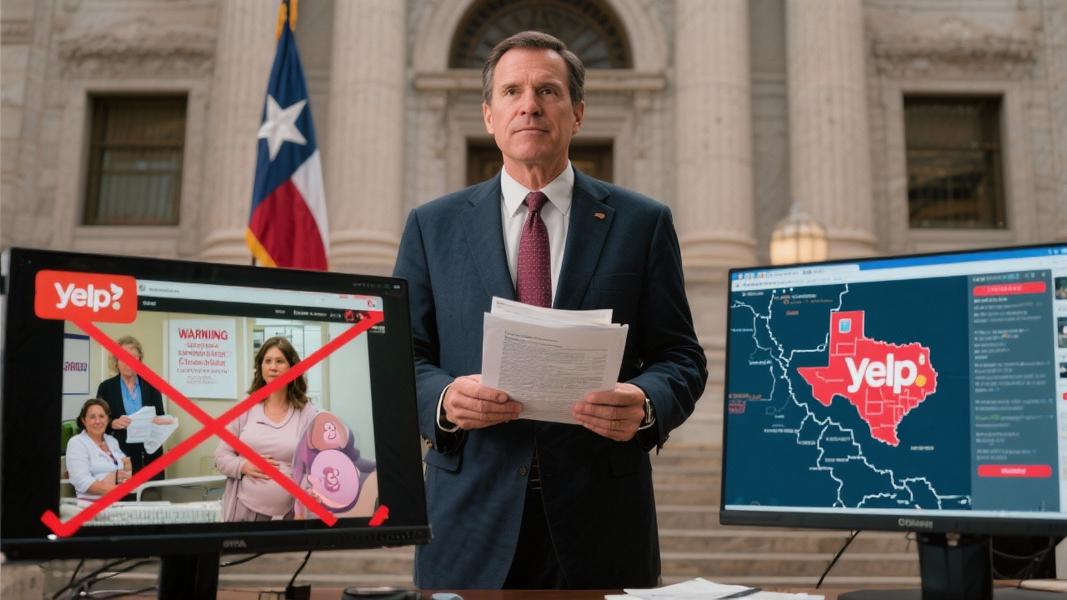
Federal Appeals Court Blocks Yelp’s Challenge to Texas Abortion Clinic Labeling Case
Yelp’s battle to fend off penalties from Texas over how it labeled crisis pregnancy centers hit a major roadblock Wednesday when a federal appeals court rejected the company’s attempt to halt state proceedings.
The Ninth U.S. Circuit Court of Appeals in San Francisco ruled that federal courts have limited authority to intervene in Texas Attorney General Ken Paxton’s enforcement action against the review platform. The decision effectively prevents Yelp from seeking federal injunctive relief in a case that sits at the intersection of corporate speech and abortion politics.
“Federal courts, where Yelp filed its lawsuit, have little authority to intervene in state proceedings,” the appeals court stated in its decision, affirming a lower court’s dismissal of Yelp’s federal lawsuit.
Bad Faith Argument Falls Flat
At the heart of the case is Yelp’s labeling of crisis pregnancy centers — organizations that counsel against abortion — on its platform. Texas officials claimed these labels violated state law, while Yelp argued its actions were protected speech.
The company had sought refuge in federal court, arguing that Paxton’s enforcement action was brought in bad faith and for harassment purposes. But the three-judge panel wasn’t buying it.
The Ninth Circuit determined that “Younger’s bad faith exception did not apply because Yelp had not sufficiently established that the Texas civil enforcement action was brought without a reasonable expectation of obtaining a valid judgment or was facially meritless.”
Why does this matter? The ruling hinges on the Younger abstention doctrine, a legal principle that generally prevents federal courts from interfering with ongoing state proceedings. For Yelp to overcome this barrier, it needed to prove exceptional circumstances — a hurdle it failed to clear.
Skepticism From the Bench
Signs of trouble for Yelp were evident even during oral arguments, when the panel appeared skeptical of claims that Texas’s top prosecutor acted in bad faith. The judges questioned whether Paxton’s enforcement action truly represented harassment rather than a legitimate legal dispute.
The doctrine of abstention now effectively “prevents Yelp Inc. from obtaining injunctive relief to block a civil enforcement action by the Texas attorney general,” as confirmed by legal observers following the case.
This setback for Yelp comes amid increasing tensions between tech platforms and state officials over content related to reproductive health services following the Supreme Court’s overturning of Roe v. Wade. Several states have enacted laws restricting how abortion-related services can be described or advertised.
What’s Next for Yelp
The ruling doesn’t end Yelp’s legal options, but it does shift the battleground firmly to Texas courts, where the company will have to defend its labeling practices under state law rather than on federal constitutional grounds.
Legal experts note that while Yelp can still raise First Amendment defenses in state court, it loses the advantage of having the case heard in the more liberal Ninth Circuit.
The decision represents yet another chapter in the ongoing struggle between corporate speech policies and state regulations in the post-Roe landscape — one where even consumer review platforms find themselves caught in America’s most contentious cultural and political divisions.
