
North Texas just got a lot more important on the global soccer map — and it’s not just because of what’s happening inside AT&T Stadium this summer.
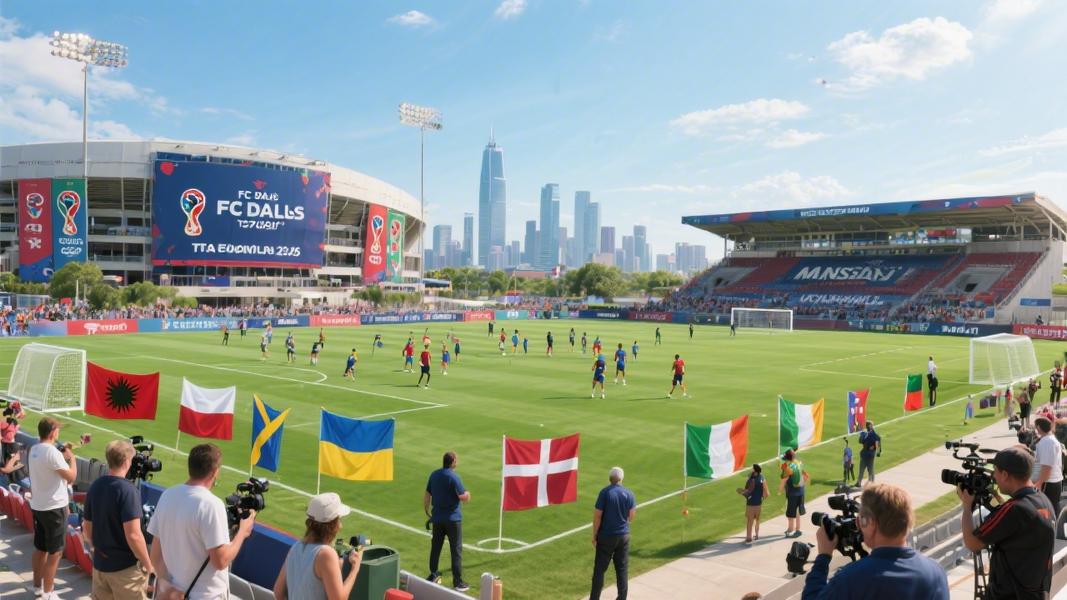
Two stadiums in the Dallas-Fort Worth region, FC Dallas Stadium in Frisco and the newly built Mansfield Stadium in Mansfield, have been officially designated as FIFA World Cup 2026 Team Base Camp Training Sites, putting North Texas at the center of one of the most logistically complex sporting events ever attempted on American soil. The designations confirm that the region won’t just be a backdrop for the tournament — it’ll be a working hub for competing national teams in the weeks ahead.
What the Designations Actually Mean
Team base camps aren’t just practice fields. They’re where national squads live, train, recover, and prepare between matches — sometimes for weeks at a stretch. Getting two of them is a genuine coup for a metro area that’s spent years positioning itself as a world-class sports destination. “This is an incredible honor for FC Dallas, Frisco, Mansfield and all of North Texas,” one official stated. “Being selected as Team Base Camp Training Sites reinforces what we’ve believed for a long time — that this region is the epicenter of FIFA World Cup 2026.”
Bold words. But the infrastructure backs them up, at least on paper. Toyota Stadium — home of FC Dallas — comes with an adjacent Toyota Soccer Complex boasting 17 fields and a track record of hosting elite international sides, including both the U.S. Men’s and Women’s National Teams and Mexico. That’s not a minor detail. FIFA’s standards for base camps are demanding, and a facility that’s already welcomed top-tier national programs carries real credibility in those evaluations.
Mansfield Enters the World Stage
Then there’s Mansfield — a city most casual soccer fans couldn’t have placed on a map five years ago. Its brand-new stadium is no afterthought. The facility features over 7,000 fixed seats, a 200,000 square-foot footprint, four locker rooms, suites, loges, and club space — the kind of spec sheet that makes FIFA site evaluators nod slowly and take notes.
Mayor Michael Evans didn’t hide his excitement. “We look forward to showing our guests the Southern hospitality Mansfield is known for,” he said. “With Mansfield Stadium and the Staybolt District lining up perfectly with the biggest sporting event in the world, Mansfield will make the most of this once-in-a-lifetime opportunity.” The Staybolt Street Entertainment District, where the stadium is anchored, gives visiting delegations and their traveling fans somewhere to actually go — which, for a city this size hosting a World Cup team, matters more than it might seem.
Which Teams Are Coming?
Here’s where things get interesting — and a little uncertain. FC Dallas Stadium is expected to host the winner of UEFA Play-Off Path B, a bracket that includes Albania, Poland, Sweden, and Ukraine. Mansfield Stadium, meanwhile, is slated for the winner of UEFA Play-Off Path D, featuring Czech Republic, Denmark, North Macedonia, and the Republic of Ireland. None of those slots are locked in yet, which means both cities are essentially preparing to roll out the welcome mat without knowing exactly who’s walking through the door. That’s the nature of World Cup logistics — you plan for everyone and wait.
Nine Matches, One Semifinal, and a Name Change
The base camps are only part of the story. North Texas is hosting nine World Cup matches at AT&T Stadium in Arlington — including a semifinal. For the duration of the tournament, the stadium will be known as Dallas Stadium, a branding requirement FIFA applies across all host venues. The first of those nine matches kicks off on June 14, when the Netherlands face Japan. “North Texas will host the first of its nine matches at AT&T Stadium in Arlington,” one report noted. “It will be called Dallas Stadium as the Netherlands faces Japan and for the duration of the tournament.”
The tournament itself opens three days earlier, on June 11, when Mexico takes on South Africa in Mexico City — a match that will likely draw one of the largest television audiences in World Cup history given the host nation’s fervor and the proximity to American viewers. From there, the global circus moves fast.
The Infrastructure Behind the Scenes
Frisco Mayor Jeff Cheney struck an almost giddy tone when asked about the moment his city had been building toward. “The World Cup is finally here,” he remarked. “We’ve been looking forward to this for years. We’re excited to host fans from all over the world and ‘roll out the red carpet’ for those visitors and our residents.” It’s the kind of quote that gets made into a banner — but there’s real substance behind the sentiment. Frisco has spent the better part of a decade constructing what’s become one of the densest sports facility clusters in the country.
Still, the tournament’s footprint in North Texas extends well beyond the stadiums. The International Broadcast Center for the entire World Cup will be housed at the Kay Bailey Hutchison Convention Center in Dallas — meaning the media nerve center for a 48-team, 104-match global tournament will be operating right downtown. Add a fan festival at Fair Park, running throughout the duration of the event, and it becomes clear that North Texas isn’t just hosting games. It’s hosting a month-long international operation.
For a region that’s quietly been making its case as a world-class destination for years, the 2026 World Cup isn’t just a moment — it’s the argument, finally proven in front of four billion people.
