
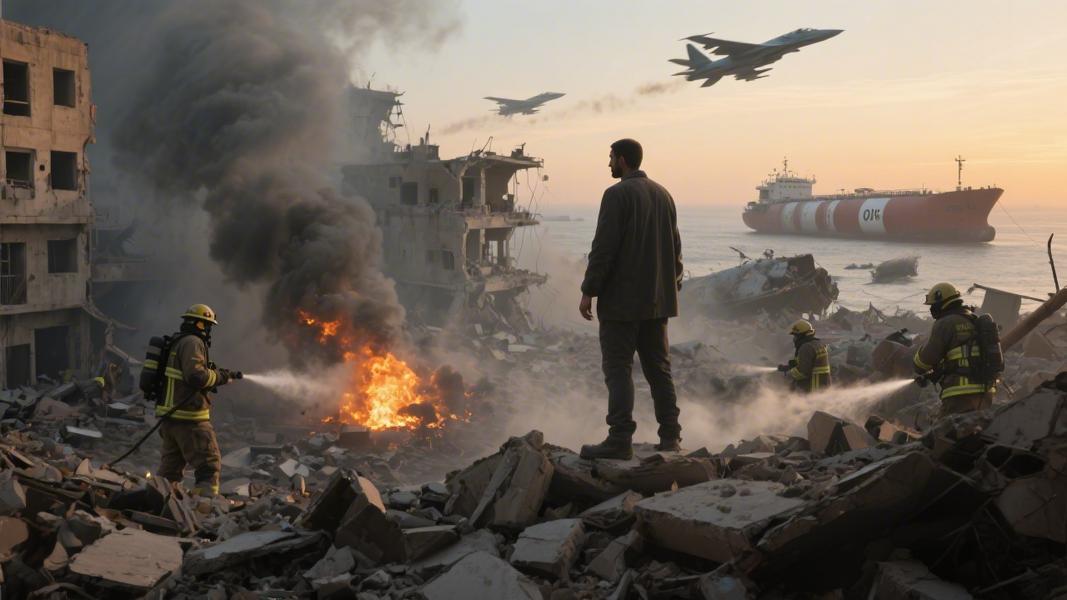
Oil markets got a rude awakening on Thursday. Brent crude blew past the psychologically charged $100-per-barrel threshold for the first time in years — and the catalyst wasn’t a gradual drift upward. It was a shock.
On March 12, 2026, Brent crude surged 9.3% to $100.50 per barrel after a series of strikes on tankers and energy infrastructure in the Middle East rattled global supply chains and sent traders scrambling. West Texas Intermediate wasn’t far behind, climbing 8.8% to $94.92 per barrel as fears of a broader disruption to Gulf shipping lanes deepened. In a single session, the oil market went from cautious to frantic.
A Threshold That Changes the Conversation
Triple-digit oil is never just a number. It’s a signal — to consumers, to central banks, to governments already navigating fragile post-pandemic fiscal ground. The crossing of $100 per barrel carries weight that $99.80 simply doesn’t, and traders know it. Markets reported the spike as directly tied to tanker strikes in Iraq and mounting concerns over the free flow of crude through the Strait of Hormuz — the narrow chokepoint through which roughly a fifth of the world’s oil supply passes every day.
Brent did pull back slightly from its intraday peak, settling around $98.45 per barrel after briefly crossing the century mark, as some investors locked in gains and assessed the damage. But the retreat offered little comfort. The underlying anxiety — that Gulf shipping lanes could face sustained disruption — wasn’t going anywhere. Markets noted that the combination of attacks on Gulf shipping and uncertainty around Hormuz flows was doing exactly what such events always do: pricing in the worst before the facts are fully known.
How Fast Did We Get Here?
Fast. Just one day before the surge, on March 11, Brent was trading at $90.96 per barrel as of 9:15 a.m. ET — itself already down slightly from $92.08 the previous session. That was, by any measure, an elevated price. Brent had already climbed roughly $21 from where it stood a year ago, a steady grind higher that had been driven by a mix of OPEC+ discipline, recovering demand, and simmering geopolitical tension. Wednesday’s level looked uncomfortable. Thursday’s looked alarming. Energy analysts tracked the pre-surge trajectory closely, noting that the market had been coiled tighter than it appeared.
Still, the speed of the move — nearly ten percentage points in a single session — is the kind of thing that forces a reassessment. That’s not a drift. That’s a repricing of risk.
Washington Responded. Markets Shrugged.
The Biden administration moved quickly, authorizing the release of 172 million barrels from the U.S. Strategic Petroleum Reserve in an attempt to cool the spike. It didn’t work — or at least, not on Thursday. Brent still closed the session up more than 9% despite the announcement, a reminder that strategic reserve releases are a pressure valve, not a fix. When the market decides it’s afraid, a government tap doesn’t immediately change the mood.
That’s the catch with supply-shock events. The SPR is a tool designed to buy time — to smooth out short-term dislocations while diplomacy or market forces do their work. But if the underlying threat to Gulf shipping persists, 172 million barrels buys weeks, not months.
What the Futures Market Is Saying
Look further out on the curve and there’s a story worth paying attention to. Brent crude futures for May 2026 were trading at $91.98, with June contracts declining to $89.35 and July sliding further to $86.71, according to data from CME Group’s futures exchange. That downward slope — what traders call backwardation — suggests the market believes the spike is real but not necessarily permanent. Prices are elevated now because supply fears are elevated now. Whether that holds depends almost entirely on what happens next in the Gulf.
But it’s not that simple. Backwardation can unwind fast. If the situation escalates — more strikes, a formal conflict, any hint of Hormuz interference — those outer-month contracts will reprice in a hurry. The futures curve is an educated guess, not a guarantee.
The Bigger Picture
For consumers, the math is straightforward and unpleasant. Oil at $100 per barrel means higher gasoline prices, higher airline fares, higher freight costs — and, eventually, higher prices for nearly everything that moves on a truck or a ship. Central banks that had been cautiously optimistic about inflation’s trajectory now have a new variable to worry about. Energy is the one input that touches almost every other input.
How long does this last? Nobody knows. The honest answer is that it depends on decisions being made right now in capitals and command centers far from the trading floors where Thursday’s chaos played out. What the markets do know is that the world’s most important commodity just reminded everyone it still has the power to rewrite the economic outlook in a single afternoon.
A hundred dollars a barrel was supposed to be a line the market had moved past. Turns out it was just waiting for the right reason to cross it again.
