
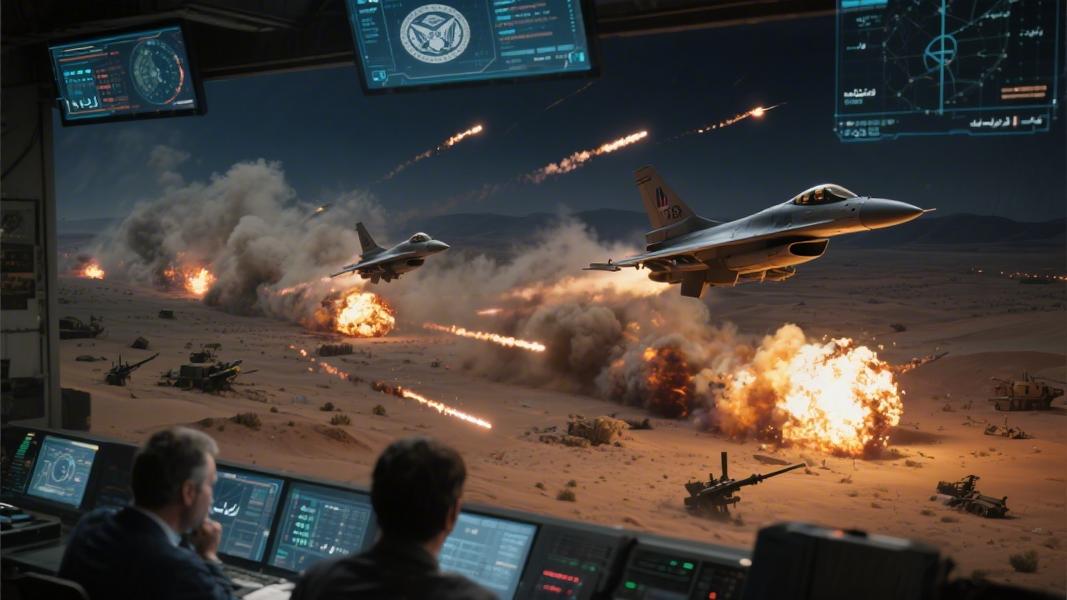
The Pentagon isn’t calling it a turning point yet — but the language coming out of Tuesday’s briefing made clear that U.S. forces are pushing harder into Iran than at any previous moment in the conflict.
On day 10 of Operation Epic Fury, Defense Secretary Pete Hegseth stood before reporters and delivered a blunt assessment: the campaign is escalating, the objectives are sweeping, and the timeline is anything but certain. “Today will be yet again our most intense day of strikes inside Iran,” he declared, framing Tuesday not as a milestone but as a floor — the latest in a series of intensifying operations that show no immediate sign of letting up.
Three Goals, No Ambiguity
Hegseth has been unusually direct about what the U.S. is actually trying to accomplish. In remarks that left little room for diplomatic interpretation, he laid out the mission in plain terms: “One — destroy their missile stockpiles, their missile launchers, and their defense industrial base. Missiles and their ability to make them. Two, destroy their Navy. And three, permanently deny Iran nuclear weapons forever.” That last word — forever — is doing a lot of work in that sentence.
Gen. Dan Caine, who appeared alongside Hegseth at the briefing, offered a complementary breakdown of the operational framework: neutralize Iran’s ballistic missile and drone capabilities, strike the Iranian Navy to keep the Strait of Hormuz open, and systematically dismantle the country’s military-industrial complex. It’s a broad mandate — arguably the most expansive military objective the U.S. has publicly articulated against Iran in decades.
The Numbers Tell Part of the Story
So is it working? By the Pentagon’s own metrics, there’s been measurable progress. Caine reported that combined U.S. and Israeli strikes have reduced Iran’s ballistic missile launches by 90% and one-way attack drone deployments by 83% since the opening of the campaign. Those are significant figures — if they hold up to independent scrutiny.
That’s the catch, though. Hegseth himself acknowledged that air dominance doesn’t mean air perfection. “You can’t stop everything that Iran fires,” he conceded, a rare moment of candor from a briefing room that doesn’t always traffic in it. The U.S. is gaining the upper hand in the skies, he argued — but the upper hand isn’t a ceiling.
A War With No Fixed End Date
How long does this go on? Even Hegseth doesn’t seem entirely sure. When pressed on a timeline, he offered a range that’s more honest than reassuring: “You can say four weeks, but it could be six, it could be eight, it could be three.” Three to eight weeks is a wide window. It suggests a military campaign that has clear objectives but murky off-ramps — which, historically, is the kind of war that tends to surprise everyone involved.
A full Pentagon update covering air dominance, the dismantling of the Islamic Revolutionary Guard Corps, and U.S. casualties was also delivered Tuesday, though specific casualty figures were not made public in the briefing materials released to press.
Iran’s Miscalculation — and Britain’s Absence
Still, there’s a geopolitical subplot here that Hegseth seemed almost eager to highlight. Iran’s retaliatory strikes on neighboring states haven’t rallied regional support — they’ve done the opposite, pushing Gulf nations closer to Washington. Hegseth argued that Iran’s “chaotic retaliation” has effectively driven its own neighbors into the American orbit. That’s either a sign of strategic miscalculation in Tehran or a dynamic that U.S. planners anticipated and are now capitalizing on — probably both.
Hegseth also took a pointed swipe at the United Kingdom, lamenting that British basing access wasn’t granted from the start of the operation. “It was unfortunate that … the Brits didn’t, from day one say, ‘Hey, go ahead and have access,'” he said — a remarkably public rebuke of a close ally, delivered mid-conflict, without much apparent concern for the diplomatic fallout.
What Comes Next
The arc of Operation Epic Fury is still being written. The objectives are ambitious — some might say historically so — and the Pentagon is projecting confidence even as it hedges on timelines and admits it can’t intercept every incoming round. Day 10 looks like momentum. Whether that momentum translates into the kind of durable outcome the administration is describing is a question that three to eight weeks — or more — will have to answer.
For now, Hegseth’s message was simple, if not exactly comforting: the most intense day of the war, as of Tuesday, was the one happening right now. And tomorrow, presumably, could say the same.
