
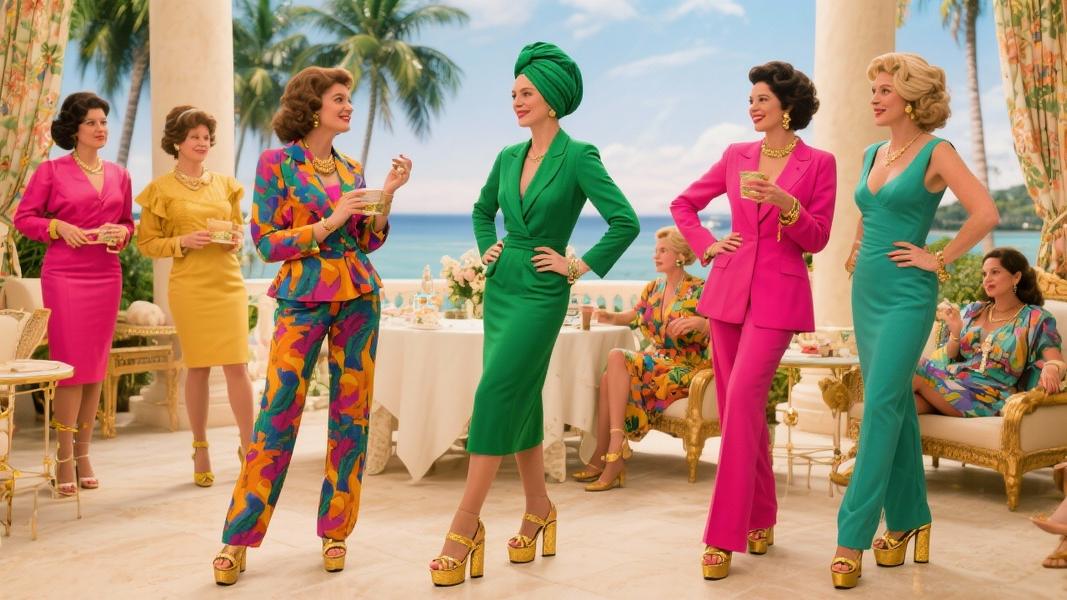
In the sun-soaked world of Apple TV+’s “Palm Royale,” the clothes aren’t just fabulous — they’re revolutionary. As the hit show enters its second season, costume designer Alix Friedberg has transformed fashion from mere eye candy into a powerful storytelling device that chronicles women’s liberation in 1960s Palm Beach.
The show’s wardrobe department has assembled thousands of looks for Season 2, with a staggering 50-60% being authentic vintage designer pieces from legends like Oscar de la Renta, Bill Blass, Oleg Cassini, and Halston. “The looks are so iconic. Sometimes Kristen will walk in in something, and it brings tears to my eyes,” a team member revealed about the emotional impact of these garments.
Fashion as Freedom
What makes these costumes particularly significant isn’t just their beauty, but how they chart the characters’ journeys toward independence. As women in the show gain agency, their wardrobes evolve. “Evelyn wore a lot more pants — which seems ridiculous to say today — but back then that was a real power move,” as one observer noted. This subtle shift in silhouette speaks volumes about the changing dynamics of power.
Friedberg’s team doesn’t just source these vintage treasures — they often build multiple versions of the same look for scenes requiring movement or multiple takes. It’s a painstaking process that ensures the visual storytelling remains consistent throughout filming. “There’s a dress that (Janney’s character) Evelyn wears that’s this all emerald green jersey, it’s an original Halston and it’s so stunning on her and it really does sort of evoke what’s to come in the ’70s,” costume experts explained to Who What Wear.
Remember the days when women’s clothing was primarily decorative? “Palm Royale” doesn’t just recall that era — it deconstructs it, showing how fashion evolved from confining to liberating. Characters like Evelyn and Dinah increasingly appear in pantsuits as they claim more personal power, a visual metaphor that requires no dialogue to convey its meaning.
Symbolic Stitching
Can a dress actually advance a plot? In “Palm Royale,” absolutely. Each garment is selected not just for period accuracy but for its narrative weight. When Maxine dons “an original Oscar de la Renta dress” that echoes something her rival Norma would wear, it’s a declaration of arrival. As costume insiders shared with Harper’s Bazaar, “it is saying to the audience without saying to the audience that she’s arrived, it’s her time, it’s time for her to rule.”
The attention to detail extends beyond the main cast. Background performers must also be impeccably dressed to create the immersive world of 1960s Palm Beach elite. This means hundreds of additional vintage-accurate looks that help establish the social hierarchy and cultural context of each scene.
In many ways, “Palm Royale” uses its costume design to tell a parallel story of American feminism. As hemlines rise and silhouettes change, we witness not just fashion evolution but women’s liberation taking physical form — one carefully curated outfit at a time.
