
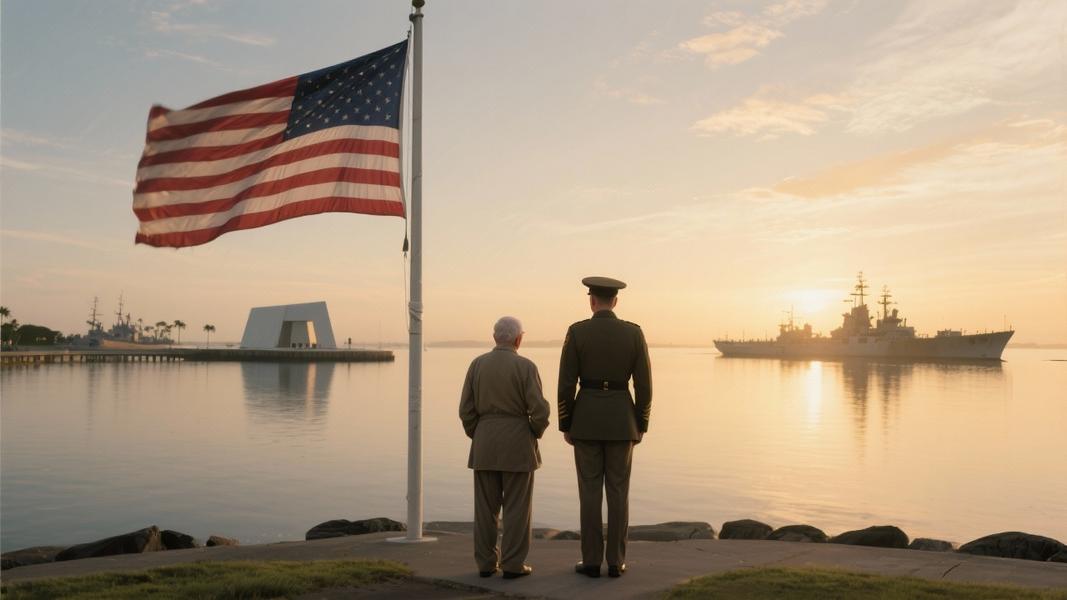
For just over an hour on a quiet Sunday morning in December 1941, the future of America changed forever as Japanese warplanes unleashed a devastating surprise attack on the U.S. naval base at Pearl Harbor, killing thousands and propelling a reluctant nation into World War II.
The assault began at 7:55 a.m. local time on December 7, when the first Japanese dive-bomber appeared over Pearl Harbor, Hawaii. What followed was a precisely coordinated attack involving 353 Japanese aircraft launched from six aircraft carriers in two waves, with the second wave striking at 8:50 a.m. before Japanese forces withdrew shortly after 9:00 a.m., according to historical records.
Devastating American Losses
The human toll was staggering. In total, 2,404 U.S. military personnel and civilians lost their lives in the attack, with nearly 1,200 others wounded, as documented by military historians. The USS Arizona suffered the heaviest losses, with 1,177 sailors, officers, and Marines killed when the battleship exploded and sank after being hit by Japanese bombs.
Breaking down the casualties reveals the attack’s widespread impact: 2,008 Navy personnel, 109 Marines, 218 Army personnel (including Army Air Forces), and 68 civilians were killed or listed as missing. The wounded included 710 Navy personnel, 69 Marines, 364 Army personnel, and 35 civilians, according to the U.S. Department of War.
How comprehensive was the destruction? Beyond the human tragedy, the Japanese attack devastated America’s Pacific Fleet. Five battleships were sunk and three damaged, among the 18 ships ultimately sunk or run aground. The attack also destroyed or severely damaged 188 U.S. aircraft, as noted in historical accounts.
A Devastating Yet Incomplete Victory
Despite the devastation, the attack wasn’t as strategically decisive as Japan had hoped. By sheer coincidence, all three U.S. aircraft carriers normally stationed at Pearl Harbor were at sea during the attack, sparing them from destruction. These carriers would later prove crucial to America’s Pacific campaign.
Japanese losses were comparatively light, with fewer than 100 men and 29 aircraft lost during the operation, as reported by The National WWII Museum.
The National Archives places the total American casualties even higher, at 3,435, with substantial losses to military equipment including eight battleships, three light cruisers, and four miscellaneous vessels that were either lost or severely damaged.
A Nation Forever Changed
The USS Oklahoma suffered the second-highest death toll after the Arizona, with 429 service members perishing when the battleship capsized after being struck by multiple torpedoes, according to the Pearl Harbor National Memorial.
The attack’s 68 civilian casualties — often overlooked in military accounts — included workers at the naval facilities and nearby residents caught in the unexpected bombardment. Many were killed by misfired American anti-aircraft shells that fell on Honolulu.
President Franklin D. Roosevelt famously declared December 7, 1941, “a date which will live in infamy” as he asked Congress for a declaration of war against Japan the following day. That declaration came within hours, with only one dissenting vote, thrusting America fully into World War II.
Eight decades later, the sunken USS Arizona remains the final resting place for more than a thousand American servicemen, its memorial drawing millions of visitors annually — a solemn reminder of the surprise attack that awakened a sleeping giant and set in motion America’s emergence as a global superpower.
