
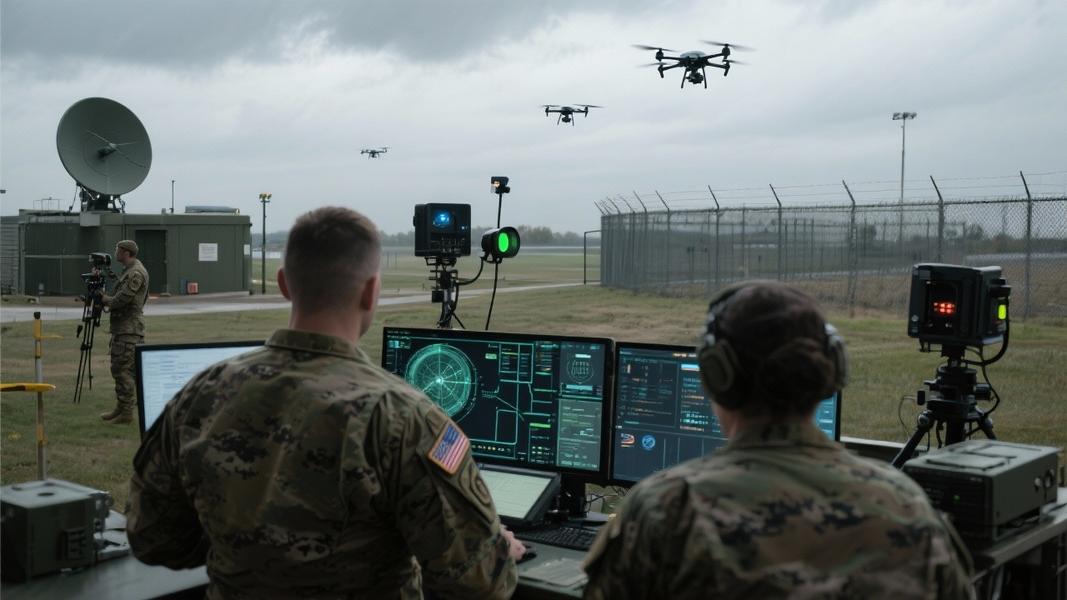
The Pentagon is significantly expanding its authority to counter drone threats on U.S. soil, marking a major shift in how military installations can respond to the growing menace of unauthorized unmanned aircraft systems.
Joint Interagency Task Force 401 (JIATF-401) announced updated counter-UAS guidance on January 26, 2026, that fundamentally changes the rules of engagement. The new policy, signed by the Secretary of War last December, empowers installation commanders to take protective actions that extend well beyond their fence lines — a dramatic departure from previous restrictions.
“Drones are a defining threat for our time. Technology is evolving fast and our policies and c-UAS strategy here at home must adapt to meet this reality,” said Brigadier General Matt Ross, Director of JIATF-401.
Breaking Down the Barriers
What’s changed? Just about everything. The updated guidance eliminates traditional fence-line limitations and treats unauthorized surveillance as an active threat, even before drones breach installation perimeters. It’s a recognition that the drone threat landscape has fundamentally shifted.
“Countering drones does not start and stop at the fence line,” Ross emphasized. “With this new guidance installation commanders are empowered to address threats as they develop, and the guidance makes clear that unauthorized drone flights are a surveillance threat even before they breach an installation perimeter.”
The policy overhaul also streamlines interagency cooperation, leveraging provisions in the FY26 National Defense Authorization Act to enhance data sharing between the Department of Defense, Department of Homeland Security, and Department of Justice. Authority to designate covered facilities has been delegated to Service Secretaries, further accelerating the protection process.
100 Days of Rapid Innovation
JIATF-401, barely three months old, has already made significant strides. The task force marked its first 100 days by consolidating counter-small UAS policies and conducting site assessments through the Pentagon’s Replicator 2 initiative.
Perhaps most impressive is the task force’s work on the southern border. “In less than 60 days — a process that traditionally takes two or three years — JIATF-401 assessed and validated capability gaps on the southern border and translated them into the Joint Task Force-Southern Border requirements document vetted through U.S. Northern Command and the services,” said Maj. Anthony Padalino, a JIATF-401 response team member. This accelerated timeline will deliver $18 million in capabilities to the border by January 2026.
The task force isn’t just reshuffling bureaucracy. It’s buying equipment — and fast. JIATF-401 recently purchased two DroneHunter F700 systems from Fortem Technologies for $3.5 million. These AI-powered platforms use radar and nets to physically capture small quadcopters and Group 2 drones, rather than simply disabling them.
“We have just one measure of effectiveness: to deliver state-of-the-art counter-UAS capabilities to our warfighters both at home and abroad,” Ross said about the acquisition.
A New Marketplace for Counter-Drone Tech
The DroneHunter purchase represents just the beginning of a broader acquisition strategy. The task force is using these initial deployments to inform a new Counter-UAS Marketplace launching initial capability by March 1.
“We are not intending to be a program office; we’re buying the stuff that can be made available to the warfighter as rapidly as possible and then let the user experiment with it so that a service can decide if this is something that we want to now purchase at scale,” JIATF Spokesman Lt. Col. Adam Scher told Air & Space Force Magazine.
The marketplace approach aims to break through traditional acquisition bottlenecks that have hampered the military’s ability to keep pace with rapidly evolving drone threats.
Broader Authority Across Government
The Pentagon isn’t the only agency getting expanded counter-drone authorities. The FY26 NDAA also broadens capabilities for the Departments of Energy, Homeland Security, and Justice, according to industry analysis.
DOE now has enhanced authority to detect, disrupt and destroy drones near nuclear sites, while DHS and DOJ have received additional countermeasure capabilities for public safety at covered facilities. This whole-of-government approach reflects the pervasive nature of the drone threat.
JIATF-401, which was established by Secretary of Defense Pete Hegseth in August 2025, recently hosted a summit with over 50 federal agencies to align counter-sUAS efforts. The gathering focused on integration during upcoming high-profile events like the World Cup and monitoring in the National Capital Region.
“Countering drones is a team sport,” Ross noted. “We have to work together, share information, and leverage each other’s strengths if we’re going to stay ahead of this threat.”
As consumer drone technology continues to advance and proliferate, the race between defensive measures and potential threats shows no signs of slowing. The question now is whether this newly empowered, whole-of-government approach can keep pace with a threat that literally changes with each new product release.
