
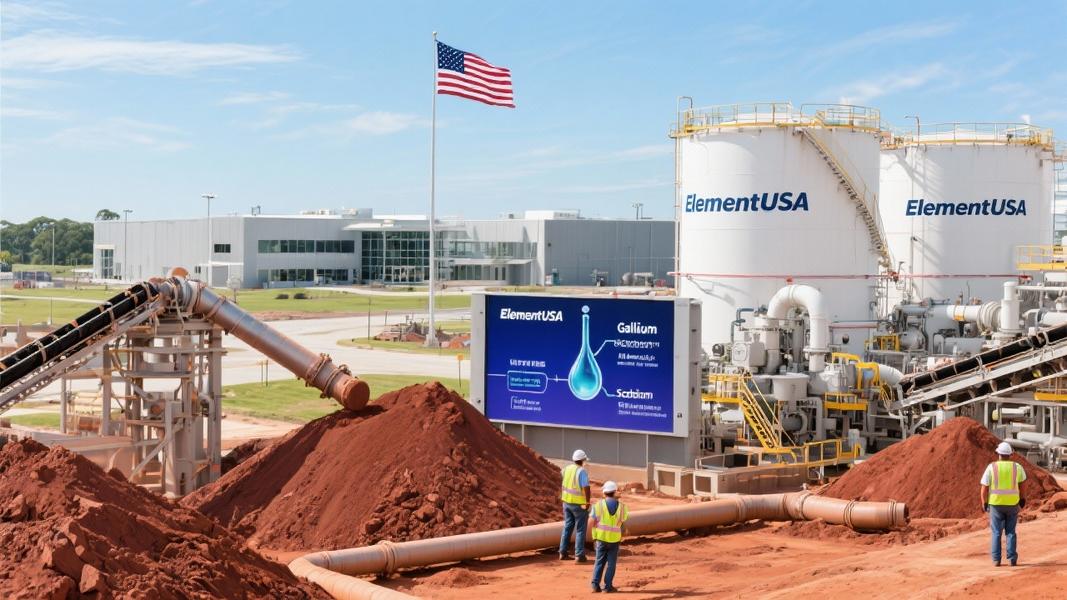
The Department of War has awarded $29.9 million to ElementUS Minerals to develop a demonstration facility that will extract critical defense minerals from industrial waste, part of a broader push to reduce American dependency on foreign mineral supplies.
The Louisiana-based project aims to separate and purify gallium and scandium — elements essential for advanced defense systems including missile platforms, sensors, fighter aircraft, and hypersonic weapons — from bauxite residue, a byproduct of aluminum production.
“The company will use a proprietary process to separate and extract these critical minerals from over 30 million tons of mineral-rich bauxite residue,” the Department of War stated in its announcement. What makes this approach particularly valuable is that it requires no additional mining operations, instead repurposing what would otherwise be industrial waste.
Strategic Response to Supply Chain Vulnerabilities
The investment comes amid escalating concerns about America’s mineral supply chains. In December 2024, China imposed export bans on several critical minerals including gallium, which is crucial for advanced radar systems used in missile defense.
This funding is part of a much larger initiative: the ElementUS project represents just one of 18 awards made by the Defense Production Act Purchases Office totaling $887 million for fiscal year 2025, with recipients contributing an additional $88 million in cost shares.
The money itself comes from the Additional Ukraine Supplemental Appropriations Act of 2022 and aligns with Executive Order 14241, signed in March 2025, which calls for “immediate measures to increase American mineral production.”
Reimagining the National Defense Stockpile
The Pentagon’s approach represents a fundamental shift in how America secures critical materials. Beyond the ElementUS project, defense officials are executing a massive $1 billion procurement initiative targeting several strategic minerals.
Defense Logistics Agency filings reveal plans to purchase up to $500 million of cobalt, $245 million of antimony, $100 million of tantalum, and $45 million of scandium. These purchases reflect a broader reimagining of the National Defense Stockpile’s purpose — moving beyond traditional war reserves toward supporting the entire defense industrial base’s sustainability.
Innovation isn’t limited to new production. The Strategic Materials Recovery and Reuse Program has demonstrated remarkable success in recycling valuable materials from military equipment. In fiscal year 2022, the program recovered 3,000 kilograms of ultra-pure germanium ingots from discarded night vision lenses and Bradley Fighting Vehicle turret windows — approximately 10 percent of annual U.S. germanium demand.
Bipartisan Support for Mineral Independence
The push for mineral security has found traction across political lines. Trump’s One Big Beautiful Bill Act allocated $7.5 billion for critical minerals — including $2 billion to expand the national stockpile by 2027, $5 billion for supply chain investments, and $500 million for a Pentagon credit program aimed at spurring private sector projects, according to reports.
But securing the supply chain requires more than stockpiling. Direct investments in production capacity have become increasingly common, with the Department of Defense executing a $400 million equity investment in MP Materials earlier this year, alongside issuing a $150 million loan to support heavy rare earth separation capacity in California, as documented by legal analysts.
The stakes couldn’t be higher. Without secure supplies of these specialized minerals, America’s most advanced defense systems — from next-generation fighter jets to hypersonic missiles — simply can’t be built. The ElementUS project represents a small but significant step toward ensuring that the Pentagon won’t have to depend on potentially hostile nations for the raw materials of national security.
