
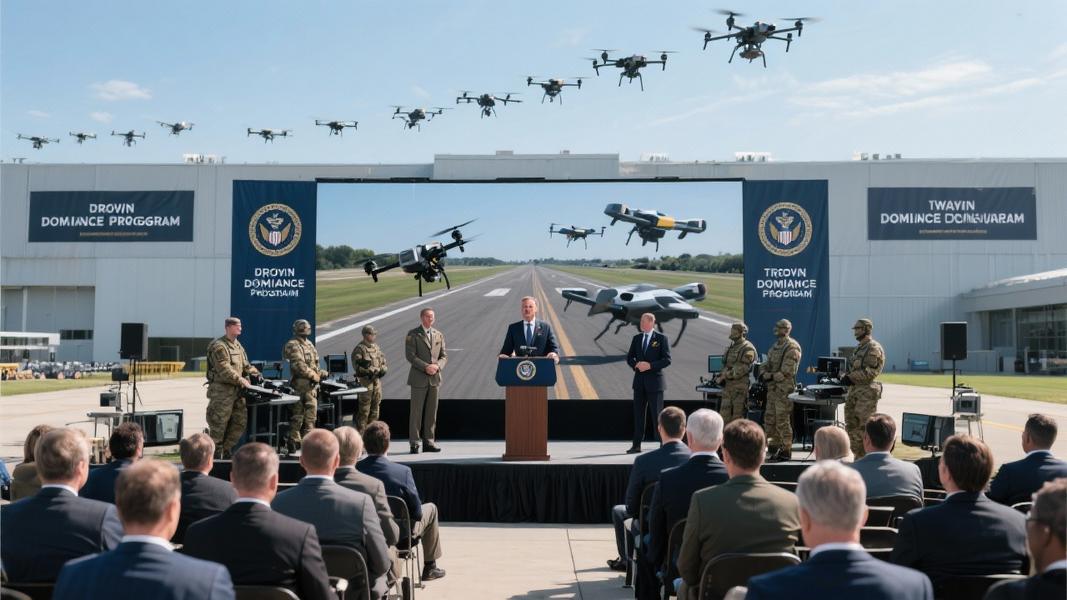
The Pentagon is going all-in on drones — and they want them by the hundreds of thousands.
The War Department announced Tuesday it has invited 25 vendors to compete in Phase I of the ambitious $1.1 billion Drone Dominance Program, set to kick off on February 18, 2026, at Fort Benning. The competition, dubbed “the Gauntlet,” will conclude in early March with approximately $150 million in prototype delivery orders.
“Drone dominance is a process race as much as a technological race,” according to the department’s press release. The program aims to rapidly field low-cost, unmanned one-way attack drones at unprecedented scale.
Speed Over Bureaucracy
War Secretary Pete Hegseth hasn’t minced words about the program’s urgency. “We are buying what works—fast, at scale, and without bureaucratic delay. Lethality will not be hindered by self imposed restrictions,” Hegseth stated.
The Pentagon plans to issue $1 billion in fixed-price orders across four phases, focusing on secure, low-cost “attritable” drones — military-speak for systems cheap enough to lose in combat without breaking the bank. The first phase targets 30,000 drones at roughly $5,000 each, with hundreds of thousands expected by 2027.
“At the War Department, we are adopting new technologies with a ‘fight tonight’ philosophy – so our warfighters have the cutting-edge tools they need to prevail,” Hegseth explained in a recent speech.
Mass Production Already Underway
Can the military industrial complex really produce drones at this scale? The Army seems to think so.
Army Vice Chief of Staff Gen. James Mingus recently revealed that the service will mass-produce 10,000 small unmanned aircraft systems per month starting next year via its SkyFoundry initiative. “We’ll be at 10,000 a month by this time next year, if not more,” Mingus confirmed.
Undersecretary of the Army Michael Obadal emphasized that SkyFoundry is about more than just manufacturing. “We can bring industry in a partnership where we can experiment with their software [and] their payloads. That’s what really matters in a drone, not the plastic and metal that goes into it,” Obadal noted.
The initiative comes amid growing recognition that mass-produced drones have transformed modern warfare, as demonstrated in conflicts from Ukraine to the Middle East.
Big Beautiful Bill Funding
Funding for the ambitious program comes from what officials call the “Big Beautiful Bill,” which Hegseth says is “ready to be used to mount an effective sprint to build combat power. We call it Drone Dominance.”
“Drone dominance will do two things: drive costs down and capabilities up,” Hegseth declared, outlining plans to deliver tens of thousands of drones in 2026, scaling to hundreds of thousands by 2027.
The rapid timeline and ambitious production goals mark a significant shift in Pentagon procurement practices, which have historically been slowed by extensive testing and bureaucratic procedures.
Whether American industry can meet these demanding timelines remains to be seen, but one thing is clear: the Pentagon is betting big that the future of warfare will be decided not by the quality of individual platforms, but by overwhelming quantity — and they’re racing to get there first.
